

Introduction
Apple Vision Pro is Apple's ambitious entry into augmented and virtual reality, positioned as a spatial computer rather than a traditional headset. First launched in February 2024 with an M2 chip, it received a significant upgrade in October 2025 with the M5 processor, improved comfort, and better display performance. Priced at $3,500, it targets early adopters and professionals willing to explore a new computing paradigm. This guide provides a comprehensive overview of its design, hardware, software, reviews, and future direction.
Should You Buy the Vision Pro?
The Vision Pro remains a niche product due to its high price and limited ecosystem. While it excels at immersive media consumption, 3D video capture, and Mac display functionality, it lacks the app library of mainstream VR platforms. The M5 refresh added a Dual Knit Band that significantly improves comfort for extended use, and the battery life now reaches three hours for video playback. However, the device is still heavy at over 1.3 pounds, and the external battery pack can be cumbersome for travel. Potential buyers are advised to try the headset at an Apple Store and research its capabilities carefully before committing. Apple has paused development on a next-generation model, suggesting the current design will remain for at least two years, making now a reasonable time to purchase for those who see value in its unique features.
Design
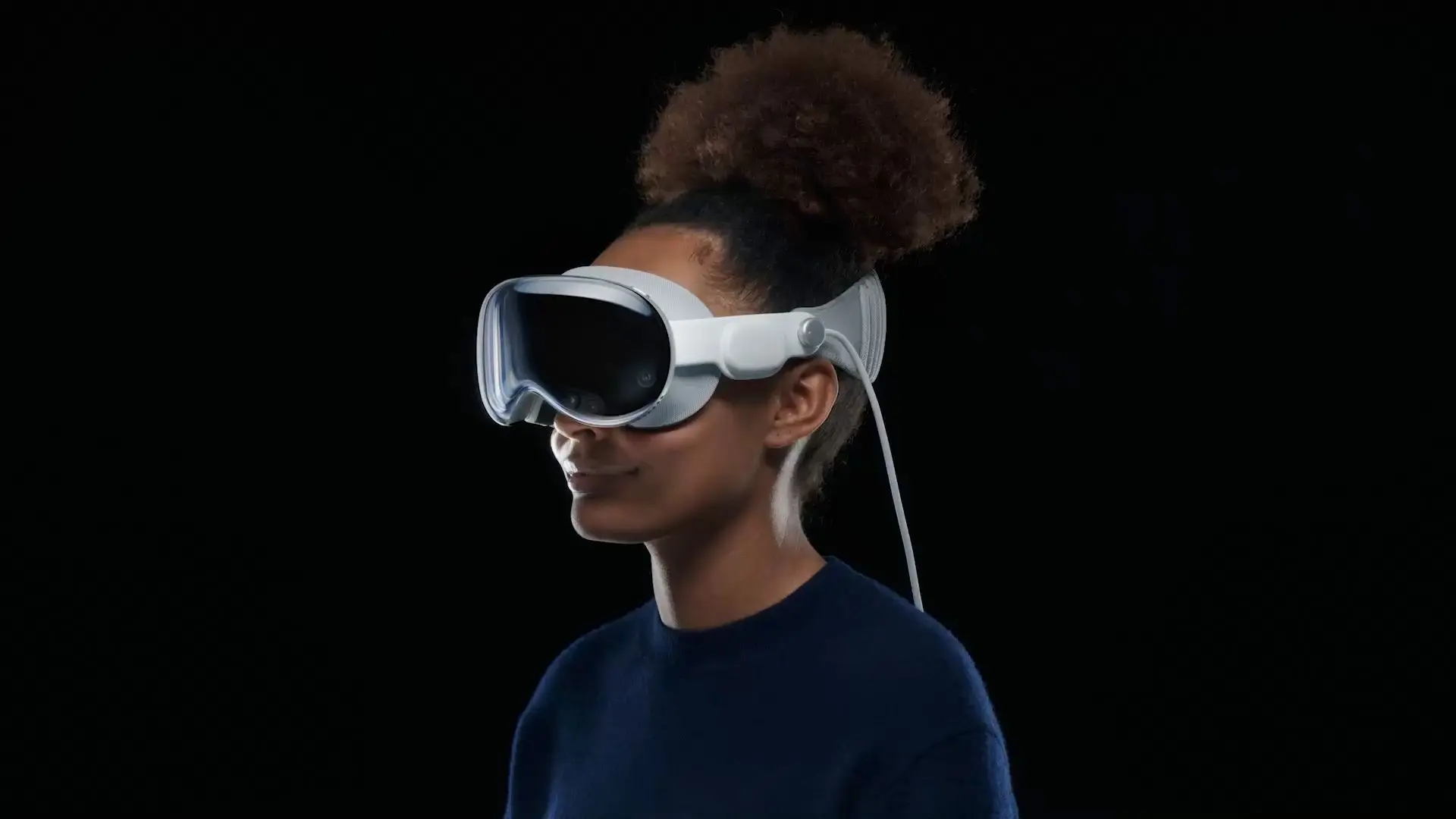
Apple Vision Pro resembles high-end ski goggles, with a curved laminated glass front attached to an aluminum alloy frame. The headset uses a magnetic Light Seal that conforms to the user's face to block external light, available in multiple sizes. The M5 model introduced the Dual Knit Band, a two-strap system with a knitted fabric that provides cushioning and breathability. An adjustable Fit Dial ensures a secure fit, and tungsten counterweights in the band help distribute weight more evenly. Physical controls include a Digital Crown for adjusting immersion levels and a top button for capturing 3D photos and videos. The headset connects via a braided cable to an external battery pack worn at the hip, which can be swapped for extended use. Available in a single silver color, the Vision Pro emphasizes a premium, minimalist aesthetic.
Display
The Vision Pro features dual micro-OLED displays, each delivering over 4K resolution for a combined 23 million pixels. With the M5 chip, the headset can render 10 percent more pixels than the M2 version, resulting in sharper text and more detailed visuals. The refresh rate supports up to 120Hz, reducing motion blur when viewing surroundings or connecting to a Mac. An external EyeSight display projects the user's eyes to others, indicating whether the wearer is in augmented or fully immersive mode. For glasses users, custom Zeiss Optical Inserts are available at $149 for prescriptions or $99 for readers, attaching magnetically to the internal lenses. The display system provides an exceptionally clear and spacious field of view, ideal for watching movies or working with multiple windows.
Cameras and Sensors
Apple Vision Pro incorporates 12 cameras and five sensors for tracking the environment and user input. Two high-resolution cameras stream the real world to the displays for augmented reality, while others handle head and hand tracking, depth mapping via LiDAR, and infrared illumination for low-light conditions. Inside, four infrared cameras monitor eye movements for navigation, enabling the wearer to select items by looking at them. Optic ID uses iris scanning for secure authentication, similar to Face ID. A dedicated 3D camera on the front captures spatial photos and videos, with a clear indicator to prevent surreptitious recording. The sensor array allows precise gesture control: tapping fingers to select, flicking to scroll, and using voice commands via Siri. Bluetooth accessories like keyboards and game controllers are also supported for alternative input.
Processors and RAM
The M5 chip in the Vision Pro features a 10-core CPU (four performance, six efficiency) and a 10-core GPU with ray tracing and dynamic caching. Built on third-generation 3nm technology, it provides up to 50 percent faster AI performance for tasks like generating spatial personas. Unified memory bandwidth reaches 153GB/s, enabling smooth multitasking and on-device machine learning. The R1 companion chip processes data from cameras, sensors, and microphones with a 12-millisecond latency, ensuring lag-free rendering. The headset includes 16GB of RAM and storage options of 256GB, 512GB, or 1TB. An internal thermal system quietly moves air to manage heat. These components deliver improved graphics, faster app loading, and enhanced immersion compared to the earlier M2 model.
Battery Life
The M5 Vision Pro offers up to 2.5 hours of general use and up to three hours of video playback on a single charge, an improvement of 30 minutes over the M2 version. The external battery pack connects via a braided cable and can be swapped for additional runtime. When plugged into a power adapter, the headset can operate indefinitely. The battery pack is designed to be worn at the hip, adding some weight but enabling freedom of movement. Apple recommends using the included USB-C cable and power adapter for recharging.
visionOS
visionOS is the operating system that powers the Vision Pro, featuring a three-dimensional interface that responds to light and shadow. Users can place apps anywhere in their environment, resize windows, and stack them. Navigation relies on eye movements, hand gestures, and voice commands. The system includes a Home View with familiar Apple apps and a dedicated App Store. visionOS supports Mac integration, allowing the headset to act as a portable 4K display with Wide and Ultrawide modes. Personas create realistic digital avatars for FaceTime and other video calls. Version 26, released in September 2025, added persistent widgets, improved personas, shared experiences with other Vision Pro users, and a Jupiter environment. Upcoming visionOS 27 will introduce face gestures, vehicle motion cues, and better hearing aid support.
Reviews and Performance
Reviewers have praised the M5 Vision Pro's improved comfort thanks to the Dual Knit Band, which reduces pressure on the face and neck during extended sessions. The performance upgrade from the M2 chip is noticeable: smoother spatial persona generation, more consistent frame rates, and 10 percent more pixel rendering for sharper visuals. The higher refresh rate (up to 120Hz) reduces motion blur, making the experience feel more natural. However, the headset remains heavy, and some users experience fatigue after two hours. The app library is still limited compared to competitors like Meta Quest, though Apple Arcade and spatial video offer compelling content. Overall, the Vision Pro is seen as a remarkable engineering achievement best suited for early adopters and professionals in media creation or productivity.
Future Plans
Apple is reportedly pausing work on a second-generation Vision Pro to focus on smart glasses without a display, similar to Meta Ray-Bans, expected in late 2026 or 2027. These glasses will have speakers, microphones, cameras, and an AI assistant. A cheaper, lighter enclosed headset is also in development but likely years away. Augmented reality glasses that connect to a Mac were canceled in early 2025, but Apple continues research into contact lenses and health applications using the Vision Pro's sensors, such as detecting depression or cardiovascular issues. The headset's long-term role may shift toward specialized use cases rather than mass consumer adoption.
Source: MacRumors News