

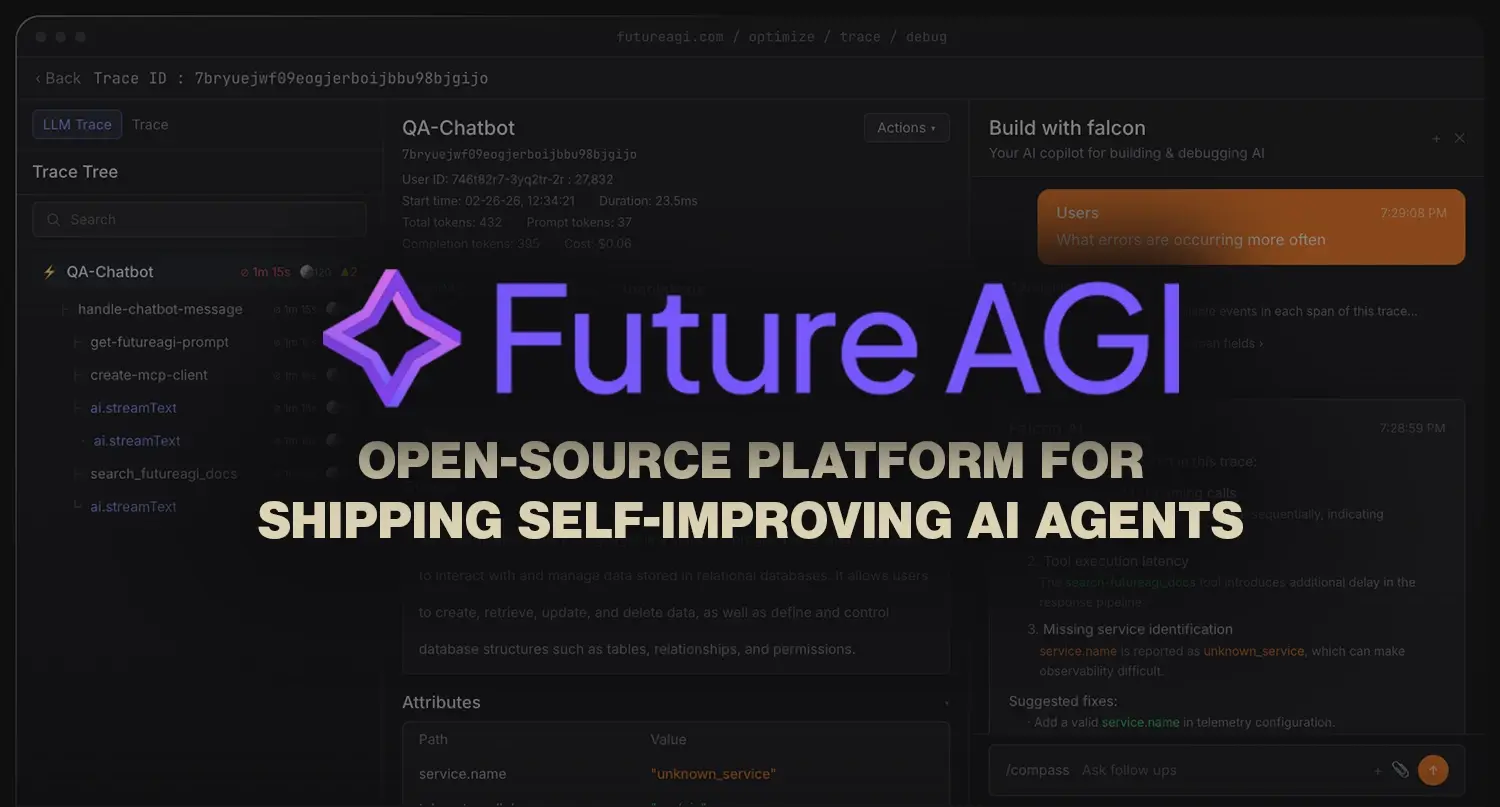
Future AGI, an open-source platform designed to support the deployment of self-improving AI agents, has been released under the Apache 2.0 license. The platform is self-hostable and aims to give developers a complete toolkit for tracing, evaluating, simulating, and guardrailing large language model (LLM) agents. With support for more than 50 agent frameworks and integrations with over 100 providers, the project positions itself as an infrastructure layer for teams moving from experimental AI to production-grade systems.
Key facts
- License: Apache 2.0, self-hostable, free on GitHub.
- Telemetry: One-time registration sends an instance ID, version string, deployment type, and admin email addresses/domains. Opt out before first boot with FUTURE_AGI_TELEMETRY_DISABLED=1.
- Core components: ClickHouse, PostgreSQL, Redis, RabbitMQ, and Temporal, all fronted by a dashboard on localhost:3000.
- Instrumentation: OpenTelemetry-based tracing covers 50+ agent frameworks, including LangChain, LlamaIndex, CrewAI, and DSPy.
- Gateway: The Agent Command Center is an OpenAI-compatible proxy for 100+ providers, with routing strategies, semantic caching, virtual keys, MCP, and A2A.
- Security: 18 built-in scanners for PII, jailbreak, and prompt injection, plus vendor adapters for Lakera, Presidio, and Llama Guard.
- Performance: Inline scanning holds P99 latency at or under 21 ms on the project's benchmark harness.
- Deployment: Air-gapped and on-prem deployment are listed as supported, with phone-home-free operation when configured correctly.
Telemetry and privacy considerations
Self-hosted instances of Future AGI register with the project on first boot. This registration happens before anyone signs in to the dashboard and sends an instance ID, a version string, a deployment type, and the email addresses and domains of active admin users. The developers are upfront about this behavior: the registration fires exactly once, and the opt-out is a single environment variable, FUTURE_AGI_TELEMETRY_DISABLED=1, placed in the .env file ahead of the first start. If that window is missed, the admin list has already left the network.
Future AGI explicitly lists air-gapped and on-prem deployment as supported, and it claims the platform is phone-home free. Disabling telemetry leaves one census ping carrying the instance ID, version, and deployment type, with email addresses withheld. Periodic heartbeats stop after that point. The telemetry section closes with a practical note for operators: “turn networking off at the edge if you need full silence.” That phrasing is a reminder that even with telemetry disabled, a network-connected system can still make incidental connections, and true isolation requires network-level controls.
What the installer holds
The installer brings up a stack consisting of ClickHouse, PostgreSQL, Redis, RabbitMQ, and Temporal, all behind a dashboard on localhost:3000. ClickHouse is the analytics database where tracing spans land. Prompt text, model output, and tool calls pass through the tracer on the way into that store. This means every interaction with an agent, from user input to final response, can be captured and inspected.
Instrumentation covers more than 50 agent frameworks, including LangChain, LlamaIndex, CrewAI, and DSPy, through OpenTelemetry. OpenTelemetry is a widely adopted observability standard, and Future AGI's use of it means teams can integrate the platform with existing monitoring pipelines. Because the defender inherits the access controls on the ClickHouse database along with the traces, security teams can apply their existing data governance policies to the observability data.
Instrumentation and agent support
The breadth of framework support is one of Future AGI's strongest selling points. LangChain and LlamaIndex are two of the most popular frameworks for building LLM applications, and both are supported out of the box. CrewAI, which focuses on role-based autonomous agents, and DSPy, which emphasizes programming rather than prompting, are also covered. For teams that have built custom agents or use less common frameworks, OpenTelemetry instrumentation can be extended manually.
Tracing is not just about debugging; it is also the foundation for evaluation and simulation. To improve an AI agent, developers need to know how it behaves in different scenarios. Future AGI's tracing layer records the full trajectory of an agent's execution, including intermediate reasoning steps, tool calls, and model outputs. This data can be replayed to evaluate whether changes to prompts, models, or tools have improved performance.
Simulation is another important piece. Running agents against recorded or synthetic scenarios lets teams test edge cases before shipping. The platform's evaluation features help developers compare different versions of an agent, measure task completion rates, and detect regressions. This workflow is essential for teams that want to build self-improving agents, because the system can use evaluation results to inform future iterations.
The Agent Command Center gateway
The platform's gateway, called the Agent Command Center, is an OpenAI-compatible proxy that fronts more than 100 providers. This means developers can use the same API interface to access models from many vendors, including commercial APIs and self-hosted models. The gateway supports routing strategies, semantic caching, virtual keys, MCP (Model Context Protocol), and A2A (Agent-to-Agent).
Routing strategies are useful for cost and performance optimization. A developer might route simple requests to a cheaper model and complex requests to a more capable one. Semantic caching can reduce latency and cost by reusing responses to semantically similar prompts. Virtual keys provide a way to manage access to model providers without sharing raw credentials. Every provider credential in a deployment terminates at the gateway, which centralizes authentication and security policy enforcement.
MCP support allows agents to connect to external tools and data sources through a standardized protocol. A2A, meanwhile, enables different agents to communicate with one another. These capabilities make the gateway more than a simple proxy; it becomes a control plane for agent traffic.
Security and guardrails
Protect, the security component of Future AGI, ships with 18 built-in scanners for PII, jailbreak attempts, and prompt injection. These scanners run inline in the gateway or standalone through the SDK. Inline scanning is designed to have minimal overhead; the project reports P99 latency at or under 21 ms on its benchmark harness. That level of performance is critical because adding a security layer that noticeably slows responses is unacceptable in production.
In addition to the built-in scanners, Future AGI provides vendor adapters covering Lakera, Presidio, and Llama Guard. Lakera is a well-known AI security platform, Presidio is a data protection and PII de-identification library from Microsoft, and Llama Guard is a Meta-developed input-output safeguard for LLMs. These adapters allow teams to use their existing security tools alongside Future AGI's native scanners.
The placement of security controls is another key design decision. Because the gateway sits in front of everything, it can inspect both incoming prompts and outgoing responses. This ensures that malicious instructions are blocked before they reach the model and that sensitive data is not exfiltrated in model output. The standalone SDK mode is useful for teams that want to integrate the scanners into custom pipelines without routing all traffic through the gateway.
Deployment and operational considerations
Future AGI is self-hostable, which means organizations can run it on their own infrastructure. The platform supports air-gapped and on-prem deployment, making it suitable for environments with strict data residency requirements. The stack is notable for using established open-source components: ClickHouse for analytics, PostgreSQL for relational data, Redis for caching, RabbitMQ for message queuing, and Temporal for durable workflow execution.
Temporal deserves special attention because it is designed to handle complex, long-running workflows. AI agents often need to wait for external events, retry failed operations, and coordinate multiple steps. Temporal provides durability and fault tolerance for those workflows, so a crash does not lose the state of an in-progress agent run.
The requirement to set the telemetry opt-out before first boot is a detail that operators must not overlook. It is easy to install software, start it, and only later read the configuration documentation. In Future AGI's case, that delay means the one-time registration has already occurred. The developers have attempted to be transparent by documenting the behavior and offering an environment variable, but the window for opting out is narrow.
Privacy-conscious teams should also note that even with telemetry disabled, the trace data stored in ClickHouse includes prompt text, model output, and tool calls. This is not telemetry sent to the vendor, but it is highly sensitive data that needs to be protected on the local system. Access controls on the database determine who can read the traces, so security teams should configure those controls carefully.
Availability and open-source model
Future AGI is available for free on GitHub. The Apache 2.0 license permits commercial use, modification, distribution, and sublicensing, with the only requirement being that recipients receive a copy of the license. This makes it an attractive option for startups and enterprises that want to avoid vendor lock-in while building AI agent infrastructure.
The platform's combination of tracing, evaluation, simulation, guardrailing, and gateway features is relatively rare in the open-source ecosystem. Many observability tools focus on tracing alone, and many security tools focus only on prompts. Future AGI's ambition is to provide an integrated platform that covers the full lifecycle of an LLM agent, from development to production monitoring.
For developers interested in self-improving agents, the evaluation and simulation capabilities are particularly important. Self-improvement is not a single algorithm but a continuous loop: observe behavior, evaluate outcomes, adjust prompts or models, and redeploy. Future AGI's tracing layer provides the observation data, its evaluation tools measure success, and its gateway makes it easy to update routing and model choices. The platform also supports guardrails that prevent the agent from going off the rails during the learning process.
One of the more subtle benefits of the OpenAI-compatible gateway is that it reduces integration friction. Teams can switch from a direct API call to Future AGI's proxy without changing their application code. This makes the platform a low-disruption addition to existing AI projects. The gateway's support for virtual keys also allows organizations to issue different keys to different teams or applications, making it easier to track usage and enforce quotas.
The news of Future AGI comes at a time when many organizations are moving AI pilots into production. A platform that promises to handle observability, security, and provider management in one place is likely to attract attention from platform engineering teams. The open-source nature of the project also means that the community can inspect the code, contribute improvements, and customize the platform for specialized use cases.
As with any open-source infrastructure tool, teams should evaluate Future AGI against their specific requirements. The telemetry behavior is one consideration; the supported frameworks and providers are others. Organizations that need deep integration with a particular agent framework or a particular cloud provider should check compatibility before committing. The project's use of standard protocols like OpenTelemetry and MCP is a positive sign, as it suggests interoperability with other tools will be reasonably straightforward.
Future AGI is positioned as a free, open-source foundation for teams that want to ship AI agents with confidence. Its focus on self-improvement, observability, and security addresses some of the most pressing challenges in the field. With support for a wide range of frameworks and providers, plus the ability to run entirely on-premises, it is a versatile option for developers, security engineers, and platform teams alike.
Source: Help Net Security News