

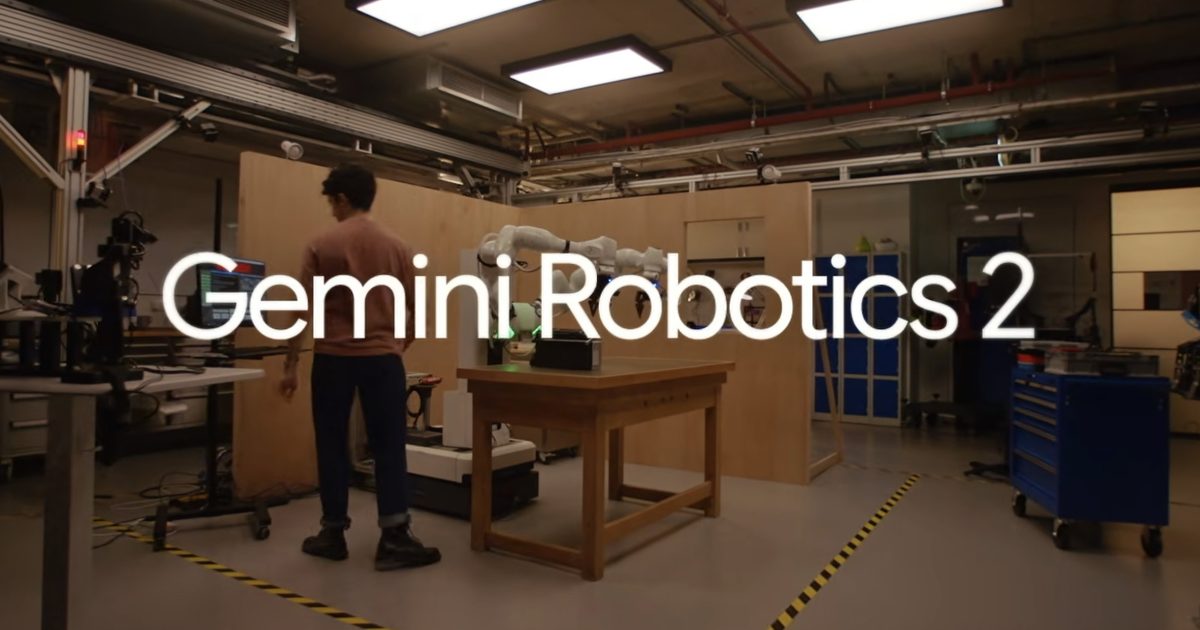
Google has unveiled Gemini Robotics 2, an advancement in embodied AI that brings humanlike balance, dexterity, and collaboration much closer to practical reality. Building on the earlier Gemini Robotics model, the new system is designed to help robots think, move, and work together in real time. Unlike most existing robots, which rely on pre-programmed routines or remote human control, Gemini Robotics 2 can reason through unpredictable situations and adjust its actions as conditions change.
From tabletop tasks to whole-body control, this release marks a major shift in how Google approaches robot intelligence. The company’s earlier robotics models were largely limited to tabletop tasks. A robotic arm would move small objects around within a fixed frame, using only the upper body. Gemini Robotics 2 changes that by controlling the entire humanoid, from its feet to its fingertips. In a demonstration with Apptronik’s Apollo 2 robot, the machine was asked to place a watering can into a bin on a lower shelf. The robot navigated across the room, picked up the can, walked to the bin, and set it down precisely in the right location.
This kind of whole-body task requires continuous coordination between locomotion and manipulation. The robot must maintain balance while carrying an object, adjust its gait to the surface, and ensure that its hand applies just enough force. Tabletop-only systems never had to handle those interacting challenges. With Gemini Robotics 2, Google is targeting a much broader class of real-world jobs, from warehouse stocking to household chores.
The new model also brings significantly better dexterity. Gemini Robotics 2 can control a five-fingered robotic hand well enough to tie a knot, seal a zip-lock bag, or unscrew a lightbulb. Those actions require fine motor control, tactile awareness, and the ability to manipulate flexible or delicate objects. The model is not limited to advanced hands, however. It works just as smoothly with simple two-fingered grippers for common industrial tasks such as packing and sorting.
This versatility is important because robot hardware varies widely. A robotic hand with five articulated fingers can perform complex operations, but many warehouses use cheaper parallel-jaw grippers. A single AI model that can operate both types of hardware reduces the need for task-specific engineering and makes automation more accessible.
Alongside the control model, Google introduced Gemini Robotics ER 2, an AI reasoning system that acts like a project manager inside the robot. It takes a high-level instruction, breaks it down into a sequence of actions, keeps track of multi-minute tasks, and can coordinate multiple robots working on the same job. This is a significant upgrade from simple instruction following because it gives robots a way to handle longer and more complex workflows.
Google is also offering an on-device version of ER 2 for robots that cannot rely on a stable internet connection. That version can adapt to a brand-new robot body in just a few hours, using as few as 200 examples. If those numbers hold up in real deployments, the technology could dramatically reduce the time and cost required to bring a new robot into production.
Safety received major attention in this release. Google introduced a new benchmark called ASIMOV-Agentic to test whether robots know when to refuse a risky action or ask a human for help. Most robotics benchmarks focus on task success rates, but they often ignore whether the action was safe or appropriate in context. ASIMOV-Agentic aims to measure judgment, not just execution.
In addition, Gemini Robotics ER 2 can sense when a person gets too close and bring the robot to a safe stop. This capability is essential for collaborative environments where humans and robots share space. A robot that blindly continues a motion as a person approaches is dangerous; one that pauses or backs away is much easier to work alongside.
The release of Gemini Robotics 2 represents a shift toward general-purpose robot intelligence. In the past, robotics research often celebrated narrow achievements: a new walking algorithm, a new gripper design, or a new way to plan paths. Google’s latest work combines locomotion, manipulation, reasoning, and multi-robot collaboration in a single system. That kind of integration is needed if robots are going to operate in human environments, where variability is endless and perfect pre-planning is impossible.
The ASIMOV-Agentic benchmark could also push the field toward more responsible development. Companies will be able to compare how different models handle ambiguous or dangerous situations, just as they compare accuracy and latency today. This may lead to standards that make it safer to deploy robots in homes and hospitals.
The on-device adaptation feature has particularly broad implications. Most robots today are trained for specific hardware and specific tasks. Any change to the physical design can require weeks of recalibration. The ability to adapt from a few hundred examples within hours suggests that future robots could be more versatile and easier to upgrade. That would be a major commercial advantage for manufacturers and a strong reason for businesses to invest in robot fleets.
Gemini Robotics ER 2 is already live on Google AI Studio, which gives developers a way to test its reasoning abilities in a browser. The other models are rolling out to early access partners, meaning Google is choosing to move carefully rather than releasing the technology immediately to everyone. This phased rollout gives the company a chance to gather feedback, identify failure modes, and improve safety before wider use.
There are still many questions about real-world performance. The demonstrations released by Google are impressive, but laboratory conditions rarely capture the messiness of actual homes and factories. Unknown objects, poor lighting, slippery floors, and unexpected human behavior will all test the limits of the system. The early access program will help expose those gaps and guide further development.
One of the most encouraging signs is that Google is clearly thinking about both capability and caution. A robot that can tie a knot is a useful machine. A robot that knows when it should not do something, or when it needs to ask for help, is a responsible teammate. As these models become more mature, the combination of advanced dexterity and sound judgment will define the next generation of robotics.
Source: Digital Trends News