

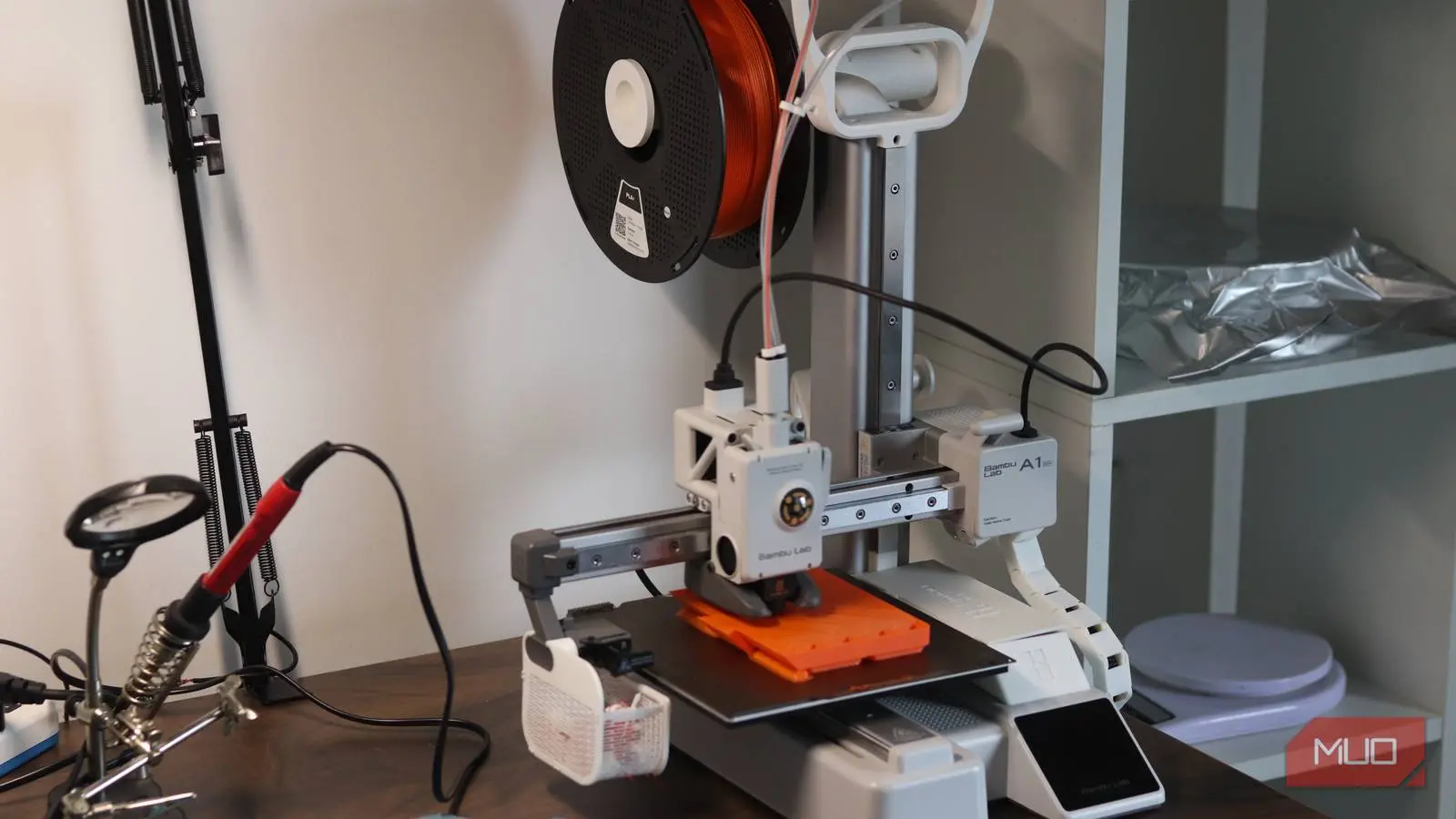
For years, every time I thought about buying a 3D printer, I talked myself out of it. My hesitation wasn't hypothetical; it was rooted in real experience. In 2017, my first job out of high school involved repairing and maintaining two 3D printers. I got them running and kept them operational, but the memory of constant fiddling stayed with me long after I left that job. When I finally bought a Bambu Lab A1 Mini in 2026, I discovered that the 3D printing world had moved on in ways I never expected. I was wrong about noise, wrong about speed, wrong about maintenance, and most of all, wrong to wait so long.
The printer was never the problem
I overestimated the noise, space, and disruption a 3D printer would bring
My early 3D printing experience centered on the Wanhao Duplicator 3, a large, heavy machine with an enclosure that felt more at home in a workshop than on a desk. It had a relatively small build volume but took up a surprisingly large amount of space. To use it, I would slice files on my PC, transfer them to a microSD card, and carry the card to the printer. Then came the part I dreaded most: leveling the bed with a sheet of paper and hoping my estimates were close enough. More often than not, the first layer told me otherwise.
That machine was also loud. The motors whined, the frame vibrated, and every print session felt like a test of patience. I wanted my next printer to sit on my electronics workbench, right next to my actual work desk. Space was a real constraint, and noise was a genuine concern. I imagined a tiny machine rattling away beside me all day, making it impossible to concentrate.
The Bambu Lab A1 Mini shattered that mental picture in the first few minutes. Its footprint is small enough to fit comfortably on a cluttered workbench, and it has a clean, modern design that doesn't look out of place next to other desktop tools. As for noise, the cooling fan is the loudest component. The stepper motors are practically inaudible from a meter away. I now run print jobs throughout the day while working at the same desk, and I barely notice the printer is running.
The difference comes down to how modern printers are built. Better motor drivers, lighter moving parts, and smarter firmware have eliminated the harsh mechanical sounds that used to define desktop 3D printing. What once felt like a workshop project now behaves more like a quiet appliance.
Speed mattered less than I expected
Long print times stopped feeling important once the printer could work unattended
My fear of 3D printing was never just about hardware; it was also about time. I associated 3D printers with glacial speeds. In my memory, even a small part could consume the better part of a day. The A1 Mini changed that almost immediately. It prints a standard Benchy test boat in roughly 20 minutes at default settings. More importantly, the functional prints that make up the majority of my work, brackets, enclosures, organizers, and mounting parts, finish in a fraction of the time older machines would have needed.
But print speed was only one layer of my time anxiety. The bigger issue was the attention a print demanded. Older printers required me to stay nearby in case the nozzle clogged, the bed shifted, or the first layer failed. That kind of constant supervision turned printing into a chore. Modern printers have largely solved this problem through automation. The A1 Mini levels its bed automatically before every print. Filament runout detection pauses the job if the spool runs dry. A built-in camera lets me check progress from an app, and with a little extra setup in Home Assistant, I can even monitor it from my smart home dashboard.
This level of reliability has changed how I use the printer. I have started prints while hundreds of kilometers away from home and returned to find a perfect part waiting on the bed. That kind of remote, hands-off operation would have been unthinkable with the machines I maintained in 2017. Modern printers, when set up with quality filament and basic maintenance, turn 3D printing into a background process rather than a time-consuming hobby.
Maintenance turned out to be mostly a myth
Modern printers require far less tinkering than their reputation suggests
Aside from print time, I expected maintenance to quietly consume my schedule. In my early days, I considered myself lucky to get through a full day of printing without unclogging a nozzle or re-leveling the bed. I mentally budgeted for recurring maintenance tasks as an unavoidable part of owning a printer. Bed calibration, nozzle clogs, belt tension checks, I thought these would be weekly rituals.
In practice, the A1 Mini has required almost nothing from me. Across more than 134 hours of total printing time, the only real task I performed was calibrating my filament, and even that was optional. The generic PLA profiles worked well enough with multiple brands of filament. I simply loaded the filament, chose a profile, and printed. The printer handled the rest.
One area where I would temper expectations is multicolor printing. The AMS and AMS Lite systems let you print with multiple colors, but they produce a significant amount of waste. I chose not to get one for that reason. Multicolor printing also adds time and filament to every print. For my everyday projects, like custom ESP32 enclosures, mounts, cosmetic parts, and replacement brackets, the single-color workflow has been remarkably low friction.
That low-friction experience is not unique to Bambu Lab. Modern printers from Creality, Elegoo, and Prusa have also moved toward automation, quieter operation, and reliable out-of-the-box performance. The reputation of 3D printers as finicky machines that require endless tinkering is largely outdated. With basic care, like cleaning the build plate and lubricating the rails occasionally, these machines just work.
The biggest mistake was waiting so long
I should have bought a 3D printer years earlier instead of overthinking it
There is a specific moment when you realize your mental model of a technology is outdated. I had been carrying around a decade-old image of 3D printing, one built from repairing an industrial-ish machine in a workshop. That image stopped me from trying something that had become far more accessible, more reliable, and more useful.
The shift in 3D printing is not just incremental. It is a fundamental change in how the machines behave. They have gone from being hobbyist tools that demand skill and patience to home appliances that you set up once and trust. Automatic bed leveling, filament runout sensors, remote monitoring, and fast, quiet motion systems are now standard features in many consumer printers. The machines no longer ask for entire days of maintenance, and they do not fail mysteriously without warning.
If your hesitation, like mine, was really about time, both the time prints take and the time the machine demands from you, then 3D printing has answered that concern. It is fast, reliable, and designed to stay out of your way. I spent years overthinking the wrong things. The noise I dreaded is gone. The maintenance I expected never showed up. The speed I feared is no longer a bottleneck. And the biggest risk, I learned, was not buying a printer and testing my outdated assumptions. I wish I had stopped waiting much sooner.
Source: MakeUseOf News