

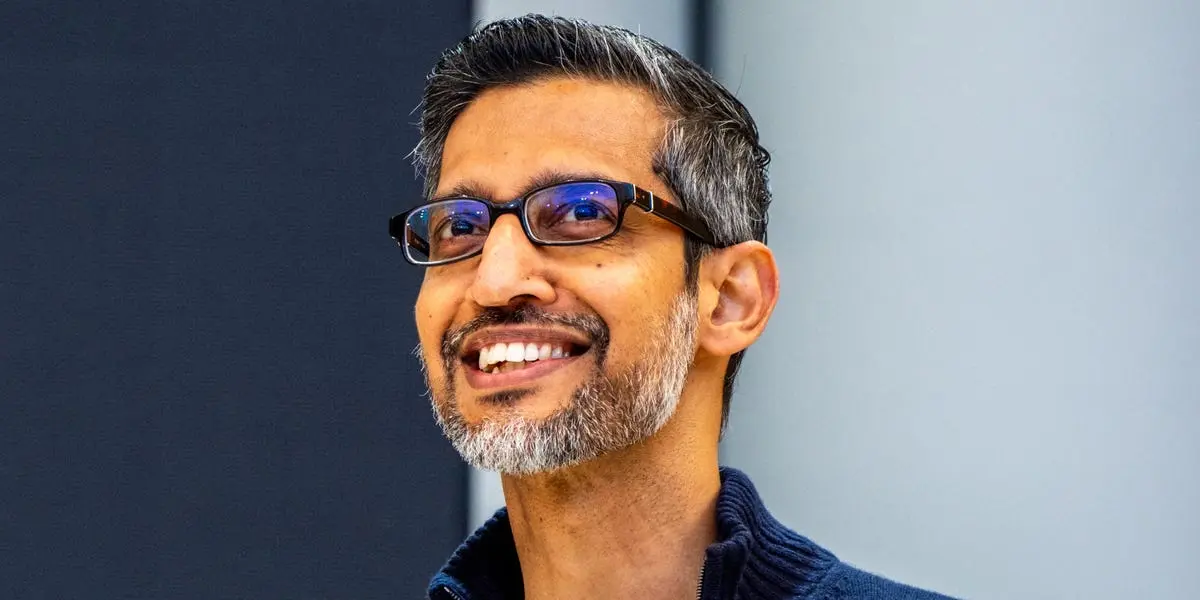
Sundar Pichai has had a meteoric rise since joining Google as a 31-year-old product manager in 2004. In the 11 years that followed his first steps on the Googleplex, Pichai was promoted four times, eventually becoming the CEO of Google in 2015. In that role, he was responsible for the company’s core businesses and cash cow — and did a good enough job that, in December 2019, he was promoted one more time, replacing Google cofounder Larry Page as the CEO of Alphabet, Google’s parent company.
Since then, he has led the almost-$2-trillion company through the pandemic, layoffs, and the AI renaissance that has taken Silicon Valley by storm. So who is Pichai, and how did he scale the ranks to get one of the most important jobs at one of the most important companies in the world? Here is a look at his life and career.
Key facts at a glance
- Pichai’s full name is Pichai Sundararajan, and he grew up in Chennai, India.
- He joined Google on April Fools’ Day in 2004, the same day Gmail launched.
- He was instrumental in the creation of Google Chrome and later led the Android division.
- He became CEO of Google in 2015 and CEO of Alphabet in December 2019.
- He earned $226 million in total compensation in 2022 and became a billionaire in 2025.
- He has testified before the U.S. Congress over antitrust and data privacy issues.
- Under his leadership, Google has made major investments in AI, including the Gemini chatbot.
Early life and education
Pichai, whose full name is actually Pichai Sundararajan, grew up in Chennai, India. His father was an electrical engineer, and his mother worked as a stenographer before having him and his younger brother. The family was not wealthy, and the boys slept together in the living room of their two-room apartment.
Early on, Pichai’s family realized he had a talent for remembering numbers after noticing he could recall every phone number he had ever dialed on their rotary phone. He has been known to sometimes show off his memorization skills at meetings. After becoming interested in computers — the first software program he wrote was a chess game — Pichai studied engineering at the Indian Institute of Technology in Kharagpur. His success there won him a scholarship to Stanford University.
Pichai earned a master’s degree from Stanford and later attended the University of Pennsylvania’s Wharton School for his MBA. He has said that moving to California was a huge leap. In a 2014 interview, he recalled: “I always loved technology growing up. I used to read about what was happening in Silicon Valley, and I wanted to be a part of it.”
When Pichai got to America in 1993, he could not believe how expensive everything was. He was in an absolute state of shock about the price of a backpack — $60. He also missed his girlfriend, Anjali. The two eventually married and now have a son, Kiran, and daughter, Kavya. Before Google, he had stints at semiconductor manufacturer Applied Materials and consulting firm McKinsey.
Pichai’s rise through Google’s ranks
Pichai had his first interview at Google on April Fools’ Day in 2004 — the same day it launched Gmail. Pichai has said he initially thought the free email service was one of Google’s famous pranks. He got his start working as a VP of product management, focused on Google’s Toolbar, a web-search feature on Internet Explorer and Firefox.
One of his early achievements was convincing Google founders Larry Page and Sergey Brin that Google should build its own web browser. In 2006, Microsoft created a doomsday scenario for Google by making Bing the new default search engine on Internet Explorer. To mitigate the effect of this change, Pichai helped convince Google executives to create its own browser, Google Chrome. Chrome is now the world’s most popular browser.
As a leader at Google, Pichai was known to be well-liked and focused on results, which resulted in more responsibility. Pichai’s substance-over-overt-style approach was, in part, what led to Pichai taking over the Android division in 2013. He spearheaded Android One, Google’s push to make high-quality smartphones accessible to as many people as possible, and was also instrumental in ensuring Android was better integrated with Google. Pichai was also behind Chrome OS, the operating system that powers Google’s inexpensive Chromebook laptops, and was reportedly instrumental in helping put together Google’s $3.2 billion acquisition of Nest in 2014.
His success garnered attention, and he was reportedly approached for a leadership role at Twitter. When Pichai turned down Twitter, he was rewarded for his allegiance, getting $50 million and a promotion. As he rose through the ranks, Pichai became the right-hand man of Google cofounder and former CEO Larry Page. In late 2014, Page put him in charge of Google+, Maps, Search, commerce and ads, and infrastructure. The move cemented Pichai’s status as Page’s second-in-command.
When Alphabet was established as Google’s parent company in 2015, Pichai was made CEO at Google, which encompassed search, YouTube, and Android. In July 2017, Pichai was named to Alphabet’s board of directors. Two years later came his final promotion at the company. Alphabet’s CEO, Page, and president, Sergey Brin, announced that they were stepping down, and Pichai would become Alphabet’s CEO.
Compensation and wealth
Pichai earned a total of $226 million in 2022, with his pay spiking thanks to a multi-year stock award granted that year, making him one of America’s best-paid CEOs. In fiscal year 2024, Pichai earned $10.73 million in total compensation. He became a billionaire in 2025, according to the Bloomberg Billionaires Index.
Public scrutiny and controversies
The top job at Alphabet also comes with increased public and internal scrutiny. In 2018, the House Judiciary Committee grilled the CEO about Google’s data privacy practices and plans with China. Two years later, Pichai testified in front of Congress again over antitrust concerns. Two other major Google lawsuits were later filed by the U.S. government over its alleged monopoly tactics.
In August 2024, a federal judge ruled against Google, finding the company had violated antitrust law to keep a monopoly on search. When penalties were announced in September 2025, Google was not forced to sell off its Chrome browser despite the Justice Department’s request for that remedy. The judge ruled Google could no longer have exclusive search deals, and the company’s stock jumped following the announcement.
Google also dealt with internal turmoil after letting go of one of its top AI ethicists. In December 2020, Google fired Timnit Gebru. Her exit came weeks after she was asked to retract a paper on the dangers of large language models and spoke out against the company’s treatment of minority employees. Google employees were seriously upset over how the firing was handled, and Gebru said that Pichai and other managers helped create hostile work environments. Pichai eventually apologized for how the company dealt with it. “I want to say how sorry I am for that, and I accept the responsibility of working to restore your trust,” he wrote.
Also in 2020, Pichai was at the forefront of Google’s response to the COVID-19 pandemic. Under his leadership, Google launched initiatives to help search users find accurate, useful information about the coronavirus. And like many large tech companies, Alphabet recruited rapidly at the start of the pandemic. Alphabet hired nearly 37,000 new workers in the 12 months leading up to October 2022. But from late 2022, Pichai had to oversee an era of cost-cutting at the company.
That culminated in job losses in January 2023, when Google layoffs affected 12,000 employees or 6% of its global workforce. Pichai said he took full responsibility for the decisions that led us here. Over 1,400 Google employees wrote an open letter to Pichai about how the layoffs were handled. “Don’t be evil,” it read, a reference to the company’s original motto. Googlers also criticized Pichai’s big payday in the face of the job cuts, accusing him of destroying morale and culture at Google.
Google also laid off hundreds more workers in its central engineering division and hardware team in early 2024. Job cuts continued into 2025, with the company flattening its management layer and shedding roles in its Cloud unit. In February 2026, Google was offering buyouts to staff in its business unit who are not all in. Pichai has also had to deal with European regulatory issues. French regulators hit Google with a roughly $270 million fine in March 2024, accusing the company of using news outlet articles to train its Gemini AI model.
The AI race
Pichai has also pushed Google forward in the AI arms race that is preoccupying Silicon Valley. Google issued a code red in December 2022 after the launch of OpenAI’s ChatGPT sparked concerns about the future of its search engine and whether chatbots might replace it. Pichai redirected resources to focus on building Google’s AI products.
It was not the first time Pichai expressed interest in the technology, though. In 2016, Pichai announced that Google would be an AI-first company. Two years later, he said it is one of the most important things that humanity is working on and more profound than electricity or fire. Google’s AI efforts have resulted in its own chatbot. In December 2023, Google’s Gemini launched. Gemini is a multimodal AI model that can process images, text, audio, video, and coding languages.
Pichai has also shifted Google’s focus to integrating AI into its other products. At the 2023 Google I/O conference, the CEO announced that Google would add AI features across Google Workspace, including in Search, Gmail, Docs, and other products. Google’s traditional search function has also become an AI product, with AI overviews rolling out in 2024. Alphabet has continued to invest heavily in AI. On an earnings call in February 2026, Google announced it planned to double its capital expenditure in 2026, with its spending expected to reach between $175 billion and $185 billion. Much of that was expected to go towards building out AI infrastructure, like chips and data centers. The company also announced the Gemini app had over 750 million monthly active users, up 100 million from October.
Personal life and politics
While Pichai is quite private, he is known to start his day with a cup of tea and an omelet — plus a copy of The Wall Street Journal. He reads the physical paper every single morning, and also reads The New York Times online. The Pichais’ morning routine also includes scrolling through TechMeme, a niche tech news website that aggregates the latest stories in tech published by media outlets.
Although he is private, Pichai has spoken out about certain causes since he became a public figure. In 2015, he responded to then-presidential candidate Donald Trump’s suggestion that Muslims be barred from immigrating to the U.S. “Let’s not let fear defeat our values. We must support Muslim and other minority communities in the US and around the world,” he wrote. Pichai was among the Big Tech executives who attended Trump’s inauguration in 2025. Google also donated $1 million to Trump’s inaugural committee.
Pichai is seen as something of a hero in his home country of India. In 2020, Pichai announced that Google would invest $10 billion into India’s tech sector over the next five to seven years to make the internet affordable and useful to everyone living in the country.
Source: Business Insider News