

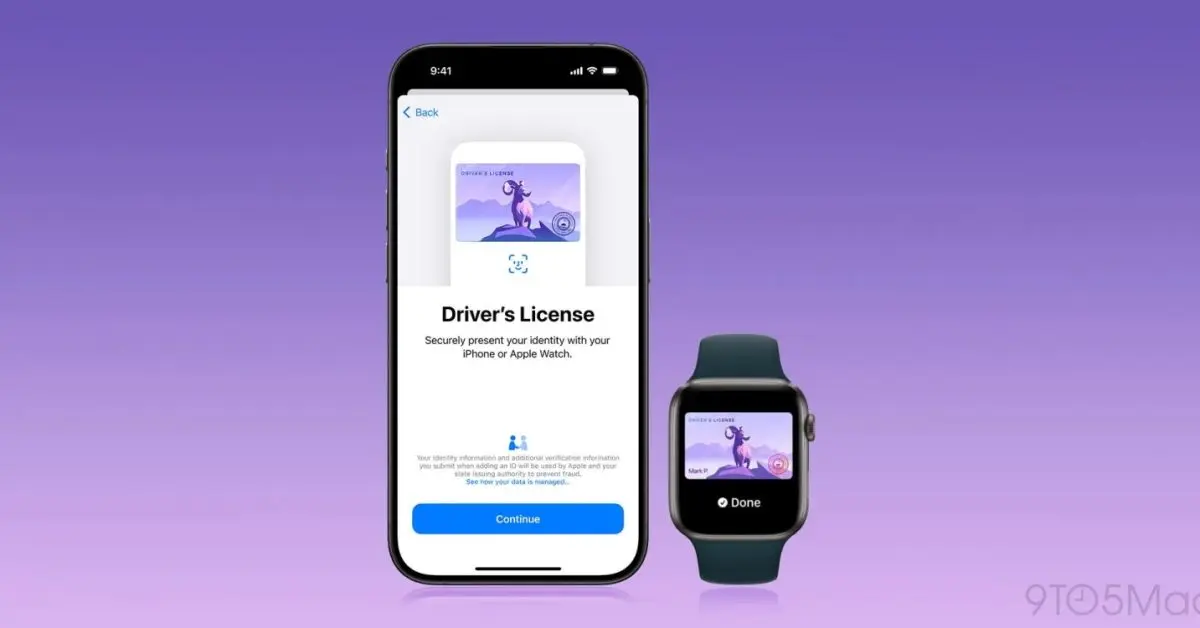
The ability to add a digital version of your driver's license to your iPhone looks like it will be rolling out to a 15th US state before too long. Apple currently lists 14 states where the capability is supported, alongside the territory of Puerto Rico, and backend assets now indicate another one will soon be added.
Backend assets spotted by MacRumors suggest that Oklahoma will soon be joining this list. The discovery comes from code deep within Apple's Wallet infrastructure, showing that Oklahoma's state ID configuration is now present, though not yet publicly available. This follows a pattern where Apple quietly prepares support for new states weeks or months before official announcements.
The concept of a digital driver's license has been discussed for years, but Apple took a major step forward in 2021 when it announced plans to allow iPhone users to add a driver's license or state ID to the Wallet app. The first states to support the feature were Arizona, Colorado, and Georgia, followed by others in subsequent years. As of mid-2026, the full list of supported states includes Arizona, Arkansas, California, Colorado, Georgia, Hawaii, Illinois, Iowa, Maryland, Montana, New Mexico, North Dakota, Ohio, and West Virginia. Puerto Rico is also supported as an additional jurisdiction. With Oklahoma likely to become the 15th state, the program continues its gradual expansion across the country.
Adding a driver's license to your iPhone is a straightforward process. Open the Wallet app, tap the plus sign, and select "Driver's License or State ID." You will then be guided through scanning the front and back of your physical license, followed by a series of facial movements (tilting your head, blinking, etc.) to verify your identity. The entire process takes only a few minutes and is secured by Face ID and the Secure Enclave on the iPhone. The digital ID is stored locally on the device, not in the cloud, ensuring that even if your phone is lost, your identity data remains protected.
Once enrolled, you can present your digital ID at participating TSA checkpoints by simply tapping your iPhone or Apple Watch on the reader. The system shows only the information necessary for the security officer, such as your name and photo, and you do not need to unlock your phone or hand it over. This adds a layer of privacy and hygiene, as you never have to physically hand your ID to another person. Additionally, for age verification at businesses like bars or rental counters, the digital ID can prove you are over a certain age without revealing your exact date of birth or address—a significant privacy improvement over traditional IDs.
However, it is important to note that the digital version does not act as a complete replacement for physical documents. Most states still require drivers to carry their physical license while operating a vehicle, and law enforcement may not yet accept digital IDs during traffic stops. Even at airports, not all TSA lanes are equipped with digital ID readers, so travelers should always carry their physical license as a backup. Apple itself advises that users should continue to carry their physical ID for now, describing the digital feature as a convenient supplement rather than a full substitute.
The push for digital driver's licenses is part of a broader trend toward mobile identity solutions globally. The ISO standard for mobile driver's licenses (mDL) has been developed, and many countries are experimenting with digital IDs on smartphones. Apple's implementation is based on this standard, ensuring interoperability with government systems. Other technology companies, such as Google and Samsung, have also begun offering similar features on Android devices, though Apple's integration with the Secure Enclave and Face ID provides an extra layer of security that is often highlighted in official documentation.
Privacy advocates have generally praised Apple's approach because it minimizes data sharing. When you present your digital ID at a TSA checkpoint, the reader requests only the specific information needed for that interaction. For example, if you are boarding a flight, the TSA officer sees your name, photo, and flight details, but not your home address or height. In age verification scenarios, the system simply confirms whether you are over 21 or over 18, without transmitting your birthdate. This selective disclosure is a key advantage over physical IDs, where the entire card is visible.
Despite the benefits, adoption has been slow. Many states are still evaluating the technology, and others have privacy concerns about digital surveillance. The backend assets indicating Oklahoma's imminent addition suggest that the state has completed its security and interoperability testing. Once launched, Oklahoma residents with an iPhone will be able to add their license within a few minutes, assuming they have a valid physical ID and a compatible device running the latest iOS version.
The list of supported states is likely to grow steadily in the coming years as more transportation agencies and businesses upgrade their equipment. The federal government has also expressed interest in digital IDs, with the TSA already rolling out card readers at over 30 airports. As infrastructure improves, the day when you can leave your physical wallet at home may finally arrive. But for now, even the most enthusiastic digital ID users should keep that plastic card handy—just in case.
Source: 9to5Mac News