

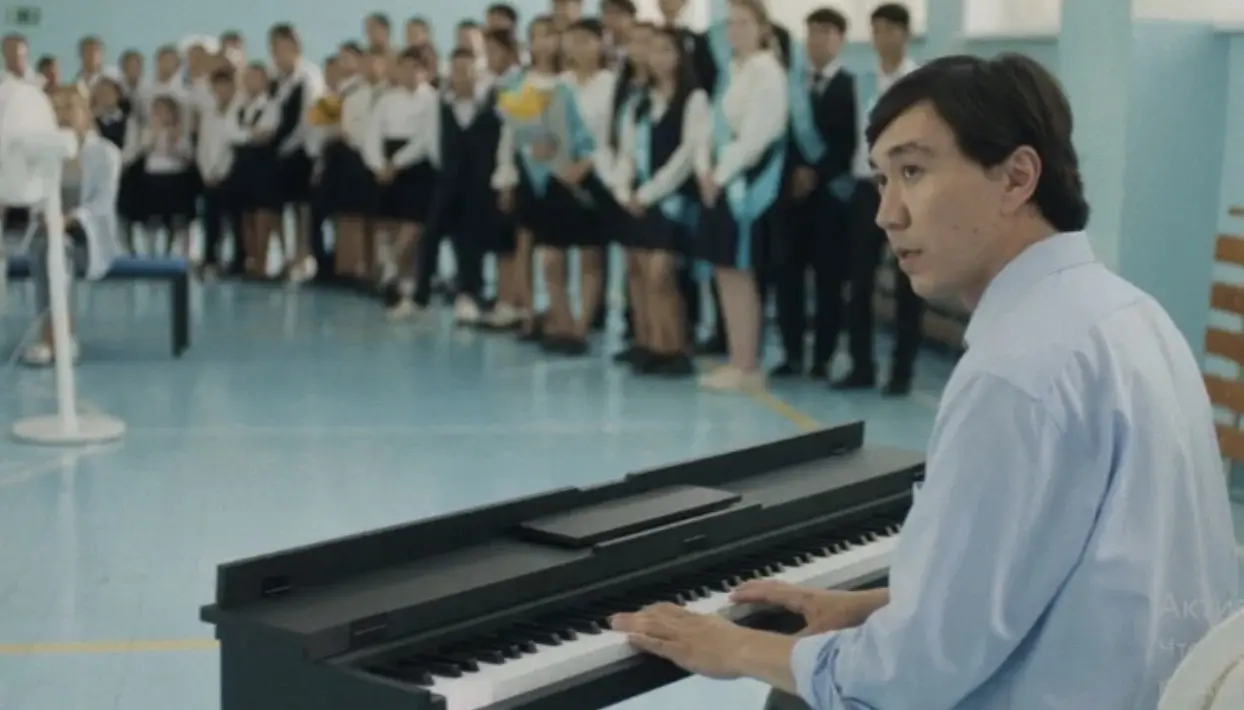
Kazakhstan is making a bold statement on the global cinema circuit this autumn. “Mūğalım” (Teacher), the feature debut of director Ayana Nurdinova, has been selected for the New Directors competition at the 74th San Sebastián International Film Festival. The prestigious Spanish festival, one of the world’s oldest Class A events, will run from 18 to 26 September. With this selection, “Mūğalım” becomes the first Kazakh film directed by a woman to compete at San Sebastián, a milestone that underscores the growing international visibility of a new generation of Kazakh filmmakers.
Key facts
- Kazakh debut feature “Mūğalım” selected for the New Directors competition at the 74th San Sebastián International Film Festival.
- The festival runs from 18 to 26 September in San Sebastián, Spain.
- The film is directed by Ayana Nurdinova and is the first Kazakh film by a woman to compete at San Sebastián.
- “Mūğalım” follows a music teacher in Balkhash who dreams of leaving for a larger city.
- It was commissioned by the Kazakh Ministry of Culture and Information and supported by the State Center for the Support of National Cinema.
The announcement comes at a moment when Central Asian cinema, and especially Kazakh cinema, is drawing renewed attention from programmers, critics and audiences. For decades, Kazakh films were known mainly to specialists, but the current wave of young directors has begun to break through festival doors. Nurdinova’s selection is particularly meaningful because it places a woman’s perspective at the centre of a national cinematic movement that has historically been male-dominated. It also signals that Kazakhstan’s state film institutions are increasingly willing to support intimate, character-driven stories rather than only large-scale historical productions.
An intimate story with universal questions
The film is set in Balkhash, an industrial city in southeast-central Kazakhstan that sits at the edge of Lake Balkhash. The city’s skyline is dominated by a copper smelter, and its identity has long been tied to industrial labour. In this environment, the protagonist works as a music teacher, a role that places him at a distance from the heavy industry that surrounds him. He dreams of leaving for a larger city, one where he believes his talents will be seen and appreciated. When the long-awaited opportunity finally arrives, however, he is forced to reconsider everything.
The central dilemma of “Mūğalım” is both personal and philosophical: what matters more, the art that lives inside a person or the recognition that comes from being part of the art world? The question is particularly difficult for artists outside major cultural capitals. For a musician in a provincial city, the dream of a career often depends on access to institutions, networks and audiences that are concentrated far away. The film asks whether relocation and recognition change the value of one’s work, or whether that value is intrinsic. In doing so, it speaks to a broad audience of artists, teachers and anyone who has ever had to choose between security and purpose.
“Mūğalım” was commissioned by the Kazakh Ministry of Culture and Information and supported by the State Center for the Support of National Cinema. These institutions have played an important role in financing and promoting new projects, and their support for Nurdinova’s debut suggests a deliberate investment in the future of the country’s cinema. The film’s title, which means “Teacher” in Kazakh, points not only to the protagonist’s profession but also to the idea of learning, passing on knowledge and the responsibility that comes with artistic craft.
Why San Sebastián matters
San Sebastián is one of the most influential film festivals in Europe. Founded in 1953 in the Basque Country of Spain, it has long been recognised alongside Cannes, Berlin and Venice as a Class A competitive festival. For filmmakers outside the United States and Western Europe, selection at San Sebastián is a major validation. The festival’s New Directors section is dedicated to first and second feature films, which makes it one of the most carefully watched platforms for spotting emerging talent.
The New Directors competition has introduced audiences to filmmakers who later achieved global acclaim, including Oscar-winning South Korean director Bong Joon Ho. Films launched at San Sebastián have gone on to win awards at national ceremonies, find international distribution and build careers for their directors. The festival’s reputation for discovering new voices is one of the reasons its selections are watched so closely. A place on any lineup, but especially the New Directors competition, can change the trajectory of a filmmaker’s career.
San Sebastián’s history also includes landmark premieres such as Alfred Hitchcock’s “North by Northwest” and the European premiere of George Lucas’ “Star Wars.” Those screenings underscore the festival’s long-standing influence on world cinema. But its real legacy is in the careers it has helped nurture. Roman Polanski, Francis Ford Coppola and Pedro Almodóvar have all had significant moments at the festival. For a debut director from Kazakhstan, being included in such company is both an honour and an opportunity.
Kazakh cinema’s expanding international footprint
The selection of “Mūğalım” did not happen in a vacuum. Over the past decade, Kazakh cinema has gradually built a stronger presence on the international festival circuit. Some of the most notable achievements include Samal Yeslyamova’s Best Actress award at Cannes in 2018 for her role in Sergei Dvortsevoy’s “Ayka.” That prize drew global attention to Kazakh acting and filmmaking. Earlier, Dvortsevoy’s “Tulpan” won the Un Certain Regard prize at Cannes in 2008, helping to introduce a new wave of Central Asian cinema to international audiences.
Other Kazakh directors have also become regulars at festivals around the world. Darezhan Omirbaev is often regarded as one of the most important figures in Central Asian art cinema, with works screened in Cannes and Locarno. Adilkhan Yerzhanov has built a reputation for genre-inflected stories that have travelled widely. The work of these directors, and many others, has established a foundation for younger filmmakers like Nurdinova. Their successes have made it easier for new projects to be taken seriously by international selectors.
The growth has also been institutional. The Kazakh Ministry of Culture and Information has increasingly invested in co-productions and debut features. The State Center for the Support of National Cinema was created to provide systematic backing for local films, from development through distribution. In addition, a number of international co-production platforms have opened their doors to Kazakh projects. The result is a more diverse and ambitious national cinema than the one that existed after independence in 1991.
More than a festival selection
For Kazakhstan, the inclusion of “Mūğalım” in San Sebastián’s New Directors competition is part of a larger story about national identity and cultural diplomacy. Film festivals are not merely competitions; they are also spaces where countries present their cultures to the world. A Kazakh film about a music teacher in an industrial city, made by a woman and entered in one of Europe’s oldest festivals, carries with it a vision of Kazakhstan that is contemporary, self-reflective and deeply human.
The film’s journey to San Sebastián also raises the profile of Kazakh cinema at a time when streaming platforms and international distributors are increasingly interested in non-Western stories. Festival success often leads to sales, and sales lead to wider audiences. A strong premiere in San Sebastián could open doors for Nurdinova’s next project as well as for other Kazakh filmmakers who are waiting for their own opportunities.
There is also significance in the fact that “Mūğalım” is a female-directed debut. The international film community has spent years confronting the underrepresentation of women in directing roles. Festivals have made visible efforts to program more work by women, and national film funds have created initiatives to support female filmmakers. Kazakhstan’s appearance in this movement matters not only for the country but also for the larger Central Asia region, where female directors remain rare in commercial cinema. Nurdinova’s selection is a sign of change, even if the road ahead remains long.
Looking toward September
As the 74th San Sebastián International Film Festival approaches, the Kazakh film community will be watching closely. The festival, which brings together thousands of film professionals from around the world, will provide a unique stage for “Mūğalım.” More information about screening times, public events and the jury is expected to be announced in the coming weeks.
Whatever happens after the premiere, the selection itself has already made a point: Kazakh cinema is no longer a peripheral presence in world film culture. It has a voice, a growing infrastructure and a new generation of storytellers. Ayana Nurdinova’s debut is part of that evolution, and San Sebastián is the next chapter.
Source: The Astana Times News