

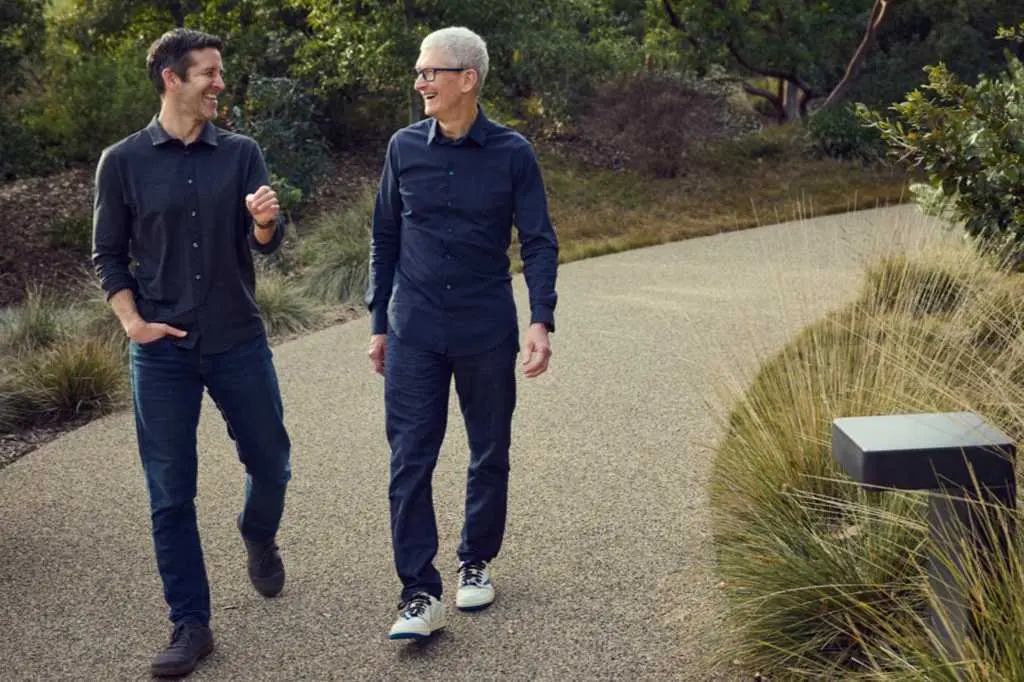
The days are counting down, and a 15-year era is drawing to a close. On September 1, Tim Cook will step back from his current role as Apple CEO, settling for a somewhat quieter job as executive chairman. It’s a natural moment to evaluate his place in corporate history, and there’s every reason to think historians will be relatively kind.
Relatively, because the bar for decency in Cook’s field is low. Look at his peers and rivals: few sane commentators would have Elon Musk, Mark Zuckerberg, or Sam Altman on their list of the ten nicest dudes who should definitely have access to political power. Much as tech in the 1960s and 1970s attracted hippies and idealists, tech in the 2010s and 2020s seems to have become the province of people who think it’s a clever gotcha to point out that humans consume food.
To a degree, such a mindset—the disposition to build and stock an underground shelter rather than work to prevent the catastrophe it’s designed for—is an inevitable result of being extremely rich and running an extremely large business in an extremely competitive market. Tim Cook is a billionaire, and it would be absurd to expect billionaires to be soft-hearted or prone to wild attacks of no-strings generosity. You don’t become a billionaire unless you’re at least above average in the ruthlessness department.
But is Cook a good and decent man? That question is not just mine. In a micro-interview last week, Cook fielded two questions from CBS News’ Jo Ling Kent, and while he technically didn’t answer either of them, he did put forward an interesting metric by which his legacy could be evaluated.
Kent: As you look back on your time as CEO, in a word, what have you stood for?
Cook: In my view, your legacy is described by others, not by yourself. I hope that people say I was a good and decent man. And if they say that at the end of the day, I will feel like I have achieved something.
That’s not one word, Tim. But the sentiment is clear.
Will we say he was a good and decent man? It’s not certain. Cook’s inner decency is almost as elusive as his interview responses. He has the vibe of decency. He comes across as a nice guy, the sort of boss who remembers people’s names and contributes handsomely to going-away gifts. But that’s enormously subjective. Those who have actually worked with him will be able to judge better than the rest of us. What can we learn from his actions?
The truth is that Cook’s actions have not always been those of an unfailingly good and decent man. On his watch, Apple’s treatment of retail and support employees has come in for severe criticism. At one meeting, Cook himself declined to answer questions submitted by the AppleToo activist group, whose leaders understandably said they did not feel heard.
The company has reportedly blocked pay surveys, likely breaking the law; it has discouraged unionization and, coincidentally or not, closed the first U.S. Apple Store to achieve unionization. Conditions in Apple’s Asian supply chain, of course, remain a serious issue.
On the other hand, all those problems were already present when Cook took the top job, and while he hasn’t solved them, he has tried. Apple published a list of suppliers for the first time in 2012, months after he became CEO. In 2020, it put a major supplier on probation for breaking the company’s code of conduct. Apple’s environmental record, while far from perfect, vastly improved under the tenure of Lisa P. Jackson, whom Cook hired in 2013 and who retired earlier this year. We even got to enjoy or endure the CEO bantering with Mother Nature at the iPhone 15 launch event.
To be clear, many of the reforms we’ve seen in the Cook era have been forced on him by regulators or bad PR. But there remains a sense that whereas Steve Jobs, for one, would have refused to give in, Cook is more conciliatory. It also appears that Cook has far more of an urge to do the right thing than his famous predecessor. In 2014, it was reported that he responded angrily to a shareholder question about whether focusing on sustainability was good for the company’s bottom line. “When we work on making our devices accessible by the blind, I don’t consider the bloody ROI,” he said. “If you want me to do things only for ROI reasons, you should get out of this stock.” It takes courage for a CEO to go after shareholders.
Cook, or Cook’s Apple, has also taken stances on immigration, abortion, and transgender rights, which will have alienated a proportion of its potential customers and allies. These positions seem motivated by principle rather than pragmatism. Some have perhaps been undermined by recent political complications, but the sense remains that he is doing what he always has: the best he can under the circumstances.
What this means is that for Tim Cook, morality is one factor within a complex algorithm affecting every decision he makes. It would be an exaggeration to claim he always does the right thing in a moral or ethical sense, regardless of its effects on his career. Apple comes first, and some of the time that means actions and policies which are difficult to defend. But if he can do the right thing, he will. And by the standard of his cohort, or of his predecessors in the hot seat at Cupertino, the fact that morality enters into the calculation at all is almost miraculous.
A record shaped by compromise and ambition
To understand Cook’s legacy, it helps to remember the impossible situation he inherited. Steve Jobs, in his final years, had transformed Apple into the world’s most valuable company. But Jobs was also a notoriously demanding and sometimes cruel leader. Cook, by contrast, has emphasized kindness, collaboration, and social responsibility, even when those values conflicted with short-term profits.
His biggest achievements include overseeing the explosive growth of the iPhone, launching the Apple Watch and AirPods, and building a services business that now rivals many Fortune 500 companies. He also steered Apple through the pandemic, supply chain crises, and a series of epic legal battles with regulators and rivals.
Yet the moral compromises have been real. Apple’s App Store policies have been criticized as monopolistic. The company has fought right-to-repair legislation. Its tax avoidance strategies have drawn international scrutiny. And despite public promises, it has often been slow to address labor abuses in its manufacturing supply chain.
Critics argue that Cook’s Apple has been too cautious, too reactive, too willing to accept incremental progress when radical change was needed. Supporters say that is exactly the point. In a world where tech CEOs have increasingly embraced authoritarian politics, conspiracy theories, and anti-social provocations, Cook’s quiet, methodical, and occasionally moral approach looks almost noble.
What this week’s Apple news tells us
Alongside the reflection on Cook’s legacy, several other Apple stories made headlines this week. Here are the key facts worth knowing:
- Apple’s upcoming iPhone event is expected to be packed with intrigue, with multiple new models anticipated.
- Apple TV has lost the plot, according to one analysis, as the streaming service struggles to find a consistent identity.
- iOS 27 may be a free update, but the artificial intelligence features are likely to carry a cost, as one industry commentator notes.
- Apple’s revolving door continues to spin, with more big-name executive changes.
- The latest episode of an Apple-focused podcast breaks down the folding phone landscape and how Apple’s upcoming iPhone Ultra will change it.
- iOS 27 beta confirms Apple’s full iPhone 18 roadmap with six new models.
- An iPhone Ultra leak confirms a dark blue model, and the name is looking increasingly likely.
- A sweeping Apple Watch rethink could bring new designs and premium models.
- Reports of the 20th anniversary iPhone’s death appear to be greatly exaggerated.
- Apple has released rare point betas for iOS 26.6 and macOS 26.6.
These stories, taken together, show an Apple still in constant motion. The company is preparing for a new generation of hardware, software, and services, even as it prepares for a change in its executive leadership. Tim Cook’s successor will inherit a very different company from the one he took over in 2011—one that is larger, more powerful, and more scrutinized than ever.
Whether Cook is remembered as a good and decent man will depend, ultimately, on who is doing the remembering. For shareholders, he is the steward who quadrupled the share price. For employees, he is a leader who spoke out on social issues but sometimes failed to address internal complaints. For the world, he is a billionaire who could have chosen to be a reclusive plutocrat but instead put a small but consistent thumb on the scale for decency.
The interview answer was telling. Cook did not say he hoped to be remembered as a great innovator, a ruthless competitor, or a visionary. He said he hoped to be remembered as good and decent. That may be the most honest and aspirational thing he has ever said. And for an industry that has produced so many self-mythologizing figures, it is a rather refreshing final note.
Source: Macworld News