

8:24 p.m., June 18 — Helene Braun
Crypto stocks finish mostly higher as Wall Street rebounds from Fed-fueled selloff
Crypto-related stocks closed mostly higher Thursday as U.S. equities rebounded from a sharp selloff triggered by the Federal Reserve's latest policy meeting under new Chair Kevin Warsh. The S&P 500 rose 1.08%, while the Nasdaq gained 1.91%. The Dow Jones Industrial Average added 0.14%. Bitcoin (BTC) fell about 2% over the past 24 hours and is trading just above $63,000 at press time.
Markets came under pressure Wednesday after the Federal Reserve's first policy meeting led by Warsh. Investors focused on the Fed's updated dot plot, which showed that nine of 18 policymakers now anticipate higher interest rates in 2026. Warsh did not provide his own rate outlook and reinforced expectations that the Fed could maintain a restrictive stance.
Among crypto stocks, miners led gains, in line with AI-related stocks. Cipher Mining (CIFR) jumped 10.7%, HIVE Digital (HIVE) rose 7.3%. Hut 8 (HUT), TeraWulf (WULF), IREN (IREN) and Core Scientific (CORZ) also posted gains.
Crypto exchanges were mixed. Robinhood (HOOD) rose 2.8%, eToro (ETOR) gained 1.7% and Galaxy Digital (GLXY) advanced 3.5%, while Coinbase (COIN) fell 1% and Gemini (GEMI) slipped 1.5%. Stablecoin issuer Circle (CRCL) edged down 0.5%.
8:07 p.m., June 18 — Helene Braun
Saylor's STRC preferred stock rebounds after sharp intraday drop
Strategy's Variable Rate Series A Perpetual Stretch Preferred Stock (STRC) recovered most of its losses Thursday after a sharp midday selloff briefly pushed the share to its lowest level since launch. STRC fell to as low as $83.26 around noon ET before rebounding to $88.59 at the close. The recovery brought the stock back near its opening price of $89.40, putting it on track to finish the session nearly unchanged.
The preferred stock has drawn attention from investors because it serves as one of Strategy's key funding vehicles for bitcoin purchases. When STRC trades above its $100 par value, the company can issue new shares through an at-the-market program and use the proceeds to buy bitcoin. With the stock trading well below that level, Strategy has paused new issuance through the program.
7:17 p.m., June 18 — Helene Braun
Strategy leans on balance sheet flexibility as preferred stock slides, TD Cowen said
Strategy (MSTR) is increasingly positioning itself as a bitcoin-focused capital markets platform rather than a leveraged bitcoin buyer, TD Cowen analyst Lance Vitanza wrote in a note on Thursday after meetings with CFO Andrew Kang. Kang told investors the company's primary goal remains growing bitcoin (BTC) per share, but management is placing greater emphasis on liquidity, credit stability and capital structure management, according to the note. Rather than focusing solely on bitcoin purchases, Strategy is balancing the interests of common shareholders, preferred investors, convertible debt holders and credit markets.
The shift comes as Strategy's Variable Rate Series A Perpetual Stretch Preferred Stock (STRC) closed at a record low of $89 on Wednesday, prompting the company to pause at-the-market share sales tied to the preferred stock. Vitanza said Kang described recent bitcoin sales and debt retirements as demonstrations of financial flexibility rather than signs of funding stress. While Strategy may slow bitcoin accumulation during weaker market conditions, management continues to measure success through bitcoin-per-share growth and bitcoin yield.
7:17 p.m., June 18 — Stephen Alpher
'Orange jumpsuit': Peter Schiff ups rhetoric against Michael Saylor
"The financial house of cards Michael Saylor built is collapsing," tweeted Peter Schiff on Thursday. "Strategy's per-share discount to its bitcoin holdings is soaring, STRC is tanking, and bitcoin itself is breaking down, taking the rest of crypto down with it. Soon, Saylor will trade in his orange tie for an orange jumpsuit." Schiff's tweet came as STRC was imploding earlier in the session, taking MSTR common stock and bitcoin along with it. STRC has bounced a bit since, but is still trading at $87, down 2.2% today and 13% below its par value. There's been no such bounce for MSTR and bitcoin, which both continue near session lows; MSTR is down 5.5% at $110 and BTC is lower by 4% at $65,500.
6:07 p.m., June 18 — Stephen Alpher
Stocks soar in face of imminent rate hikes while crypto implodes
The Kevin Warsh-led Fed shocked markets with its hawkish turn on Wednesday, but stocks are brushing it off. After a brief, shallow selloff on the news, equity investors have returned to buying low and selling high, lifting the Nasdaq higher by 1.6% in mid-afternoon action on Thursday. AI-related favorites like Nvidia, Broadcom and AMD are higher in the area of 4%, while Micron Technologies is up 9% and Intel is gaining 10.6%. The S&P 500 is up "just" 1%, but is being held back by defensive sectors like healthcare and consumer staples, while energy names head lower in the face of falling crude oil prices.
Crypto, however, continues a steep selloff, with bitcoin (BTC) lower by 4.3% to $62,500, and ether (ETH), XRP (XRP) and solana (SOL) posting even larger percentage declines. As for those rate hikes, there's now a 34% chance of one coming as soon as the Fed's next meeting in July. Those odds were just 8% ahead of yesterday's Fed meeting. The chances of one or more rate hikes by the September meeting have risen to 67%.
3:41 p.m., June 18 — James Van Straten
AI rally accelerates as bitcoin slips below $63,000
The divergence between AI and bitcoin continues to widen. Bitcoin (BTC) has slipped below $63,000 and is now trading around $62,900, while AI-related stocks continue to extend their gains. Among AI-linked miners, Cipher Digital (CIFR) is up 10% and has reached new all-time highs. TerraWulf (WULF) has added another 4%, Galaxy Digital is up 4%, WhiteFiber (WYFI) has surged 15%, and IREN (IREN) is higher by 3%.
The strength is also evident across semiconductors and memory stocks, which continue to push to fresh highs. The DRAM ETF has gained 10%, while the VanEck Semiconductor ETF (SMH) is up 5%. Among individual names, Micron Technology (MU) has risen 7%, and Sandisk has jumped 11%, highlighting the continued investor appetite for AI infrastructure exposure.
2:44 p.m., June 18 — James Van Straten
Saylor's STRC plunges to record low as Strive's SATA joins preferred stock selloff
STRC/SATA (TradingView)
Strategy's high-yielding preferred stock STRC continues to sell off, falling to a new record low of $85.32 Thursday morning. It's bounced a hair in recent minutes to $86.20, still down 3.15% for the day. One prevailing narrative was that investors were rotating out of STRC and into Strive's similar security, SATA, due to SATA's daily dividend feature and higher yield. That narrative is falling by the wayside today as SATA is also down 3.15% and trading well below par at $96.85. Bitcoin (BTC) is at a session low of $63,500, down 2.5% over the past 24 hours. U.S. stocks, meanwhile, are surging, the Nasdaq higher by 1.4%.
1:27 p.m., June 18 — James Van Straten
SpaceX slips a but further, but remains well above IPO level
SpaceX (SPCX) is lower by 4% in early trading on Thursday, trading below $185. That's down from an intraday high of $225 earlier this week, but still higher by more than 35% from its $135 IPO price.
1:07 p.m., June 18 — Stephen Alpher
FT's Strategy (STRC) obituary might be a good sign for bulls
The details aren't really that important. The struggles of bitcoin, Strategy, and its high-yielding preferred stock STRC have been well-known and well-covered for months. The timing, however, is. With bitcoin back near multi-year lows, Strategy common stock (MSTR) near a 52-week low, and STRC plunging to 11% below par value, the FT and its Alphaville editors — persistently negative on all things crypto for as long as the sector has existed — minutes ago published yet another of their obituaries. "Stretch is beginning to operate like a tapeworm inside the Strategy belly," wrote Craig Coben. "The longer it remains there, the more nutrients it consumes. It may be better to expel it sooner rather than later." "Stretch was marketed as an 'iPhone moment' for digital credit, but it has turned into something far more sinister for shareholders," Coben concluded. Close watchers will recall the last time the FT was so giddy about bitcoin's demise — the weekend after BTC's early February crash to $60,000. Three months later, the price had rallied nearly 40%.
12:10 p.m., June 18 — Stephen Alpher
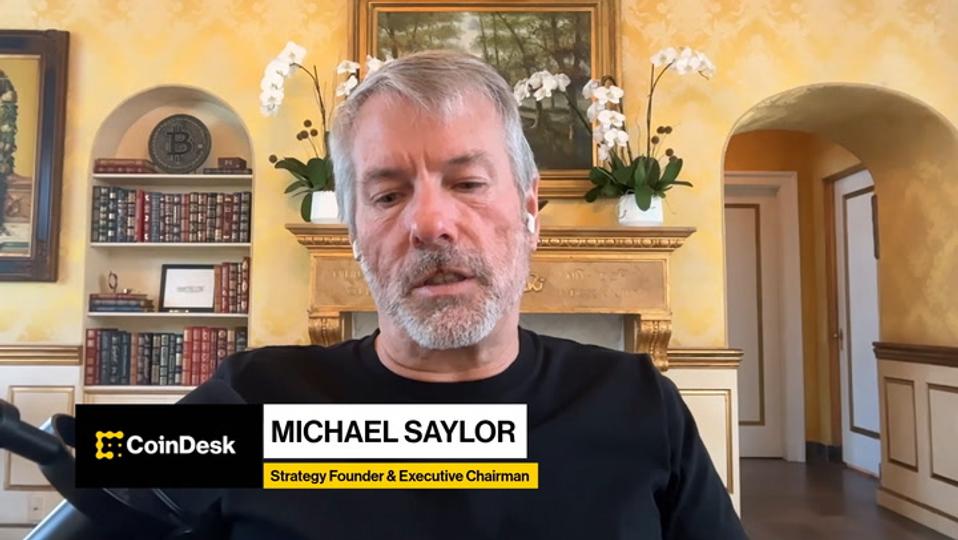
Saylor shows no hesitation as MSTR and STRC get slammed, BTC heads lower
"Building on 846,842," tweeted Strategy Executive Chairman Michael Saylor minutes ago, referring to the amount of bitcoin held on his company's balance sheet. The post comes as bitcoin slid back towards multi-year lows on the Fed's hawkish pivot on Wednesday. Strategy's common stock MSTR fell 5.1%, nearing a 52-week low. Its high-yielding preferred stock, STRC, tumbled back to $89, a full 11% below par, suggesting investors are demanding a dividend well in excess of the current 11.5%. "Bitcoin is stuck in limbo until the market gets rid of Saylor or a price-insensitive nation state starts bidding to infinity," tweeted persistent (and currently right) doomer Wazz. "The former is more likely than the latter IMO. Every single day the bitcoin price action is hostage to Strategy Ponzi, the bitcoin narrative takes a hit."
11:53 a.m., June 18 — James Van Straten
Intel jumps 9% on reported Apple chipmaking partnership in the US
Intel shares jumped more than 9% in pre-market trading on Thursday after President Donald Trump announced on Truth Social that the chipmaker will partner with Apple (APPL) to design and manufacture semiconductors in the United States. In a post on Truth Social, Trump said, "Apple has agreed to work with Intel to design and build its chips in America," while also highlighting domestic chipmaking initiatives from Nvidia (NVDA) and Elon Musk's Terafab. Intel stock has soared over 220% year to date, pushing the company's market capitalization above $610 billion. The U.S. government currently owns roughly a 10% stake in Intel, a position it acquired in August 2025.
10:58 a.m., June 18 — James Van Straten
Dollar index hits one year high as hawkish fed boosts greenback
DXY Index (TradingView)
The U.S. Dollar Index (DXY) has climbed to 100.7, its highest level since May 2025 and a one year high. A stronger dollar is typically bearish for risk assets as it tightens global financial conditions, reduces liquidity, and increases the attractiveness of dollar denominated investments. The DXY had traded in a relatively narrow 96 to 100 range over the past year before breaking higher. The move followed a hawkish debut FOMC meeting from new Federal Reserve Chair Kevin Warsh on Wednesday. Despite the dollar's strength, bitcoin and gold continue to hold above $64,000 and $4,200, respectively.
9:31 a.m., June 18 — Shaurya Malwa
A hawkish Fed is a headwind for crypto, but maybe a sign of strength
The Fed's hold this week mattered less for crypto than what it signaled, according to Matthew Pinnock, chief operating officer at Altura DeFi. Chairman Kevin Warsh's first meeting offered little clarity, avoiding firm commitments on the path ahead, while the updated projections turned hawkish. Policymakers now see the federal funds rate ending 2026 at 3.8%, up from 3.4% in March, implying possible hikes rather than the cuts markets had penciled in. Rising Treasury yields reflect a market repricing for a longer stretch of restrictive policy, a near-term headwind for risk assets, Pinnock said in a message to CoinDesk.
He sees a more constructive read underneath, however. The hawkish stance also signals the Fed's confidence in the economy. If AI-driven productivity supports growth and inflation stays contained, Pinnock noted, investors may come to view the posture as a sign of resilience rather than a threat to the risk-on backdrop that has supported bitcoin's advance.
9:05 a.m., June 18 — James Van Straten
Markets rebound as investors digest hawkish Fed pause
Markets are rising before the opening of U.S. equity trading after a late selloff on Wednesday following Federal Reserve Chair Kevin Warsh's first FOMC meeting. As expected, the Fed left interest rates unchanged, but the accompanying statement and press conference struck a more hawkish tone, weighing on risk assets into the close. The U.S. Dollar Index (DXY) has remained above 100, while the Invesco QQQ ETF is up 1.5% in pre-market trading. Precious metals are modestly higher, with gold trading below $4,300 per ounce and silver below $69 per ounce. Bitcoin is hovering above $64,000, while crude oil continues to weaken to below $74 per barrel. Meanwhile, U.S. Treasury yields edged lower, with the 10-year Treasury yield declining to 4.5%.
7:52 a.m., June 18 — Omkar Godbole
BTC derivatives alert: Massive put buying at $62,000 signals weekend caution
Bitcoin's (BTC) options market on Deribit shows a significant surge in short-term bearish positioning. Data tracked by Laevitas shows whale-sized buying of bitcoin put options at the $62,000 strike expiring on June 21, that is, three days from now. A total of 1,750 contracts hit the tape, with buyers paying over $600,000 in premium for the hedge. Laevitas described it as "near-term downside protection in the weekend expiry." A put option gives the buyer the right, but not the obligation, to sell the underlying asset, in this case, BTC, at a predetermined price on or before the expiration date. The $62,000 strike put expiring on June 21 is essentially a bet that bitcoin’s spot price will be below that level at expiry.
6:35 a.m., June 18 — Shaurya Malwa
Bitcoin whales are buying the dip as ETFs sell
Bitcoin's largest wallets are buying the dip. Addresses holding 1,000 or more BTC now control about 7.17 million coins, their highest since March 14, according to Santiment. The accumulation comes as the recovery rally stalls near $64,000, per CoinDesk data, and it cuts against Wednesday's flows. Spot bitcoin and ether ETFs both posted broad outflows after the Federal Reserve turned hawkish and took rate cuts off the table. Whales are adding while the ETF bid fades.
The move fits a run of accumulation signals this month. Exchange reserves have fallen roughly 80,000 BTC since February as coins move into storage, long-term-holder balances sit near records, and wallets with a history of holding absorbed about 125,000 BTC in the first half of June. The caveat is that these are accumulation readings, not a guarantee of direction. As a share of total supply, the whale stake near 35.8% still sits below its December peak.
6:02 a.m., June 18 — Shaurya Malwa
Bitcoin and ether ETFs both bled cash after the Fed turned hawkish
US spot bitcoin and ether ETFs both turned to outflows on Wednesday in a sign the recovery rally has lost its institutional bid. Bitcoin funds lost $82 million and ether funds $29 million, SoSoValue data shows. The bitcoin outflow was broad this time, with even BlackRock's IBIT shedding $31 million and ARKB down $44 million, while every ether fund finished in the red.
The trigger was the Federal Reserve. Kevin Warsh's first meeting as chair held rates at 3.50% to 3.75% on Wednesday, as expected, but the projections turned hawkish. The median forecast now sees the policy rate ending 2026 at 3.8%, up from 3.4% in March, and nine of 18 officials penciled in a hike this year. Markets put the odds of an increase as soon as October near 60%. The rate cuts that helped power the bounce are gone.
The price tape stalled with the flows. Total crypto market value has held flat near $2.26 trillion since Tuesday's close, and bitcoin has eased to about $63,800, mid-range of the climb it built over the past 11 days, per CoinDesk data. The macro backdrop has flipped. The peace deal that drove the recovery eased inflation fears, but a Fed now leaning toward hikes has replaced the cut bets crypto was counting on. The next tests are October hike odds and whether the ETF bid returns.
For context, the behavior of STRC is particularly noteworthy because it reflects the market's perception of Strategy's capital structure. Launched in early 2026, the Variable Rate Series A Perpetual Stretch Preferred Stock was designed to provide a dividend that resets quarterly based on a spread over the Secured Overnight Financing Rate (SOFR). The idea was to offer a floating-rate product that could appeal to income-seeking investors while giving Strategy a flexible funding source. However, as bitcoin prices have stagnated and the broader macro environment has shifted, the stock has lost its appeal. Trading below par means that new issuance is unattractive, cutting off a key source of liquidity for the company's bitcoin acquisition strategy.
Meanwhile, the hawkish shift from the Fed under Kevin Warsh marks a dramatic departure from the rate-cutting cycle that many had anticipated. Warsh, a former Fed governor known for his hawkish leanings, took office in April after the previous chair stepped down. His first FOMC meeting on Wednesday sent shockwaves through markets, not because of the rate decision (which was a hold), but because of the updated dot plot and his press conference language. By signaling that rate hikes could be on the table for 2026, the Fed effectively reversed the market's expectation of a dovish pivot. This has pushed the U.S. dollar to one-year highs, weighed on commodity prices, and created a bifurcation between traditional tech stocks and the crypto sector.
The divergence between AI and crypto is especially stark. While AI stocks continue to rally on optimism about productivity gains and government support for domestic chip manufacturing, bitcoin remains mired in a downtrend. The reasons are manifold: higher interest rates reduce the opportunity cost of holding non-yielding assets like bitcoin; a stronger dollar tightens global liquidity; and the collapse of STRC has raised questions about the financial health of one of the largest corporate bitcoin holders. Yet some analysts see the current pessimism as overdone. The whale accumulation signals, combined with the fact that ETF outflows have been relatively modest compared to prior drawdowns, suggest that long-term believers remain committed. Moreover, the historical precedent of bearish coverage from prominent skeptics often coinciding with market bottoms adds a contrarian angle.
In the options market, the heavy put buying at the $62,000 strike indicates that professional traders are bracing for further downside into the weekend. This is consistent with the trend of declining open interest and negative funding rates in the perpetual futures market. However, such concentration of bearish bets can sometimes lead to a short squeeze if the market stabilizes. The weekend could see volatile price action depending on how news events unfold, particularly regarding US-Iran ceasefire talks and any further commentary from Fed officials.
Overall, the crypto market is at a critical juncture. The failure of bitcoin to hold above $64,000 after the Fed news has dampened sentiment, but the resilience of the stock market suggests that the selloff is sector-specific rather than systemic. For Strategy, the focus remains on its ability to manage its balance sheet through this period of stress. The company still holds over 846,000 bitcoin, worth roughly $53 billion at current prices, but its debt obligations and preferred stock liabilities have created a complex capital structure that investors are increasingly wary of.
Source: Coindesk News