

Bitcoin Slips as Rate Cut Hopes Fade
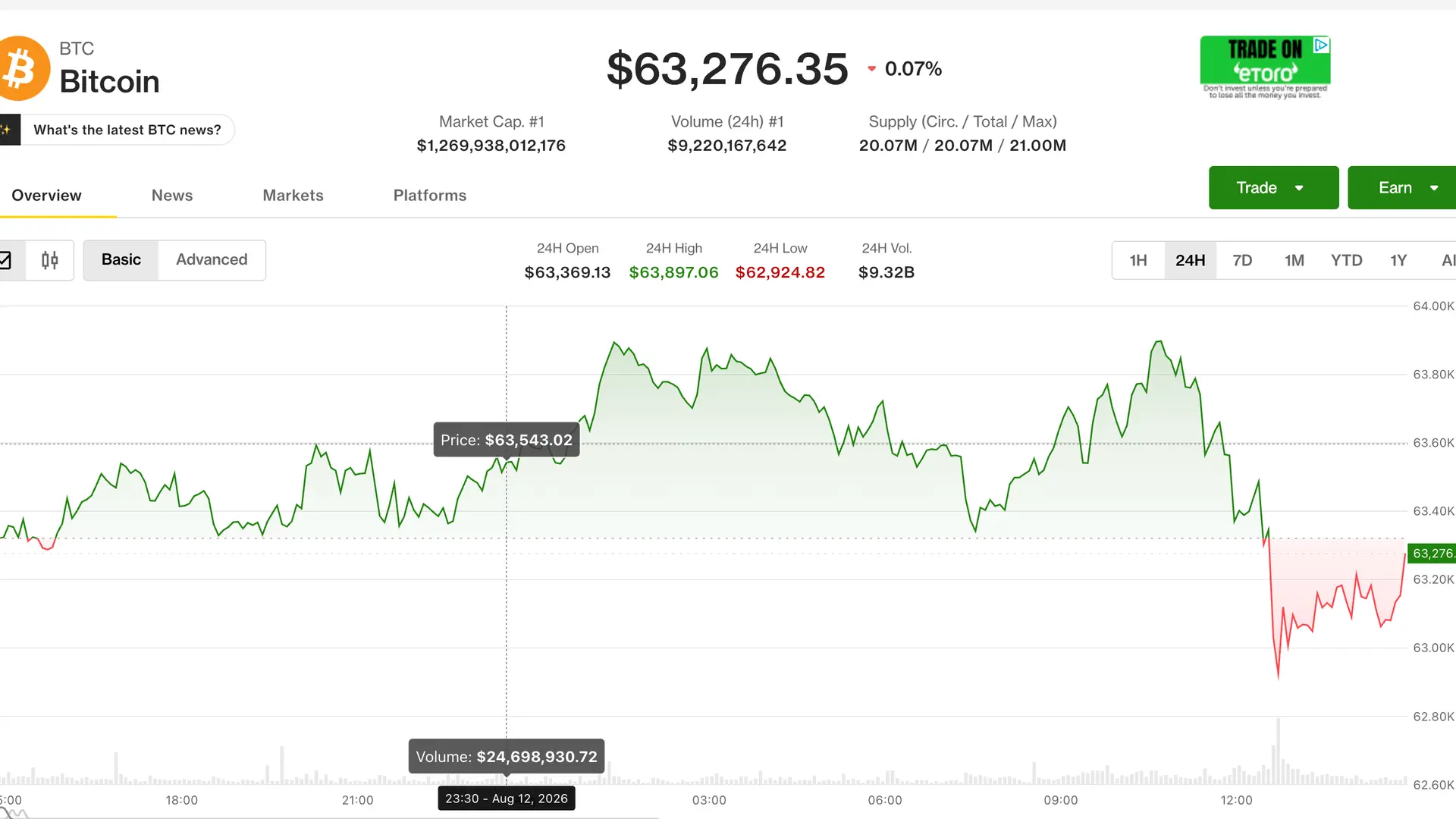
Bitcoin (BTC) remained trapped in a tight trading range on Thursday, but the modest move that did occur was to the downside. The leading cryptocurrency slipped below $63,000 at one point during the afternoon before recovering to around $63,100, a decline of roughly 0.5% over the past 24 hours. Other major cryptocurrencies also traded lower, reflecting a broader lack of momentum across the digital asset market.
The dip came despite improving conditions for risk assets. A softer-than-expected U.S. inflation report on Wednesday, followed by a benign producer price index (PPI) reading on Thursday, appeared to take the idea of a September Federal Reserve rate hike off the table. The two-year Treasury yield, which had been above 4.30% just days ago, slid back to 4.14%. Lower bond yields typically reduce the opportunity cost of holding non-yielding assets like bitcoin, yet the cryptocurrency struggled to find buying interest.
Instead, institutional money continued to favor equities. The S&P 500 rose another 0.55% on Thursday, notching a fresh record close. That divergence between stocks and bitcoin underscores the cautious positioning among crypto traders, who are waiting for a clearer catalyst before committing to directional bets.
Fed Rate Hike Odds Tumble After Inflation Data
The market's reaction to the latest inflation figures was immediate. According to CME FedWatch, which derives probabilities from positioning in short-term interest rate futures, the odds of a September rate hike fell to just 32%. One month ago, those chances were above 75%. Traders still see a nearly 70% probability of tighter policy by the end of the year, but the near-term outlook has shifted significantly.
The producer price index was flat in July, compared with economist forecasts for a 0.2% increase. On a year-over-year basis, PPI rose 4.7%, below the 4.9% consensus and down from 5.5% in June. Core PPI, which excludes food and energy, rose 0.2% month-over-month, also short of the expected 0.3%. Annual core inflation eased to 4.2% from 4.7%.
These figures followed Wednesday's consumer price index release, which came in line with expectations. Together, the two reports suggest that price pressures are cooling, though not necessarily fast enough to satisfy the Federal Reserve's most hawkish members.
Cleveland Fed President Beth Hammack remains an outlier. Speaking at an event in Ohio on Thursday, she reiterated her support for higher interest rates, arguing that she needs more confidence that inflation will return to the Fed's 2% target. "I love to see that those numbers are coming in lower — that's a good thing — but I don't have confidence that we're going to continue to see that," she said. Hammack was one of three dissenting votes in favor of a rate hike at the Fed's July meeting.
Whale Places $1 Million Bullish Bitcoin Bet
Despite the lackluster price action, at least one large trader is positioning for a near-term breakout. Data source Laevitas flagged the purchase of approximately $1.07 million worth of bitcoin call options with a strike price of $65,500, expiring on Aug. 15 — just two days after the trade was placed. The options give the buyer the right to purchase 4,054 BTC at that price.
With bitcoin trading around $63,500 at the time, the price would need to rally more than $2,000 in two days for the options to expire in the money. The trade is a speculative bet on an imminent upward move, potentially ahead of a weekend squeeze or a sudden shift in market sentiment.
Tether Completes Landmark KPMG Audit
In a significant development for the stablecoin industry, Tether announced Thursday afternoon that it had completed a full financial audit by accounting firm KPMG. Tether said KPMG issued an unqualified audit opinion on its financial statements as of Dec. 31, 2025, meaning the auditor found the statements to be fairly presented in accordance with U.S. generally accepted accounting principles (GAAP).
Tether also noted that KPMG physically counted and inspected every individual gold bar held by the company, verifying the existence and identifying information of each bar rather than relying solely on reports from custodians or counterparties. The stablecoin issuer holds substantial gold reserves as part of its backing for USDT, the largest stablecoin by market capitalization.
"This is a defining moment for the stablecoin industry," said Tether CEO Paolo Ardoino. "For years, some detractors said an audit of Tether could not be completed." The audit is likely to bolster confidence in Tether's operations and could have implications for the broader stablecoin market, which has faced scrutiny from regulators and skeptics alike.
Volatility Compression Points to Late-Cycle Shift
Bitcoin's extremely narrow trading range is attracting attention from on-chain analysts. James Check, a well-known bitcoin analyst, likened the current conditions to a coiled spring, but warned that history suggests such quiet spells often mark late-stage bear markets or the early phases of new bull markets.
"There have only been a handful of memorable instances in my Bitcoin career where the market has gone this dead quiet," Check said. The 30-day price range is now just 5.6%, one of the narrowest on record, he noted. In the past, similar compression has resolved into explosive moves — sometimes higher, sometimes lower.
The lack of volatility is also reflected in trading volumes. Combined centralized exchange volumes fell to a 32-month low in July, while decentralized exchange spot market share reached an all-time high. That suggests that while institutional interest remains tepid, retail traders are increasingly turning to on-chain trading venues.
Equities and Corporate Earnings Take Center Stage
While bitcoin and crypto majors tread water, equities continue to hit new highs. The S&P 500 reached an all-time high of 7,815 on Thursday, up 0.68% on the day and 13% year to date. The record run underscores the strength of traditional risk assets, which are benefiting from resilient corporate earnings and expectations of easier monetary policy later this year.
Bitcoin miners and related companies are also in focus. Bit Digital (BTBT) saw its shares rise 10% after reporting second-quarter revenue of $32.1 million, up 15% quarter over quarter, driven by growth in its cloud services business. The company held roughly 164,311 ETH, worth about $258 million at quarter-end. Its majority-owned subsidiary WhiteFiber, which gained 8% on Thursday, is expanding its AI infrastructure operations, with initial billing underway at its NC-1 data center and more than $540 million in new cloud contracts.
Bullish (BLSH), a digital asset exchange, is also set to report second-quarter earnings later Thursday, with analysts expecting revenue of $88.44 million and earnings per share of $1.13. Shares of Bullish have declined 41% over the past 90 days and trade about 80% below their all-time high. The company's IPO occurred exactly one year ago this week.
Sharplink to Deploy $200 Million in ETH via Lido
In a move that highlights the growing intersection between corporate treasuries and decentralized finance, Sharplink (SBET), an Ethereum-focused treasury company, announced plans to deploy $200 million of ether through the liquid staking protocol Lido. The company will receive wrapped staked ether (wstETH), which represents the deposited ETH plus accrued staking rewards. Anchorage Digital will custody the tokens.
The arrangement allows Sharplink to earn staking rewards while maintaining an asset that can be used across DeFi applications, including as collateral. CEO Joseph Chalom said the move is part of an expansion of the company's existing staking and restaking strategy. Lido currently has roughly $16.5 billion of ETH staked through the protocol, with about $10 billion of wstETH serving as collateral in various DeFi protocols.
Altcoins and Inflation Dynamics
Amid the sideways action in large-cap cryptocurrencies, a handful of smaller tokens are posting outsized gains. OKB, MNT, and VVV each rose more than 6% in the past 24 hours, ranking among the best-performing assets in the top 100 by market capitalization. These moves are not driven by rotation out of bitcoin, however. Bitcoin's dominance rate remains steady near 59%, a level it has held since July, indicating that traders are not abandoning the majors for speculative mid-caps.
Macro strategist Mike "Mish" Shedlock offered a cautionary note on the inflation narrative. In a blog post, Shedlock argued that the July CPI report looked tame mainly because of a temporary drop in energy and gasoline prices. Underneath the surface, inflation remains sticky, and food prices are undercounted by Bureau of Labor Statistics methodology, he said. The index also ignores key housing costs such as property taxes, insurance, and home prices.
That could explain why the consumer and producer price reports did not translate into a material weakening of the U.S. dollar index, and by extension, why bitcoin failed to rally on the news. Bitcoin continued to trade choppily below $64,000, with the next major catalyst likely to be the Fed's policy meeting in September or a breakout from the current trading range.
Economic Data Recap
Thursday also brought the latest initial jobless claims, which rose to 209,000 from 200,000 in the prior week, slightly above the 202,000 forecast. The labor market remains tight, which could give the Fed cover to keep rates higher for longer if inflation proves sticky.
For now, the market is pricing a 68% chance of no change in September, according to CME FedWatch. However, the outlook for 2026 remains uncertain. Traders are still betting on an almost 70% probability of at least one rate hike between now and year-end, a reminder that the fight against inflation is far from over.
Source: Coindesk News