

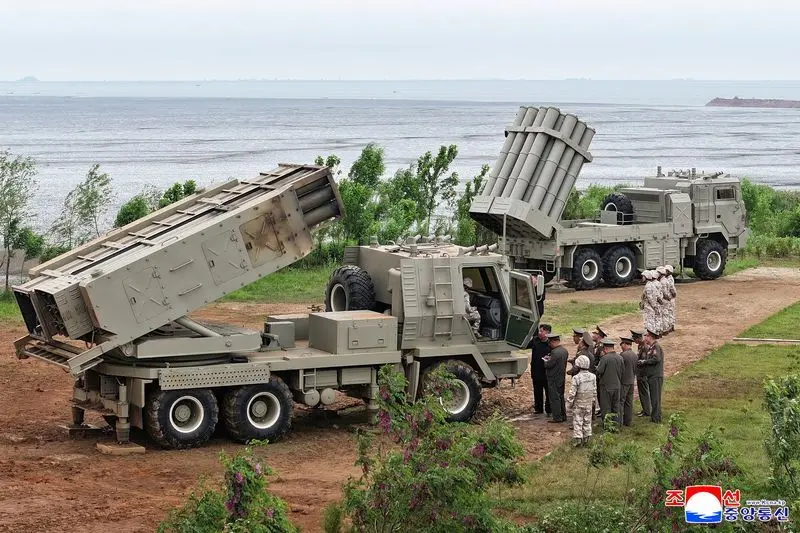
North Korea has conducted new weapons tests that included tactical ballistic missiles, artillery rockets, and what state media described as AI-guided precision cruise missiles, according to a report from the Korean Central News Agency (KCNA) on Wednesday. The tests were supervised by leader Kim Jong Un, who declared the upgraded systems suitable for modern warfare and ordered their deployment near the border with South Korea.
The latest round of launches occurred on May 26, 2026, and involved a diverse array of munitions. KCNA reported that the tests evaluated the power of a "special mission warhead" on tactical ballistic missiles, the reliability of long-range multiple-launch artillery rockets, and the accuracy of AI-guided tactical cruise missiles. Kim Jong Un was quoted as saying the weapons and automated launch systems had been successfully upgraded to "suit the proper conditions of modern warfare so as to enhance their application to combat."
This marks a significant intensification of North Korea's ongoing efforts to modernize its conventional arsenal, which has proceeded in parallel with its better-known development of long-range ballistic missiles and nuclear weapons. Since 2023, Pyongyang has steadily improved its tactical missile systems, often citing the need to counter what it perceives as threats from South Korea and the United States. The country has also abandoned its long-standing policy of seeking eventual reunification with the South, instead designating South Korea as its "primary foe."
AI-Guided Cruise Missiles and Their Strategic Implications
Perhaps the most noteworthy aspect of this test series is North Korea's claim to have incorporated artificial intelligence into the guidance systems of its cruise missiles. KCNA stated that the cruise missiles deployed near the border are equipped with precision navigation and AI-guided control systems capable of striking targets at a range of 100 kilometers (62 miles). This range places the densely populated capital of South Korea, Seoul, well within striking distance, as the Demilitarized Zone separating the two countries is only about 35 to 50 kilometers from the city center.
Analysts have interpreted North Korea's mention of AI guidance as a significant technological leap. Yang Uk, a military expert at the Asan Institute for Policy Studies, explained that the AI component is likely used during the terminal phase of flight to recognize and lock onto targets using real-time data. "It's about using AI when recognising the target and guiding the missile," Yang said. North Korea had previously stated that it employed AI technology in its drones, but this is the first public reference to its use in missile systems.
Hong Min, a senior researcher at the Korea Institute for National Unification, added that the claim probably refers to an upgraded version of an existing digital guidance system combined with automatic target recognition technology. However, both experts cautioned that the degree of sophistication is impossible to verify from the state media report alone. The lack of independent verification is a recurring challenge when assessing North Korean weapons claims, as the country tightly controls information and often exaggerates its capabilities for political and diplomatic leverage.
Despite these uncertainties, the development signals a clear intent by North Korea to field increasingly advanced conventional weapons. Cruise missiles are generally harder to intercept than ballistic missiles because they can fly at low altitudes and maneuver. Adding AI-enhanced terminal guidance would further improve their accuracy and ability to strike moving or heavily defended targets. This is particularly concerning for South Korea and the United States, as it could undermine their missile defense systems and increase the lethality of North Korean preemptive strikes.
The Role of Battlefield Data from Ukraine
North Korea's rapid progress in missile and rocket technology may also be linked to its military cooperation with Russia. Since late 2023, Pyongyang has supplied Moscow with ballistic missiles and artillery rockets for use in the war against Ukraine. Western intelligence agencies have confirmed the transfer of such weapons, and there is evidence that North Korean missiles have been used in combat operations. In return, it is believed that North Korea has received valuable battlefield data, including information on how its projectiles perform under real combat conditions, as well as possible technical assistance from Russian engineers.
This exchange could have accelerated North Korea's missile development cycle. The data on flight trajectories, accuracy under electronic warfare conditions, and effectiveness against modern air defense systems would allow North Korean engineers to refine their designs without having to conduct as many expensive and risky tests. The tests announced on Wednesday may reflect the incorporation of lessons learned from the Ukraine conflict, particularly regarding the need for precision guidance and electronic countermeasures.
The deployment of advanced artillery rockets and AI-guided cruise missiles also suggests a shift toward a more sophisticated conventional warfare doctrine. Historically, North Korea's artillery has been largely unguided, relying on massed barrages to overwhelm defenses. The introduction of precision-guided munitions would allow for more surgical strikes against key command centers, air bases, and infrastructure, potentially changing the strategic calculus on the Korean Peninsula.
Background: North Korea's Expanding Missile Arsenal
North Korea has been one of the world's most prolific missile testers over the past two decades. Its program initially focused on Scud-derived ballistic missiles, but has since expanded to include solid-fuel rockets, submarine-launched ballistic missiles (SLBMs), hypersonic glide vehicles, and intercontinental ballistic missiles (ICBMs) capable of reaching the United States. The country conducted a record number of missile tests in 2023 and 2024, with launches often timed to coincide with political events or military exercises by South Korea and the United States.
While much of the international attention has focused on North Korea's nuclear-capable long-range missiles, the conventional side of its arsenal has also grown rapidly. The country has developed multiple types of short-range ballistic missiles (SRBMs), such as the KN-23 and KN-24, which are designed to be highly mobile and difficult to intercept. These systems can carry a variety of warheads, including bunker-busters and cluster munitions. The addition of AI-guided cruise missiles further diversifies North Korea's strike options and complicates defense planning for its adversaries.
The tests on May 26 also included long-range multiple-launch artillery rockets, which have been a staple of North Korea's arsenal for decades. In recent years, the country has developed longer-range versions, such as the 600mm super-large multiple rocket launcher, which can reach targets deep inside South Korea. The artillery rockets tested alongside the guided missiles likely represent an effort to modernize and extend the reach of this existing capability.
Regional Reactions and Security Implications
South Korea's military detected the launch of multiple projectiles on May 26, including a ballistic missile, and immediately reported the activity. The Joint Chiefs of Staff said they were analyzing the launches and maintaining readiness. The United States, which has stationed approximately 28,500 troops in South Korea, also condemned the tests, calling them a violation of UN Security Council resolutions and a threat to regional stability.
Japan, which lies within range of some North Korean missiles, also expressed concern. Chief Cabinet Secretary Yoshimasa Hayashi said Tokyo would continue to work with Washington and Seoul to strengthen deterrence. The tests come amid heightened tensions on the Korean Peninsula, as the Kim regime has increasingly relied on weapons development to project strength both domestically and internationally. Economic difficulties caused by international sanctions, the COVID-19 pandemic, and natural disasters have made military achievements a key propaganda tool for the regime.
Analysts say North Korea's strategy is to develop a credible conventional deterrent that can inflict devastating damage on South Korea and US forces in the region, thereby raising the cost of any military action against Pyongyang. The inclusion of AI-guided systems is a logical step in this strategy, as it enhances the precision and survivability of North Korea's strike assets. However, it also risks provoking an arms race in Northeast Asia, as South Korea and Japan may seek to develop or acquire similar technologies to counter the threat.
The tests also underscore the growing challenge of verifying North Korea's weapons claims. Without access to the test site or independent monitoring, outside observers must rely on satellite imagery, telemetry intercepts, and analysis of debris from failed tests. North Korea's propaganda apparatus often exaggerates success, but even partial achievements can indicate important technological trends. The claim of AI-guided cruise missiles, for example, may be based on a system that uses simple pattern-matching rather than advanced deep learning, but it still represents a capability that could be improved over time.
In the longer term, the proliferation of AI-equipped weapons to a rogue state like North Korea raises broader questions about the risks of autonomous systems in warfare. While North Korea's AI guidance is likely limited to terminal homing and target recognition, the potential for future development of more autonomous decision-making loops is concerning. International treaties and export control regimes have yet to address the unique challenges posed by AI in weapons systems, and North Korea's progress may spur other countries to accelerate their own programs.
For now, the immediate consequence of the May 26 tests is a further deterioration of the security environment on the Korean Peninsula. South Korea's new government, which has taken a harder line against Pyongyang, has pledged to strengthen its own missile defenses and expand the role of its preemptive strike capabilities. The United States has also reinforced its commitment to extended deterrence, including the occasional deployment of strategic assets such as bombers and aircraft carriers to the region. The cycle of provocation and response thus continues, with no end in sight.
Source: The Star News