

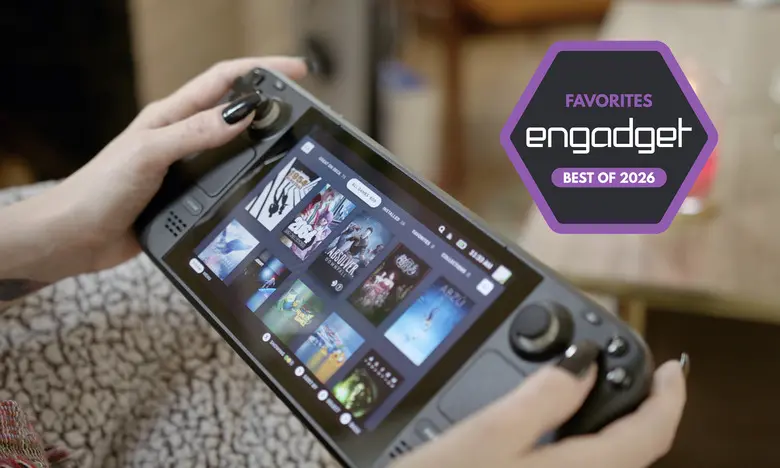
The gaming handheld market has matured significantly. In 2026, you'll find devices spanning from compact retro emulation machines to full-fledged portable PCs capable of running the latest AAA titles. This variety is exciting but can be overwhelming. The best gaming handheld now depends largely on how, where, and what you want to play. Some handhelds prioritize simplicity, long battery life, and pocketable designs for quick sessions. Others offer large screens, powerful chips, and access to massive game libraries at the cost of size and endurance. We have tested and tracked this fast-moving space to identify which devices are truly worth your money.
Best Handheld Gaming PC for Most People: Steam Deck
Valve's Steam Deck remains the best balance of price, performance, and usability. The Steam Deck OLED is the standout model, featuring a 7.4-inch HDR OLED display with 1,280 x 800 resolution, up to 90Hz refresh rate, and peak HDR brightness of 1,000 nits. It runs on a custom 6nm AMD APU with 16GB of RAM and offers storage options of 512GB or 1TB. The OLED model's battery is 50Whr, giving three to twelve hours of playtime depending on the game. Its chassis is lighter than the original, and the fan is quieter.
The entry-level Steam Deck with an LCD display costs $399 and remains an excellent budget option. It has the same core experience with a 7-inch IPS panel and a 40Whr battery. Both models run SteamOS, which has evolved into a user-friendly platform with constant updates. They can play a vast library of Steam games, including demanding titles like Elden Ring and Final Fantasy VII Rebirth, though some live service games with anti-cheat software remain incompatible. The Steam Deck also excels at emulation with tools like EmuDeck, supporting everything from PS2 and GameCube to older consoles. Its main drawbacks are its bulk—nearly a foot long and two inches thick—and a somewhat mushy d-pad. Still, at $399 for the LCD model, it's a phenomenal value.
Best Premium Handheld Gaming PC: Lenovo Legion Go S (SteamOS)
The Lenovo Legion Go S is the first third-party device to natively run SteamOS, offering a modern alternative to the Steam Deck. The configuration with an AMD Ryzen Z1 Extreme processor, 32GB of RAM, and 1TB SSD costs $899.99. It features an 8-inch IPS display with 1,920 x 1,200 resolution, 120Hz refresh rate, and variable refresh rate (VRR) support, which minimizes screen tearing. The Legion Go S can draw up to 33W in handheld mode or 40W when plugged in, significantly more than the Steam Deck's 15W. This translates to higher frame rates in demanding games, often reaching 60 fps at higher settings.
The device has a larger chassis with textured grips and offset joysticks that many console gamers will find familiar. It includes Hall effect sensors to prevent joystick drift and dual USB-C ports. However, it is heavier than the Steam Deck (1.61 pounds) and lacks HDR support. Its battery life is slightly shorter than the Deck's, especially under heavy load. The fan is also louder. A cheaper model with a Z2 Go chip, 16GB RAM, and 512GB storage is available for $650, but we have not tested that variant. The Legion Go S is best for users who want more power and a larger VRR display while retaining SteamOS's ease of use.
Best Windows Gaming Handheld: ASUS ROG Xbox Ally X
For users who need the flexibility of Windows 11, the ASUS ROG Xbox Ally X is the top choice. It retails for $999.99 and features an AMD Ryzen Z2 Extreme chip, 24GB of RAM, and a 1TB SSD. Its 7-inch IPS display runs at 1080p, 120Hz, with VRR support and 500 nits brightness. The device promotes a new Xbox full-screen experience that aggregates games from multiple storefronts and reduces desktop clutter, though it's still fundamentally a Windows PC.
Performance is a key advantage: the Xbox Ally X often outperforms the Steam Deck in AAA games, especially with its Turbo mode that boosts power to 35W when plugged in. The large 80Whr battery delivers roughly three and a half hours of play in demanding titles. Controls are comfortable, with tight face buttons, hall-effect joysticks, and an Xbox controller-like feel. The main downsides are the price, some quirks of Windows 11 on a handheld (awkward desktop navigation, bloatware), and lackluster haptics. If you have an Xbox Game Pass subscription or want to play games from Epic, GOG, or other launchers without workarounds, this is the best Windows handheld.
Best Mobile Gaming Handheld for Most People: Retroid Pocket 5
The Retroid Pocket 5 is an Android-based device ideal for emulating older consoles. It costs $219 and features a 5.5-inch OLED display at 1080p, a Qualcomm Snapdragon 865 chip, 8GB of RAM, and 128GB of storage. It runs Android 13 and can emulate a wide range of systems, from PS2 and GameCube to PSP and Dreamcast, often at higher resolutions. We tested PS2 games like Gran Turismo 4 and Midnight Club 3 at full speed with 1.5x to 2.5x resolution, and GameCube titles like Super Mario Sunshine at 2x-3x. It also handles native Android games and cloud streaming well.
The device has a sturdy plastic build, a vibrant OLED screen, and comfortable grips. However, setup is labor-intensive: you need to secure BIOS files, configure emulators, and sometimes tweak GPU drivers. The joystick layout places the left stick under the d-pad, which can be awkward for some games. Battery life ranges from three hours for demanding Android games to over ten hours for 8-bit emulation. The Retroid Pocket 5 is a fantastic value for enthusiasts willing to tinker.
Alternative Mobile Handheld: Retroid Pocket Flip 2
The Retroid Pocket Flip 2 is essentially the Pocket 5 in a clamshell design. It costs $229 and shares the same Snapdragon 865 chip, OLED display, and battery. The clamshell offers physical protection, but the recessed joysticks and flat back make it slightly less comfortable than the Pocket 5. It's a great choice if you prefer the DS-like form factor.
Best Mobile Gaming Handheld Overall: AYN Odin 2
For users willing to spend more on an emulation machine, the AYN Odin 2 offers superior performance. Starting at $299 for 8GB RAM and 128GB storage, it uses a Snapdragon 8 Gen 2 chip, which provides smoother emulation across PS2, GameCube, and even some Switch games. It has a 6-inch 1080p IPS display, an 8,000mAh battery lasting over eight hours on heavy use, and a comfortable design with offset joysticks. It is larger than the Retroid handhelds but still more portable than a full PC. Battery life can exceed 20 hours for lighter tasks. The Odin 2 is a polished, powerful device for those who prioritize performance and comfort.
Other noteworthy devices include the Analogue Pocket for Game Boy enthusiasts, the Playdate for unique experimental games, and the Nintendo Switch 2, which is excellent for Nintendo exclusives but not included as a formal pick due to its different ecosystem. The market also features powerful Windows competitors like the Lenovo Legion Go 2 (with an 8.8-inch OLED) and the MSI Claw 8 AI+. However, the ASUS ROG Xbox Ally X remains our top recommendation for Windows users due to its balance of performance, battery life, and software experience.
When choosing a handheld, consider your primary use case: if you want to play modern PC games natively, a Steam Deck or Legion Go S is ideal. If you need Windows for wider compatibility, the ASUS ROG Xbox Ally X excels. For retro gaming and emulation, the Retroid Pocket 5 or AYN Odin 2 provide excellent experiences. Budget-conscious buyers should look at the Steam Deck LCD or Retroid Pocket 5. The landscape is rich with options, and the best device is the one that best matches your gaming habits.
Source: Engadget News