

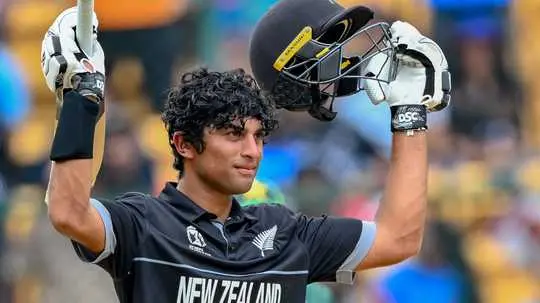
At 23, Rachin Ravindra has already become one of the most talked-about batters at the ICC Men's Cricket World Cup 2023. Standing on the verge of surpassing Kane Williamson's record for the most runs by a New Zealand batter in a single World Cup, the left-hander has been a revelation for the Black Caps. Currently sitting among the top three run-scorers of the tournament with 565 runs, he needs just 14 more to eclipse Williamson's tally of 578 from 2019. Yet, the story of how he got here is not about statistics alone; it is a tale of dedication, family, and an upbringing rooted in sport.
A childhood defined by commitment
Rachin's father, Ravi Krishnamurthy, recalls a defining moment from his son's childhood. When Rachin was eight or nine, he was struck by a ball during a net session in Wellington and had to be rushed to hospital. The very next thing the family heard, he was back at the nets, ready to resume training. "He came back after he was cleared of any serious damage," says Krishnamurthy. That resilience at such a tender age set the tone for years to come.
Training in New Zealand is not for the faint-hearted, especially in Wellington, where biting cold and sub-zero temperatures can make outdoor practice a challenge. But Rachin was undeterred. As a schoolboy, he would train in the indoor nets before attending school. "It was the routine for several years," his father recalls. "I've never seen him not wanting to go to training since a very young age."
This commitment was matched by a family environment in which cricket was always present. Krishnamurthy, a Level 3 coach in New Zealand and an IT professional, began coaching Rachin early. The pair shared a natural bond over the game, and that connection became the foundation of Rachin's development.
A pathway forged through age-group cricket
Rachin's rise through the ranks was steady rather than meteoric. He represented New Zealand at the Under-19 World Cup, where he gained valuable experience in high-pressure junior tournaments. His left-arm spin and elegant batting caught the eyes of selectors, and it was not long before he made his international debut across formats. By the time the 2023 World Cup arrived, Rachin had already displayed glimpses of his talent in bilateral series, though few expected him to become one of the leading run-scorers of the tournament.
His ability to play spin and pace with equal ease is a product of those formative tours to India and his exposure to top-quality bowling from an early age. Watching some of the greatest batters of the modern era in action, both in India and at home in Wellington, gave him a broad education in shot-making and game awareness.
The Hutt Hawks tours and a life-changing sight
Krishnamurthy has long been involved with the Wellington-based Hutt Hawks Club, where he ran a cricket training programme. Over the years, he organised more than 25 tours to India, bringing along players such as Tom Blundell, Luke Woodcock, Jimmy Neesham, and Jeet Raval. Rachin, naturally, was part of those trips. With New Zealand Cricket's support and the assistance of former internationals Bruce Edgar and Chris Nevin, the boys visited cities including Bangalore, Mysore, Chennai, Hyderabad, and Anantapur.
One tour left an especially vivid impression. During a visit to Bangalore, the group was staying at the KSCA Club House while the Test between India and Australia was taking place at the Chinnaswamy Stadium. Rachin and his teammates witnessed Sachin Tendulkar score a historic double century. "Rachin and other boys witnessed that first hand at the Chinnaswamy stadium in Bangalore," says Krishnamurthy. It was a moment that inspired the young cricketer in ways that would only become apparent later.
Back home in Wellington, Rachin also had a front-row seat to another piece of history. He was a flag-bearer during the 2014 Test between India and New Zealand at the Basin Reserve, where Brendon McCullum smashed a triple hundred. Over the years, Rachin was fortunate enough to watch Rahul Dravid, VVS Laxman, Ricky Ponting, Matthew Hayden, Brian Lara, and Kumar Sangakkara live. In fact, as his father proudly notes, Rachin may not have missed a single international match in Wellington since childhood.
A name ahead of its time
One of the most fascinating aspects of Rachin's story is his name, which combines the initials of two Indian cricketing icons: Rahul Dravid and Sachin Tendulkar. But the family insists it was never a calculated move. "When Rachin was born, my wife suggested the name, and we didn't spend a lot of time discussing it," says Krishnamurthy. "The name sounded good, was easy to spell, and short, so we decided to go with it. It was only some years later that we realized the name was a mix of Rahul and Sachin's names which my wife had come up with."
He adds that the choice had no hidden ambition to make his son a cricketer. "I don't think the name had anything to do with kindling the interest of cricket in Rachin. It is merely a coincidence, but we are, of course, happy with the name." In New Zealand, the connection went mostly unnoticed. "If we named Rachin with a mix of rugby players, it would have probably come up for discussion in NZ," he jokes.
Still, the name has given Rachin a unique connection to two of the game's greatest figures. He has met both Dravid and Tendulkar. Dravid, who coached India A, crossed paths with Rachin when he played for New Zealand A. The Tendulkar encounter came during India's tour of New Zealand in 2008-09, when the maestro was training at the Sky Stadium nets in Wellington. "Sachin Tendulkar was graceful enough to even help out in the nets showing us how it's done," recalls Krishnamurthy, who was training in the adjacent net with his son.
A complete batter in the making
At the World Cup, Rachin has looked every bit the modern, complete batter. He began the tournament with a composed century against England, and his consistency has been remarkable. According to Krishnamurthy, watching his son bat brings no more nerves than a normal game. "One thing the media has got right is my likeness towards Sachin. I think I was more nervous before Sachin went out to bat, my palms sweaty and heart thumping. Even more for Sachin, than Rachin," he smiles.
Sunil Gavaskar, the legendary Indian opener, has already called Rachin a future superstar of world cricket. "We're grateful to those legends," says Krishnamurthy. "They have taken to Rachin but we do know these are baby steps and there is a long way to go for Rachin. Hopefully he goes all right and proves them right. Ultimately, cricket is the winner here, providing a platform for players to showcase their talent."
Williamson's seal of approval
New Zealand captain Kane Williamson has been equally effusive in his praise. "Yeah, quite incredible really," Williamson said of Rachin. "I'm sure we'll see plenty more of it to come. (He) burst onto the scene and in a big way in a role that perhaps wasn't sort of natural, maybe, within our environment. But to do what he's done so far in this tournament with his feet firmly on the ground has been really, really special, and as we've all seen. It's not just the volume of runs that he's achieved so far but how he's been scoring them and how it's been geared towards trying to move the team forward."
Rachin's ability to adapt to the role of opener has been crucial for New Zealand, and his mature approach has drawn comparisons to some of the best in the business. At just 23, he has already shown the temperament and technique to succeed on the world stage. With 14 runs needed to overtake Williamson's 2019 tally, history is well within his reach.
Beyond the numbers, Rachin's story is a reminder of how cricket can weave together cultures, families, and generations. From cold indoor nets in Wellington to the roaring crowds of Indian stadiums, his path has been shaped by dedicated parents, memorable tours, and a genuine love for the game. And as his father wisely puts it, those are still baby steps in a long journey. Cricket, meanwhile, continues to provide the perfect stage for such talent to flourish.
Source: Cricbuzz News