

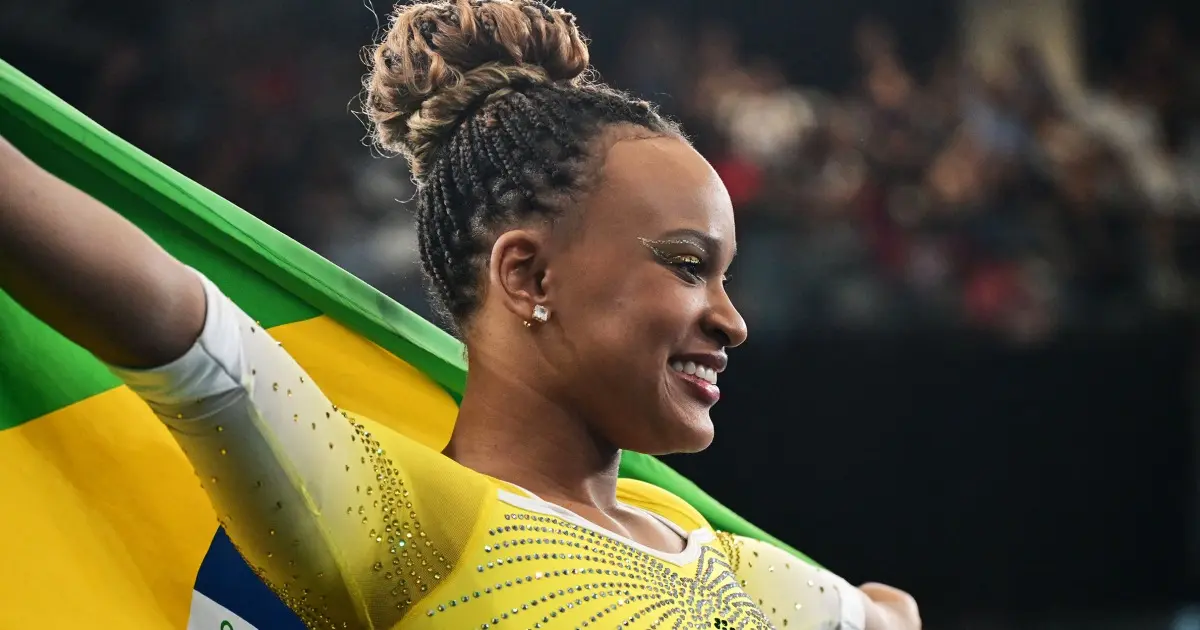
The Paris Olympics is expected to belong to Simone Biles. The American superstar returns to the biggest stage in sport with a dazzling array of high-difficulty skills and a chance to add to her already unmatched legacy. But the competition is far from predetermined. Brazil's Rebeca Andrade, a 25-year-old phenom, has emerged as the most credible threat to Biles' gold-medal hopes, and their anticipated showdown is shaping up to be one of the most compelling storylines of the 2024 Games.
Andrade is no longer a relative unknown. She became a household name in Brazil after winning two medals at the Tokyo Olympic Games, and she has spent the past few years proving that her success was not a fluke. At the Paris Olympics, she and Biles are expected to face off for gold in the all-around, the vault and the floor exercise. While they have competed against each other before, Paris is set to be the first Olympic meeting in which both are at peak physical form and technical sharpness.
From Rio heartbreak to Tokyo breakthrough
Andrade and Biles came of age on the sport's biggest stage concurrently, each making their Olympic debut at the 2016 Rio de Janeiro Games. Their results in Rio, however, painted very different pictures. Biles, then 19, won four golds and a bronze, immediately sparking "GOAT" discussion after three consecutive world all-around titles. Andrade, competing in front of a boisterous home crowd, qualified in third place for the all-around final, ahead of Russian legend Aliya Mustafina, and seemed ready for a breakthrough. But she could not maintain that level in the final and finished 11th.
It was a learning experience, one that showed both her immense potential and the gap she still needed to close. For the next several years, Andrade's progress was slowed by a series of serious injuries. She tore her ACL in 2015, again in 2017, and yet again in 2019. Each time, the question of whether she would ever reach the top of the sport became louder. She missed international competitions for long stretches, and Brazil failed to qualify a full team for Tokyo, meaning she would have to earn her place as an individual if she wanted to compete at all.
The postponement of the Tokyo Games due to the Covid-19 pandemic proved to be a turning point. It gave Andrade the extra time she needed to recover from her third ACL operation, and she finally arrived in Japan as a new athlete. During podium training, she stunned the gymnastics community by unveiling a Cheng vault, one of the hardest vaults in women's gymnastics. The Cheng consists of a round-off entry with a half-turn onto the vaulting table, followed by a layout with a twist and a half. It is a move performed by only a handful of gymnasts worldwide, including Biles, and Andrade had been training it in secret.
In Tokyo, the daring move paid off. Andrade clinched the Olympic gold medal on vault after Biles withdrew from the final because of the "twisties," a mental block that caused the American to lose her sense of space mid-air. Andrade also won silver in the all-around final, finishing behind Suni Lee after stepping out of bounds twice on her final event, the floor exercise, which erased her narrow lead. She returned to Brazil with two Olympic medals and a place in her country's sporting history.
A new vault that could change everything
For Paris, Andrade has been preparing an even bigger statement. She has teased a vault that has never been performed by a female gymnast in competition: a triple-twisting Yurchenko. If she completes it cleanly in Paris, the skill will bear her name in the Code of Points, the sport's official rulebook for rating difficulty. Such a vault would give Andrade a significant increase in difficulty, helping her close the gap with Biles, who has long enjoyed the highest start values in the world.
The triple-twisting Yurchenko is a high-risk, high-reward skill. It requires explosive power, flawless timing and extreme spatial awareness, and a mistake could be costly. But Andrade has shown throughout her career that she is willing to take bold risks for the chance to make history. Adding this vault to her repertoire would not only make her more competitive in the vault final, but also boost her all-around score potential, where fractions of a point can be the difference between silver and gold.
Biles remains the benchmark in difficulty, with several skills named after her, including the Biles II, a double backflip with three twists on floor. At the 2023 world championships, Biles reclaimed her world titles in the all-around, balance beam and floor exercise. Andrade, meanwhile, won the world vault title after Biles sat down on her Biles II vault in the event final. The two women have traded blows at the top, and their all-around score differential at those world championships was just 1.633 points, a margin worth slightly more than a fall. Most of that gap came from Biles' starting value advantage, which was about 1.5 points higher than Andrade's. That means Andrade does not need to out-skill Biles on every event; she simply needs to start close enough and then hit her routines while hoping Biles makes an uncharacteristic error.
A landmark rise for Brazilian gymnastics
Andrade's individual success has also lifted her entire nation. At the 2022 world championships in Liverpool, England, she became the first South American woman to win the world all-around title, defeating American gymnast Shilese Jones. That achievement crowned a remarkable rise from injury-ravaged obscurity to the top of the sport. It also inspired a new generation of Brazilian gymnasts and raised expectations for the country's program on the global stage.
Last year, Brazil won its first world team medal in women's gymnastics, finishing with silver behind the United States and ahead of France. With the Russian team, the reigning Olympic champions, out of Paris contention because of the war in Ukraine, Brazil is now eyeing its first Olympic team medal. If the U.S. team commits some uncharacteristic errors in Paris, Brazil could even push for the team gold. China, Italy and France are also expected to be in the mix, making the team final one of the most open competitions in years.
Andrade's leadership and consistency have been crucial to Brazil's improvement. She competes on all four apparatuses with a rare combination of power, elegance, and resilience. Her floor exercise, set to Brazilian music, has become a crowd favorite, and her tumbling passes are among the most difficult in the world after Biles. On uneven bars and balance beam, she has also developed into a reliable medal contender, comfortable enough to challenge for podium finishes on every event.
A rivalry built on mutual respect
Despite the intense competition, there is no animosity between Andrade and Biles. On the contrary, their rivalry has been marked by mutual admiration. Andrade has spoken openly about the honor of competing alongside Biles, who she says raises the level of the entire sport. "It's about doing my best," Andrade told reporters. "And I hope she [Biles] does, too, that she does her best, because it's an honor to be able to compete alongside her."
Biles, for her part, has praised Andrade's artistry and athleticism, acknowledging that the Brazilian has pushed her to be better. Their relationship adds an emotional layer to their battles, reminding fans that even in the cutthroat world of elite gymnastics, respect and sportsmanship can coexist with the desire to win.
For Andrade, the Paris Olympics is not only about medals. It is about completing a journey that began with the disappointment of Rio, continued through three ACL surgeries, and reached its first peak in Tokyo. She has already proven she can win on the world's biggest stage. Now she has a chance to cement her place as one of the greatest gymnasts of her generation by defeating the greatest of all time when it matters most. The beam, the vault, the floor and the all-around will all be battlegrounds, and the outcome is far from certain. If Andrade's new vault lands and her routines remain clean, the world may witness something no one expected at the start of the year: the Brazilian flag raised above the American star in Paris.
Source: NBC News News