

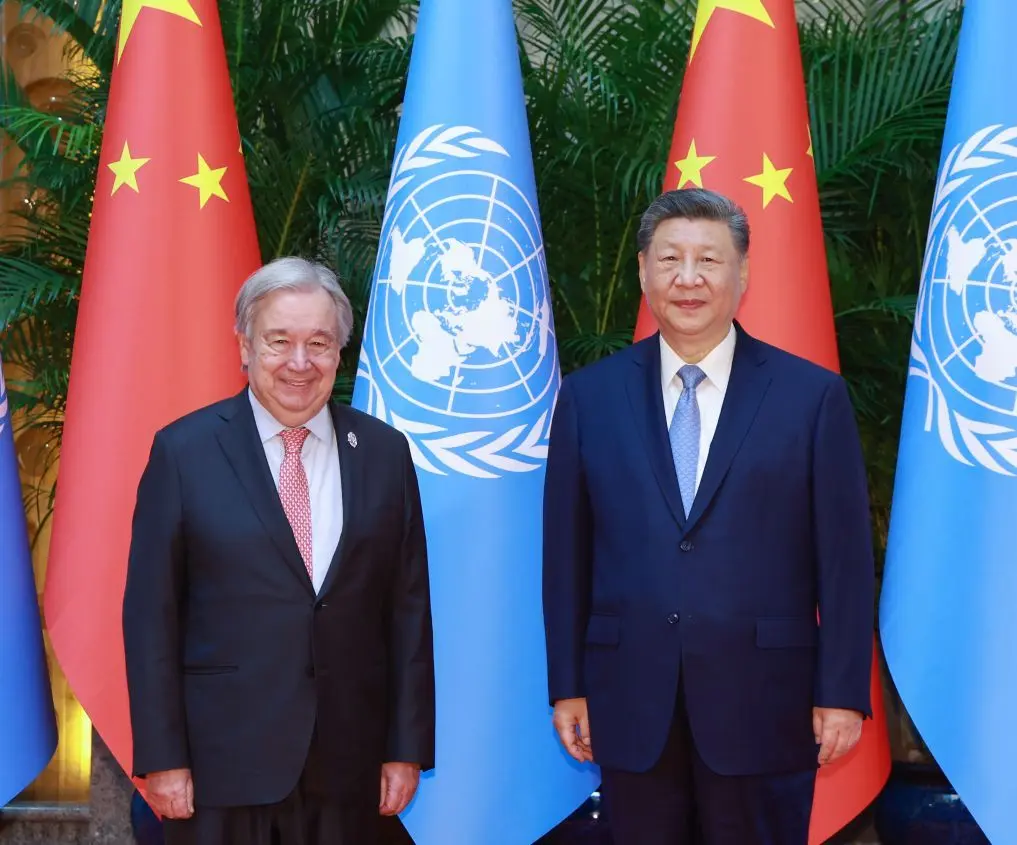
Meeting in Shanghai on the Eve of the 2026 World AI Conference
President Xi Jinping met with United Nations Secretary-General António Guterres in Shanghai on Friday, reaffirming China's steadfast support for the UN as the cornerstone of global governance. The meeting, held on the sidelines of the 2026 World Artificial Intelligence Conference and High-Level Meeting on Global AI Governance, underscored the deepening partnership between China and the UN at a time of mounting geopolitical tensions and technological transformation.
Xi praised Guterres' decade-long leadership at the helm of the organization, describing him as a staunch defender of multilateralism who had taken on such pressing global challenges as climate change, digital governance, and institutional reform. "You have demonstrated remarkable resolve in upholding the principles of the UN Charter," Xi said, noting that Guterres had also pushed forward governance frameworks for emerging fields, including artificial intelligence, and advanced much-needed reforms within the UN system.
A Historic Milestone: 55 Years of China at the UN
The meeting also marked the 55th anniversary of the restoration of the People's Republic of China's lawful seat at the United Nations in 1971. Xi reflected on this historic event, calling it a victory for the forces of justice and international law. Over the past five and a half decades, Xi said, China has remained a consistent contributor to world peace, sustainable development, and the international order. "China’s commitment to the United Nations has never wavered," he emphasized, adding that Beijing would continue to defend the authority and central role of the organization in international affairs.
Under Xi’s leadership, China has advanced the concept of building a "community with a shared future for humanity" as a guiding vision for global cooperation. Xi noted that this vision, along with Beijing’s four global initiatives—the Global Development Initiative (GDI), Global Security Initiative (GSI), Global Civilization Initiative (GCI), and Global AI Governance Initiative—are designed to strengthen, not weaken, the UN’s status and effectiveness. "These initiatives aim to complement the UN’s role and to breathe new life into multilateralism," Xi stated.
Growing Instability and the Call for Genuine Multilateralism
Turning to the current state of world affairs, Xi warned that growing instability and uncertainty across the globe made genuine multilateralism more important than ever. He called for a stronger role for the UN in addressing conflicts, preventing unilateral actions, and maintaining peace and security. "Every country’s sovereignty, territorial integrity, and legitimate rights must be respected," Xi stressed, in an implicit rejection of unilateral sanctions and military interventions.
In a powerful remark that many observers interpreted as a critique of power politics, Xi declared: "The world must never be allowed to return to the law of the jungle." He urged the international community to uphold the international system and rules established after the Second World War, while also pursuing necessary reforms to ensure the UN remains relevant and effective in a rapidly changing world. Xi argued that major powers should shoulder greater responsibilities in this process, and said China has consistently sought to build stable relations with other major countries to contribute greater certainty to international affairs.
Guterres’ Response: A Shared Opposition to Unilateralism
Secretary-General Guterres thanked Xi for China’s continued support for multilateralism, the United Nations, and international cooperation. He noted that China had set an example for other nations through its commitment to sustainable development and its active engagement in UN-led initiatives. "The UN will continue working closely with China," Guterres said, adding that the organization firmly opposes unilateralism, protectionism, and hegemonic behavior. He reaffirmed the UN’s dedication to upholding the UN Charter and international law, and to promoting a more multipolar world order in which all nations have a voice.
Guterres also acknowledged the importance of China’s role in global AI governance, given that the meeting took place alongside the World AI Conference. He called for responsible development and use of artificial intelligence, stressing that the UN must play a leading role in setting ethical standards and ensuring that AI benefits all of humanity. "China’s leadership in AI is undeniable, and we look forward to its constructive participation in global governance discussions," he added.
Expanding the Context: China’s UN Journey from 1971 to 2026
To fully appreciate the significance of this meeting, one must consider the trajectory of China’s relationship with the United Nations since 1971. When the General Assembly voted to restore the PRC’s lawful seat — replacing Taiwan — it marked a turning point in Cold War diplomacy. Over the years, China evolved from a cautious participant to a major contributor of UN peacekeeping troops, a leading voice in climate negotiations, and a top funder of the organization’s regular budget. Today, China is the second-largest contributor to the UN budget and a permanent member of the Security Council.
The 55th anniversary comes at a time when the UN faces multiple crises: conflicts in Ukraine, Gaza, Sudan, and elsewhere; rising great-power rivalry; and global challenges from pandemics to climate change. China has positioned itself as a mediator — such as hosting peace talks between Iran and Saudi Arabia — and as an advocate of a more inclusive multilateral order. Xi’s meeting with Guterres reaffirms this posture while seeking to reassure the international community that China intends to work within the UN system rather than circumvent it.
The AI Conference: A New Frontier for Global Cooperation
The 2026 World Artificial Intelligence Conference in Shanghai is itself a significant event. As AI continues to revolutionize industries and raise ethical concerns, the conference brings together government leaders, tech executives, and academics to discuss governance, safety, and innovation. China has released its own AI governance framework, emphasizing human-centric development, fairness, transparency, and accountability. The high-level meeting on global AI governance that Guterres attended alongside Xi signals a push for stronger international coordination – an area where the UN could play a central coordinating role.
Xi’s emphasis on multilateralism and the UN’s role extends naturally to AI. He has called for global rules to prevent the weaponization of AI and to bridge the digital divide. Guterres, for his part, has repeatedly warned about the risks of unchecked AI development and has advocated for a global AI oversight body. Their alignment on this issue suggests that future UN efforts in AI governance will have strong Chinese backing.
Implications for International Relations and the UN Reform Process
The Xi-Guterres meeting also touched on UN reform, a long-standing and contentious issue. Rising powers like India, Brazil, Japan, and Germany have pushed for expansion of the Security Council to reflect contemporary realities, while permanent members have been divided. China has called for reform that enhances the representation of developing countries while protecting legitimate interests of existing members. Xi indicated that China is open to reforms that strengthen the UN’s effectiveness, though he did not offer specific proposals.
Analysts note that China’s growing influence within the UN is part of a broader strategy to reshape global governance. By championing multilateralism and opposing “hegemonic behavior,” China positions itself as a defender of the international order, even as some Western critics accuse it of leveraging the UN to advance its own geopolitical goals. Guterres’ warm reception of Xi suggests the UN secretariat values China’s engagement, especially as other major powers sometimes bypass the organization or critique its effectiveness.
The meeting comes at a time when US-China rivalry is intensifying across multiple domains, including technology, trade, and security. Xi emphasized the importance of stable major-power relations, indirectly addressing concerns that Beijing seeks to undermine US-led institutions. By hosting the UN chief and participating actively in the AI conference, China is signaling its willingness to cooperate on global issues even as bilateral tensions persist.
A Natural Ending: The Significance of the Moment
As the meeting concluded, both leaders expressed optimism about the future of UN-China collaboration. Xi reiterated that China would continue to back the UN’s work, including peacekeeping operations, development programs, and climate action. Guterres thanked China for its financial contributions, its role in promoting the Sustainable Development Goals, and its leadership in the Belt and Road Initiative, which aligns with UN development objectives. The dialogue between the two men highlighted a shared vision of a more just and stable world order, where the UN remains at the center of international cooperation. With the world facing unprecedented challenges, the partnership between China and the United Nations appears set to deepen in the years ahead.
Source: The Star News