

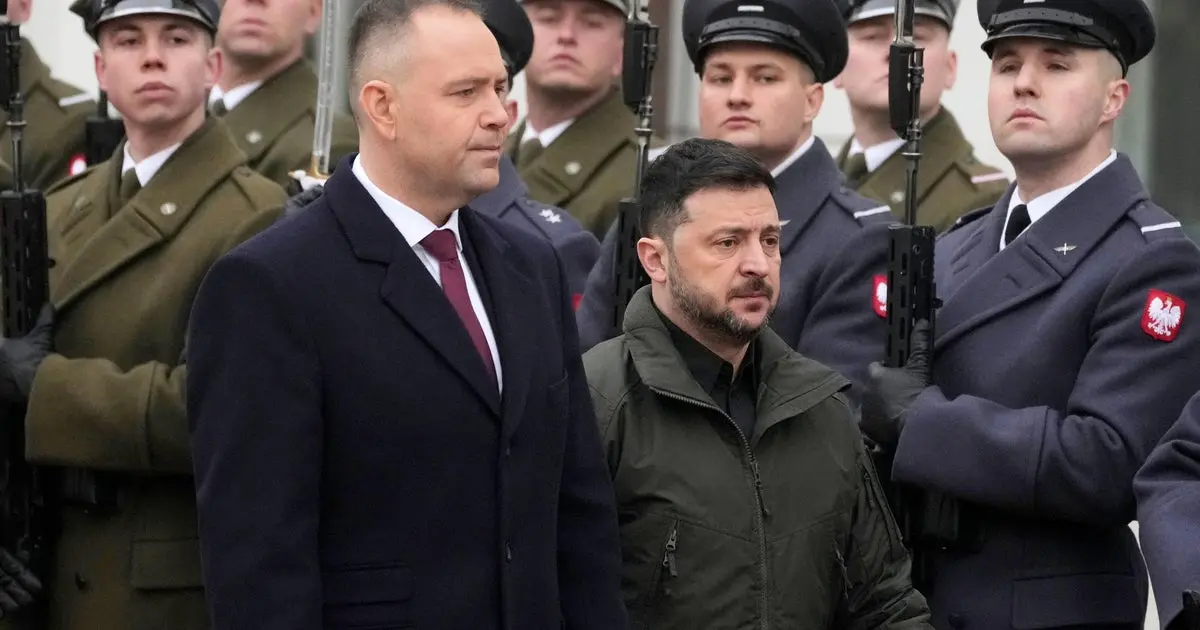
Ukrainian President Volodymyr Zelenskyy has returned Poland's highest state honor, the Order of the White Eagle, after Polish President Karol Nawrocki revoked the award amid a politically charged dispute over World War II history. The move marks a significant strain in the relationship between the two neighboring countries, which have been close allies since the start of Russia's full-scale invasion of Ukraine in 2022.
The controversy began in May 2025 when Zelenskyy issued a decree naming a unit of Ukraine's Special Operations Forces after the Ukrainian Insurgent Army (UPA), a paramilitary organization that operated during the 1940s and 1950s. The UPA fought for Ukrainian independence against both Nazi Germany and the Soviet Union, but it has also been accused by Poland of committing mass killings of Polish civilians, particularly in the regions of Volhynia and Eastern Galicia. In 2016, the Polish Parliament officially recognized these crimes as genocide.
President Nawrocki, a nationalist politician who has often used anti-Ukrainian rhetoric to bolster his domestic support, announced the revocation in a 13-minute address on social media. He stated that for the majority of Polish society, the UPA remains a formation responsible for cruel crimes against Polish citizens during World War II. The decision was met with widespread criticism in Ukraine, where many viewed it as an unfriendly act that plays into the hands of Russia.
In a social media post on X, Zelenskyy explained his decision to return the award, saying he believed it was meant for the Ukrainian people and their army. He accompanied the post with photos of the order and a postal receipt showing it was being mailed back to the Polish presidential office. Four Ukrainian officials, including the head of the Presidential Office Kyrylo Budanov, also announced they would return state honors previously awarded by Poland.
The dispute has deeper roots in the complex history between Ukraine and Poland. During World War II, the UPA and Polish underground forces engaged in a brutal conflict in the ethnically mixed territories of what is now western Ukraine. The violence resulted in the deaths of tens of thousands of Poles and Ukrainians, with each side accusing the other of atrocities. In recent years, both countries had made some progress toward reconciliation, including discussions on the exhumation of Polish victims buried in Ukrainian territory. A December 2025 meeting between Zelenskyy and Nawrocki in Warsaw had signaled a potential breakthrough, but the naming of the UPA unit reversed that progress.
The timing of the dispute is particularly delicate. Poland has been one of Ukraine's most steadfast supporters since the Russian invasion, hosting millions of Ukrainian refugees and serving as a key logistical hub for Western military aid. However, the war has also fueled nationalist sentiments in both countries. In Poland, some politicians have exploited anti-Ukrainian attitudes for electoral gain, even as Ukrainian workers contribute significantly to the Polish economy. President Nawrocki's decision to revoke the honor is widely seen as part of his broader strategy to appeal to nationalist voters ahead of upcoming elections.
Ukrainian officials have expressed concern that the dispute could undermine the united front against Russia. Kyrylo Budanov described Nawrocki's decision as a gift to Moscow, which would certainly use it to divide the two countries. Arseniy Yatsenyuk, a former prime minister of Ukraine, criticized Zelenskyy's decision to return the award, arguing that one harmful and incorrect decision by the Polish president should not be corrected by further incorrect decisions from Ukraine.
Polish Prime Minister Donald Tusk, a political rival of Nawrocki, urged both leaders to tone down emotions and avoid stoking tensions. In a social media post, Tusk wrote that the front line in the war against Russia runs elsewhere, and that the row between Poland and Ukraine only delights Russian President Vladimir Putin and shocks their allies. The dispute comes just ahead of a major international conference on Ukraine's post-war reconstruction scheduled to be held in Poland, which Zelenskyy had been expected to attend. The current tensions could affect the atmosphere of that event.
The Ukrainian Insurgent Army has long been a contentious symbol in Ukrainian-Polish relations. While many Ukrainians view the UPA as freedom fighters who resisted both Nazi and Soviet oppression, Poles predominantly remember them as perpetrators of ethnic cleansing. During the Volhynia massacre of 1943-1944, UPA units carried out coordinated attacks on Polish villages, resulting in an estimated 60,000 to 120,000 Polish deaths. In retaliation, Polish underground forces attacked Ukrainian civilians, leading to further casualties. The legacy of this violence remains deeply painful on both sides.
Despite the current friction, both countries have expressed a desire to maintain their strategic partnership. Ukraine is heavily dependent on Western military and financial aid, and Poland plays a crucial role in facilitating that support. Poland, for its part, views Ukraine's independence as vital to its own security, given the threat posed by an aggressive Russia. The two nations share a long border and have deep historical ties, both positive and negative.
The dispute over the UPA naming also highlights broader challenges in Ukraine's efforts to build a national identity while waging war. Ukraine has been reclaiming and reinterpreting its history, including figures and organizations that were previously suppressed during Soviet times. The UPA is one such example, and its rehabilitation is seen by many Ukrainians as a necessary step in asserting their sovereignty. However, this process sometimes clashes with the historical narratives of neighboring countries.
Looking ahead, the ability of Ukrainian and Polish leaders to manage this dispute will be closely watched by allies in NATO and the European Union. Both countries are key members of the Western alliance system, and any public rift could be exploited by Russian disinformation campaigns. The international community has urged restraint and a focus on shared interests. The United States and other allies have emphasized the importance of unity in countering Russian aggression.
In his social media post, Zelenskyy expressed pride in the Ukrainian people and every Ukrainian warrior, reaffirming Ukraine's gratitude for Poland's support while stating that Ukraine remains open to resolving historical differences. He concluded by saying he believes the future will confirm the respect Ukrainians deserve. Whether that future includes a mended alliance with Poland remains uncertain, as both nations navigate the intersection of memory, politics, and war.
Source: Cbsnews News