

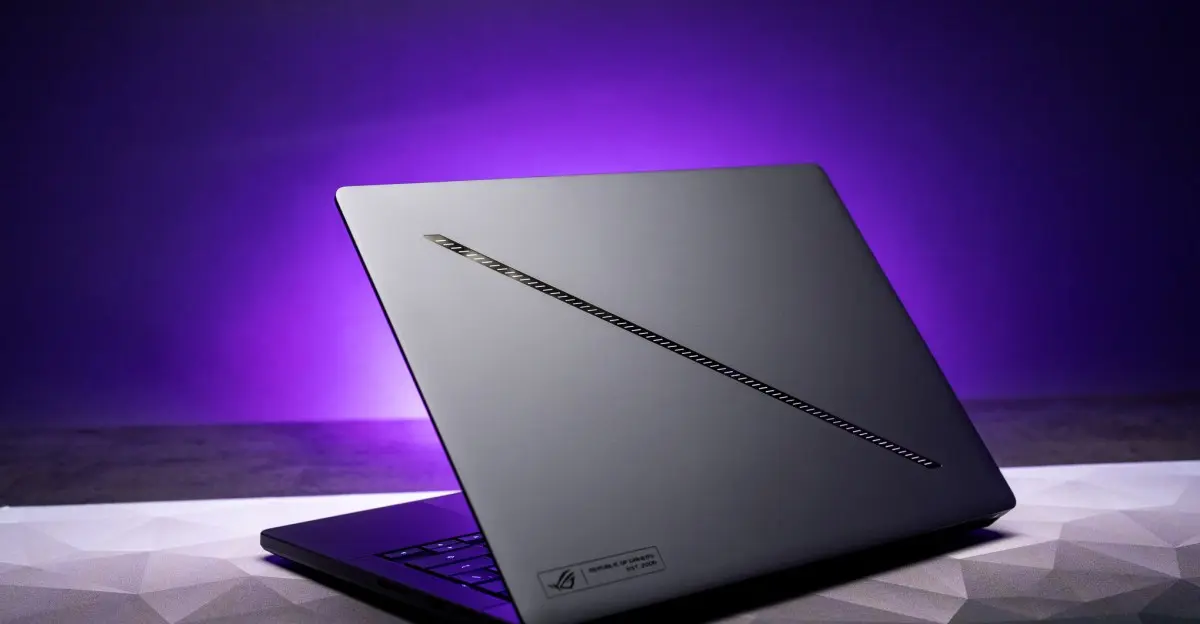
The Asus ROG Zephyrus G14 has been a favorite among laptop enthusiasts since its debut in 2020, earning praise for blending portability with gaming and creative performance. The 2026 model, now powered by Intel's new Panther Lake processors and featuring Nvidia's GeForce RTX 5070 Ti, aims to raise the bar even higher. It boasts a 14-inch 2880x1800 OLED display running at 120Hz, a full-size SD card slot (a long-awaited addition), and a battery that can last over 10 hours under light use. Yet for all its improvements, the G14 faces a daunting hurdle: a price tag that has soared to $3,600 for the reviewed configuration, making it nearly $1,000 more than its immediate predecessor.
A Familiar Design with Refined Details
The 2026 G14 retains the sleek, minimalist aesthetic of the 2024 redesign. The chassis is crafted from aluminum, weighing just 3.48 pounds and measuring 0.63 to 0.72 inches thick—comparable to a 14-inch MacBook Pro. Asus has made subtle tweaks: the animated slash lighting on the lid now features more LED segments, and the bottom vents have switched from rectangular slots to circular holes for a cleaner look. The keyboard remains one of the best on a Windows laptop, with deep key travel and a satisfying tactile feel, second only to Lenovo ThinkPads. The large mechanical trackpad provides a firm, responsive click, though it doesn't support clicking in all four corners like some competitors.
The port selection is generous and slightly upgraded. On the left side, users find Asus's proprietary power connector, HDMI 2.1, two USB-A 3.2 Gen 2 ports, one Thunderbolt 4 USB-C (with DisplayPort and Power Delivery), and a 3.5mm audio jack. The right side adds another USB-C 3.2 Gen 2 port, a USB-A port, and—importantly—a full-size SDXC UHS-II card slot, a feature photographers and videographers have long demanded. Previous G14 models only offered microSD, which is slower and less convenient. The 1080p IR webcam delivers adequate quality for video calls but struggles in low light, earning a mediocre grade.
Performance: A Work and Gaming Powerhouse
Under the hood, the review unit packs a 16-core Intel Core Ultra 9 386H CPU (part of the Panther Lake family) paired with an Nvidia GeForce RTX 5070 Ti laptop GPU (5,888 CUDA cores), 32GB of soldered LPDDR5X RAM, and a 1TB NVMe SSD. This combination delivers outstanding performance for both productivity and gaming. In synthetic benchmarks, the G14 scores 2,909 in Geekbench 6 single-core and 17,145 in multi-core, edging past the previous AMD-based model. In Cinebench 2026, it achieves 517 in single-core and 4,645 in multi-core. GPU-intensive tasks fare equally well: the 3DMark Time Spy graphics score of 14,941 is impressive for a 14-inch chassis with a 130W total GPU power (TGP), up from 120W on last year's model.
Real-world usage confirms these numbers. Editing 50-megapixel RAW photos in Adobe Lightroom Classic feels snappy, even on battery power with the fans barely spinning. The laptop handles heavy processing—such as batch applying edits to hundreds of images—without significant slowdowns. Video editing in Premiere Pro is also smooth: a 4K export completed in 4 minutes and 20 seconds, faster than the last-gen AMD version (6 minutes 25 seconds) but slower than Apple's M5 MacBook Pro (2 minutes 47 seconds). The G14's SSD, while fast, is about 12% slower than its predecessor in sustained reads (6,154 MB/s vs. 6,964 MB/s), though this is unlikely to affect most users.
Gaming is where the G14 truly shines. In Battlefield 6, it delivers 65–70 fps at native 2880x1800 resolution on the High preset without DLSS. Helldivers 2, which lacks DLSS, runs at 80–90 fps on similar settings. Marathon comfortably hits 70 fps at High with DLSS set to Quality. The laptop does get warm under load—especially the bottom—but the keyboard deck remains tolerable, with only a slight warmth on the left palm rest. The fans are audible in Performance mode but not intrusive; switching to Turbo mode boosts frame rates by up to 10 fps but makes the fans loud enough to warrant headphones.
Battery Life: A Giant Leap Forward
One of the most significant upgrades in the 2026 G14 is battery life, thanks to Intel's efficient Panther Lake architecture. In the Verge's battery rundown test (continuous web browsing and video playback), the new G14 lasted over 17 hours—more than double the 8.5 hours of the 2025 AMD model. In real-world use, the 73Wh battery provides a full workday: over 10 hours of mixed usage with dozens of Chrome tabs, Slack, music streaming, and occasional photo editing at 80% screen brightness. When pushing the discrete GPU harder, battery life drops to around five to six hours, which is still competitive for a gaming laptop.
The Price Problem
Despite these strengths, the G14's pricing is a major sticking point. The base configuration with an RTX 5070 Ti, 16GB RAM, and 1TB storage starts at $3,450; the reviewed unit with 32GB RAM costs $3,600. This is roughly $1,000 more than a nearly identical 2025 model with an AMD Ryzen AI 9 HX 370 and the same GPU, RAM, and storage. The price hike stems from several factors: the new Intel chip, global memory shortages (dubbed 'RAMageddon'), and a general trend of rising costs for premium Windows laptops. Asus has kept last year's AMD models in the lineup as cheaper alternatives, but they may not remain at their current prices for long.
For $3,600, buyers face tough competition. A 14-inch M5 MacBook Pro at the same price offers superior CPU performance and longer battery life, but cannot run Windows games natively. A larger gaming laptop like the Asus ROG Strix Scar 16, priced at $3,300, delivers higher frame rates thanks to a bigger 240Hz Mini LED screen and more powerful GPU options, but sacrifices portability. Alternatively, one could buy an entry-level MacBook Pro and a PlayStation 5 Pro or Steam Deck for the same money, creating a two-device solution that may better suit mixed work and gaming needs.
The Zephyrus G14's value proposition has eroded. When it launched in 2020, a well-configured model cost around $1,400. Now, the cheapest new Intel version is more than double that. The laptop itself is excellent—combining a gorgeous OLED display, great speakers, long battery life, and powerful components in a portable chassis. But the $1,000 premium over last year's model is hard to swallow, especially when that last-gen version still performs admirably. Asus may argue that the new features—Panther Lake efficiency, a brighter screen (500 nits SDR, up to 1,100 nits HDR), the SD card slot, and Thunderbolt 4—justify the price, but for many users, those upgrades aren't worth the extra cost.
In a market where Windows laptops are becoming increasingly expensive, the G14 stands as a luxury item. It remains the go-to choice for those who demand a single device for work, creative tasks, and gaming without compromise on portability. But for the price of this one laptop, you could build a desktop PC and buy a budget laptop, or invest in two specialized devices that each outperform the G14 in their respective domains. The 2026 Asus ROG Zephyrus G14 is a technical achievement, but its pricing may keep it out of reach for many who would love to own it.
Source: The Verge News