

As robotaxi services steadily pop up in cities around the world, self-driving technology in commercially available passenger cars has been slow to catch up. While companies like Waymo and Cruise have been deploying fully autonomous taxis in select urban areas, the average car buyer still has limited access to advanced driver assistance features beyond adaptive cruise control and lane keeping. Stellantis, the parent company of Jeep, Ram, Dodge, Fiat, and several other automotive brands, is the latest major automaker to announce plans to bring more advanced automated driving capabilities to its vehicles.
The company announced a new strategic technology partnership with UK-based autonomous driving startup Wayve. This collaboration aims to integrate Wayve's AI Driver system into Stellantis' STLA AutoDrive platform, an open and modular architecture designed to support various levels of driving automation. The integration could eventually equip some Stellantis vehicles with hands-free, supervised driving technology that operates on both city streets and highways, similar to systems already available on Tesla and Rivian vehicles. Stellantis and Wayve describe this first iteration as a Level 2++ system, meaning drivers would still need to remain attentive and ready to take control at any moment.
The Technology Behind Wayve's AI Driver
Wayve's AI Driver is fundamentally different from many competing autonomous driving systems. Instead of relying on high-definition maps and predefined routes, Wayve uses a camera-based system powered by machine learning to understand and navigate the environment. The software learns from real-world driving data, allowing it to handle novel situations without the need for constant map updates. This vehicle-agnostic approach theoretically allows the system to be adapted to any type of vehicle, from passenger cars to delivery vans, without requiring expensive hardware modifications.
Founded in 2017 by Alex Kendall and Alex Haque, Wayve has rapidly gained recognition for its innovative approach to autonomous driving. The company's focus on end-to-end deep learning — where cameras perceive the road and the neural network directly outputs driving commands — has attracted significant investment. Earlier this year, Wayve closed a $1.2 billion Series D investment round from a range of investors, including SoftBank, Microsoft, Nvidia, and Uber. Just last month, Advanced Micro Devices (AMD), Arm, and Qualcomm Ventures announced a separate $60 million investment, underscoring the industry's confidence in Wayve's technology.
Uber's investment specifically supports the development of Wayve-powered robotaxis on the Uber platform. The companies plan to launch their first service in London in 2026, with intentions to expand across multiple markets. This dual-track strategy — licensing the AI Driver to automakers for consumer vehicles while simultaneously developing robotaxi services — gives Wayve a unique position in the autonomous driving ecosystem.
Partnership and Implementation Timeline
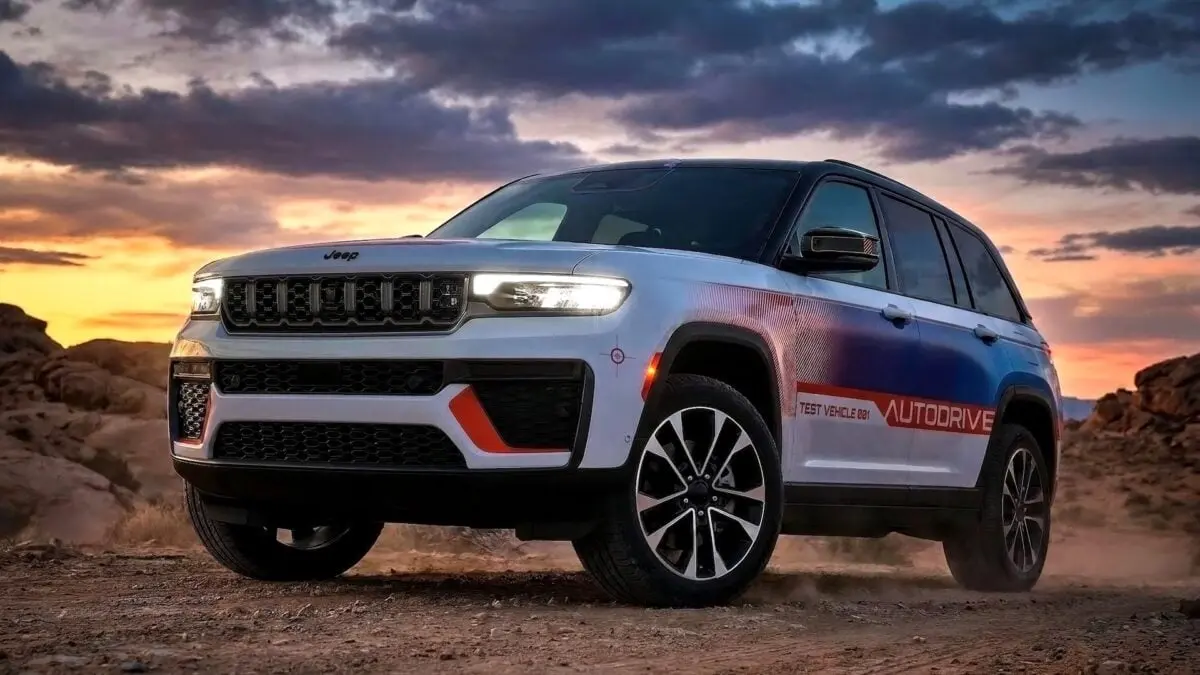
Stellantis and Wayve have already demonstrated the speed of their collaboration. According to the press release, the teams developed a prototype on Stellantis' Jeep Cherokee platform in less than two months, showcasing the adaptability of Wayve's system. The first vehicle integration is planned for North America in 2028, though Stellantis has not specified which brands or models will receive the technology first. The company's STLA AutoDrive platform is designed to be scalable across multiple vehicle architectures, so the system could appear on a wide range of vehicles from different brands.
While Stellantis's initial focus is on Level 2++ supervised driving, the platform can support more advanced automated driving features as regulations and customer expectations evolve. The partnership agreement includes provisions for future upgrades, potentially allowing Stellantis vehicles to reach Level 3 or even Level 4 autonomy under specific conditions. This gradual approach mirrors the strategies of other automakers who are cautiously rolling out increasingly capable systems as the technology matures and public trust grows.
Competitive Landscape and Industry Implications
The announcement places Stellantis in competition with other automakers that have already deployed or announced similar systems. Tesla's Full Self-Driving (FSD) capability, Rivian's Highway Assist, and Ford's BlueCruise all offer hands-free driving on pre-mapped highways. However, Wayve's system aims to differentiate itself by operating on both highways and city streets without requiring detailed mapping. Nissan also signed on to use Wayve's technology in December 2024, announcing that it would integrate the AI Driver into a broad range of its cars starting in 2027.
For Stellantis, the partnership represents a strategic bet on a relatively young startup rather than building proprietary technology in-house. The company's STLA Brain and STLA AutoDrive platforms are designed to be open and flexible, allowing Stellantis to quickly adopt external innovations. This could prove advantageous in a rapidly evolving industry where staying ahead of the curve is crucial. The partnership also diversifies Stellantis's approach to autonomy; the company has previously invested in other autonomous driving firms and collaborated with BMW on automated driving features.
Historical Context of Autonomous Driving Development
The autonomous driving industry has gone through several cycles of hype and disillusionment since the DARPA Grand Challenges in the early 2000s. The last decade saw a rush of investments and ambitious timelines, many of which failed to materialize. Companies like Uber's Advanced Technologies Group, Argo AI, and others were acquired or shut down after burning through billions of dollars. However, the survivors — Waymo, Cruise, Baidu, and now Wayve — are slowly bringing products to market.
The robotaxi sector, despite its promise, has proven to be capital-intensive and difficult to scale. Waymo's expansion into multiple cities has been slower than expected, and Cruise faced regulatory challenges after an accident. Meanwhile, the approach of embedding self-driving features into consumer vehicles — the path Stellantis is taking — offers a more gradual revenue model and allows automakers to amortize development costs over millions of vehicles sold. Level 2++ systems, while not fully autonomous, provide immediate value to drivers by reducing fatigue on long trips and improving safety.
Wayve's method of learning from real-world data also addresses a key limitation of traditional autonomy stacks: handling corner cases. By training a neural network on massive datasets of human driving, the system can develop a generalized understanding of traffic patterns, road markings, and even unexpected obstacles like pedestrians or animals. This approach is analogous to how large language models like GPT learn language patterns — the model doesn't memorize every possible sentence but learns to generate coherent responses based on its training.
Technical Details of Wayve's AI Driver
The Wayve AI Driver uses a combination of cameras and machine learning algorithms to perform the entire driving task, from perception to planning to control. Unlike many competitors that rely on lidar, radar, and ultrasonic sensors, Wayve's system is primarily vision-based, which reduces hardware costs and simplifies integration. The company's website states that the system can be trained on data from any vehicle, making it suitable for fleet deployments across diverse platforms.
Stellantis's STLA AutoDrive platform is built on a scalable electronic architecture that allows for over-the-air updates and continuous improvement. By integrating Wayve's software, Stellantis can offer customers new features and performance enhancements throughout the vehicle's lifecycle. This approach aligns with the broader automotive trend of treating vehicles as software platforms that can be upgraded after purchase, similar to how Tesla regularly updates its vehicles' firmware.
One of the key challenges for any autonomous driving system is ensuring safety at scale. Wayve has not published detailed safety data, but the company claims its system is designed to meet or exceed industry standards for automotive reliability. The partnership with Stellantis includes rigorous testing and validation processes, and both companies emphasized that safety is the top priority. The Level 2++ designation ensures that the driver remains legally responsible for the vehicle, which reduces regulatory complexity while still offering meaningful convenience.
Future Outlook and Potential Challenges
The road to widespread adoption of self-driving technology is still long. Despite significant progress, fully autonomous vehicles that can operate in all conditions remain elusive. Weather, construction zones, and unusual traffic patterns continue to pose challenges for even the most advanced systems. Wayve's vision-based approach, while innovative, may struggle in scenarios where cameras are blind — such as heavy fog, snow, or direct sunlight. Lidar and radar are more robust in such conditions, which is why many companies use a sensor fusion approach.
Nevertheless, the Stellantis-Wayve partnership represents a vote of confidence in the vision-only pathway. If successful, it could accelerate the deployment of advanced driver assistance features across millions of vehicles from one of the world's largest automakers. For consumers, the immediate benefit will be reduced stress on daily commutes and long road trips. For Stellantis, it offers a competitive edge in a market where tech features increasingly influence purchasing decisions. And for Wayve, the partnership provides a massive data collection platform and a route to scale that few startups have achieved.
As the autonomous driving industry matures, collaborations like this one are likely to become more common. Automakers bring manufacturing scale, dealer networks, and regulatory relationships, while tech startups bring agility and cutting-edge algorithms. The combination could finally bring self-driving technology from the realm of science fiction to everyday reality. Stellantis's customers can look forward to a future where their Jeep, Ram, or Dodge moves them down the highway while they supervise from the driver's seat — but not yet with full attention required.
Source: Gizmodo News