
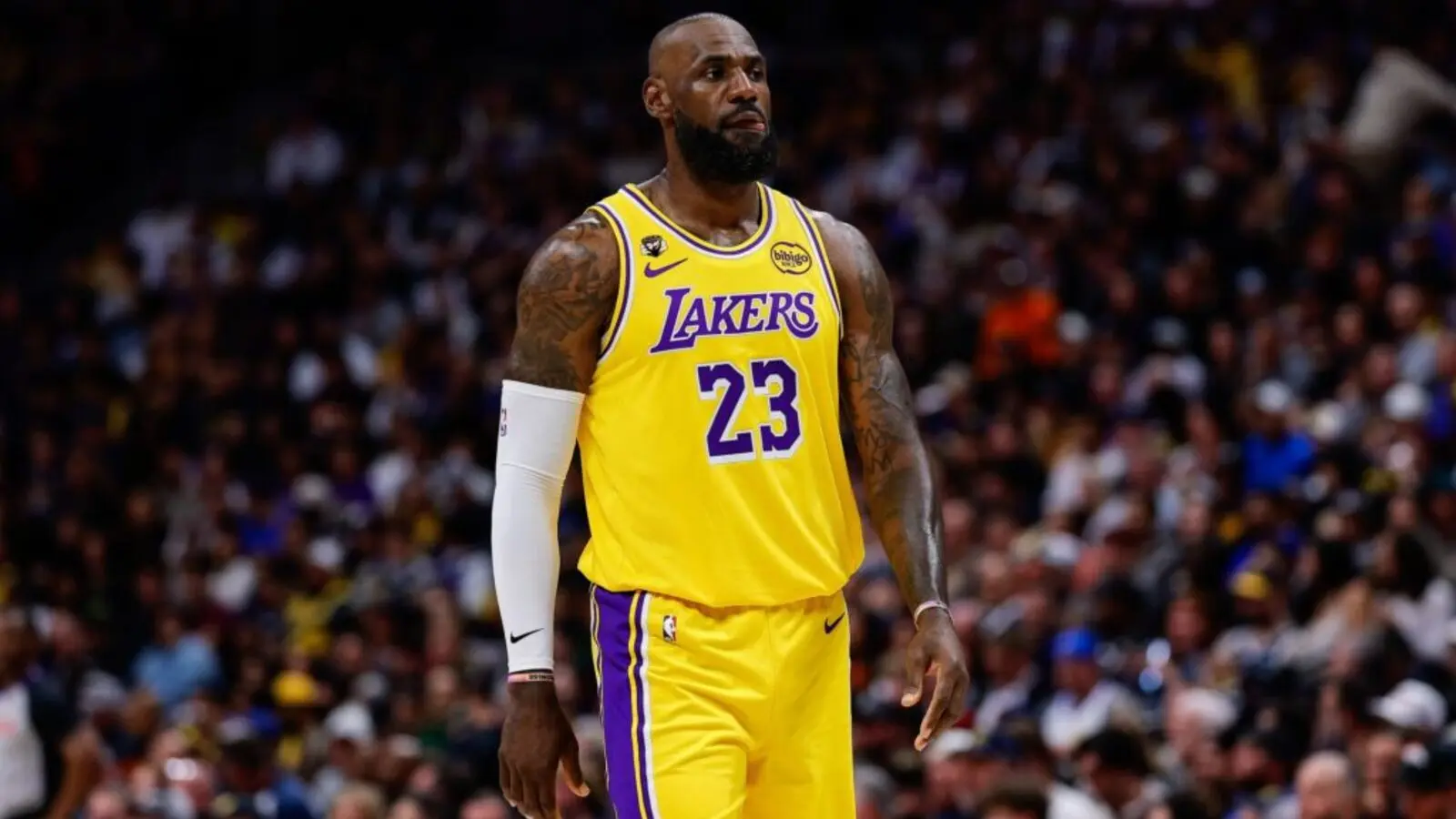
LeBron James' agent Rich Paul has publicly refuted recent reports suggesting the Lakers superstar felt disgruntled and underappreciated by the organization following an incident involving a game ball. Speaking on the Game Over podcast with Max Kellerman, Paul made it clear that the narrative of LeBron being upset over a signed basketball was overblown and inaccurate.
"I think people are reading too much into the signed ball," Paul said. "I never in my life seen LeBron get disgruntled about a basketball or some type of accolade." He added, "I can't tell you how many Player of the Week, Player of the Month, MVPs, Gold Medals, trophies, dating back to 1992. This man got so many awards. Another basketball?"
The controversy stems from an ESPN report by Dave McMenamin detailing an incident after the Lakers' March 31 win over the Cleveland Cavaliers. According to the report, Lakers general manager Rob Pelinka entered the locker room with the game ball and presented it to head coach JJ Redick to commemorate his 100th career win, rather than to LeBron James. That same game, LeBron had become the winningest player in NBA history, securing his 1,229th career victory (regular season and playoffs combined).
McMenamin reported that LeBron saw this as another example of the organization taking him for granted and shifting its priorities away from him. According to the report, LeBron left the locker room without changing, visibly unhappy. However, Paul's comments suggest that such an interpretation misrepresents LeBron's character and his relationship with the Lakers.
"I can tell you this: LeBron has never been the type to complain about who gets what ball or who gets what trophy," Paul continued. "He's focused on winning and on the team. If he was disgruntled, believe me, you would know it." Paul, who has represented LeBron since the start of his career and is one of his closest confidants, acknowledged that even he doesn't have a definitive read on what LeBron felt in that specific moment. "But I know what I know," Paul said. "And I know he's not going to let a ball determine his happiness."
The incident comes at a critical juncture for the Lakers. LeBron is an unrestricted free agent this summer, and his future with the franchise is uncertain. At 41 years old and entering his 23rd season (should he decide to return), LeBron has already accomplished nearly everything a player can achieve: four NBA championships, four MVP awards, an Olympic gold medal, and countless other records. Yet the question remains whether he will continue his career in Los Angeles or seek a new challenge elsewhere.
LeBron's Role and the Lakers' Dilemma
This season, LeBron had accepted a reduced role as the team's third option behind Anthony Davis and Austin Reaves. However, injuries to both players forced him back into the primary scoring role just before the playoffs. He responded by leading the Lakers past the Houston Rockets in the first round, demonstrating that he still possesses elite talent. But the team's overall struggles — injuries, inconsistent play, and front-office decisions — have led to questions about the organization's direction.
ESPN's Brian Windhorst, who has covered LeBron extensively throughout his career, highlighted the Lakers' predicament. "The Lakers have a problem," Windhorst said. "They don't want to lose LeBron James, and they don't want to lose his 21 points, seven rebounds and seven assists per game. But they don't want to pay $50 million for him. Because the rest of the league isn't going to come bidding $50 million to get LeBron."
Windhorst's analysis underscores the delicate balance the Lakers must strike. LeBron's on-court production remains elite, but his age and declining athleticism have prompted some to question whether he is worth a max contract. However, LeBron's off-court value — his marketing power, ticket sales, and global appeal — makes him an asset that transcends basketball statistics.
"The concept that he's just not as good anymore and that maybe he's only worth $30 million instead of $50 million [is] something LeBron James doesn't believe in," Windhorst added. "I don't expect him to accept that. And I'll tell you one thing: If you're the Lakers and you force LeBron to leave, he'll go somewhere else and play for less money."
The Historical Context of LeBron's Career
LeBron James' journey from a high school phenom in Akron, Ohio, to the NBA's all-time leading scorer and winningest player has been defined by resilience and excellence. He has played for three franchises: the Cleveland Cavaliers, Miami Heat, and Los Angeles Lakers. With each team, he brought championships and changed the culture. His ability to adapt his game over two decades is unprecedented. In his younger years, he was a scoring machine and explosive athlete. Now, he relies on basketball IQ, playmaking, and a reliable three-point shot.
The winningest player milestone is especially significant. To pass legends like Kareem Abdul-Jabbar, Robert Parish, and Tim Duncan in career wins requires not only longevity but sustained team success. LeBron has achieved this through a combination of talent, leadership, and an unmatched work ethic.
Yet even with such accolades, LeBron has faced moments of tension with organizations. His departure from Cleveland in 2010, the infamous "Decision," and his return in 2014 are well-documented. In Miami, he famously clashed with Pat Riley over team direction. In Los Angeles, he has dealt with front-office instability, coaching changes, and roster turnover. The game ball incident is just the latest chapter in a relationship that has had ups and downs.
What This Means for LeBron's Free Agency
As of now, LeBron has not publicly indicated his plans for the 2026-27 season. The NBA's free agency period begins in July, and the Lakers are expected to make a strong push to retain him. However, reports suggest that LeBron may consider leaving if he feels the organization does not value him appropriately. The game ball incident, while seemingly trivial, could be symbolic of deeper issues.
Several teams have reportedly expressed interest in signing LeBron should he become available. The Golden State Warriors, Miami Heat, and Cleveland Cavaliers have all been mentioned as potential suitors. LeBron has also expressed a desire to play with his son, Bronny James, who could enter the NBA in 2026. Although Bronny's draft stock is uncertain, the possibility of playing together remains a factor in LeBron's decision.
Rich Paul's comments are intended to de-escalate the tension and signal that LeBron is not demanding a trade or a change. But the underlying reality is that LeBron holds all the leverage. He can choose to opt in to his player option, sign a new contract, or explore free agency. The Lakers, for their part, must decide whether they are willing to meet his financial demands and build a contending roster around him.
Brian Windhorst's observation that LeBron might accept less money elsewhere is telling. If the Lakers lowball him, he could take a pay cut to join a contender — similar to what he did when he left the Heat in 2014. That would be a devastating blow to the Lakers' franchise, both competitively and financially.
Ultimately, the coming weeks will determine LeBron's legacy and the Lakers' future. For now, Rich Paul's insistence that LeBron is not disgruntled may be an attempt to control the narrative and keep negotiations calm. But actions speak louder than words, and LeBron's ultimate decision will reveal his true feelings about the organization and his place in the NBA pantheon.
Source: Yardbarker News