

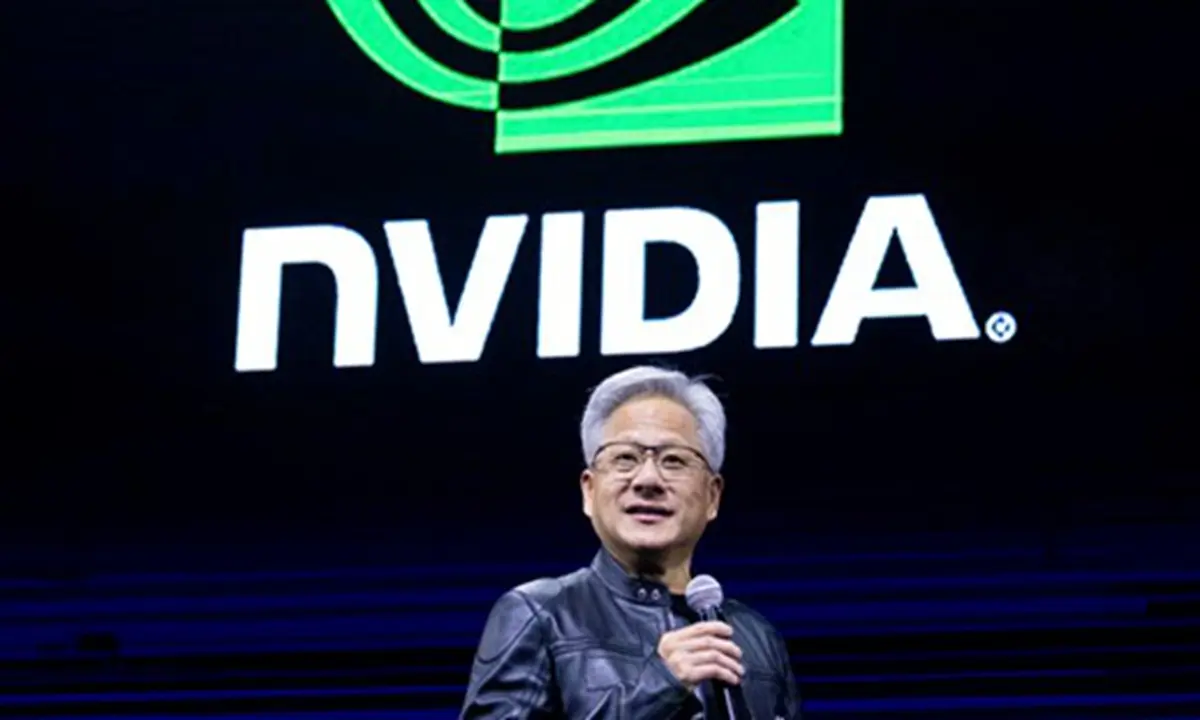
Nvidia CEO Jensen Huang delivered a video address during the opening ceremony of the fourth China International Supply Chain Expo (CISCE) held in Beijing on Monday, stating unequivocally that "China is one of the world's great centers of technology and industry." The statement underscored the company's long-standing recognition of China's pivotal role in the global tech landscape, particularly in artificial intelligence and supply chain innovation.
The CISCE, which began in 2023, has become a premier platform for discussing global supply chain resilience and collaboration. This year's event, running from November 28 to December 2, 2026, gathered industry leaders, policymakers, and technology giants to explore the interconnectedness of modern economies. Huang's participation via video highlighted the significance of the expo in fostering international cooperation.
In his address, Huang emphasized the critical nature of supply chains, calling them "one of the most important systems in the world." He elaborated: "Supply chains connect energy, factories, logistics companies, and customers. They connect the world. And every supply chain is also an information system." This perspective reflects Nvidia's core belief that data and computing power are the backbone of modern industrial ecosystems.
Huang's praise for China extended beyond supply chains to its talent pool. "China is one of the world's great centers of technology and industry. The engineers are excellent. Developers move fast, companies built at remarkable scale," he said, adding his congratulations for the expo: "Congratulations again on CISCE 2026. I wish you a very successful expo."
This is not the first time Huang has commended Chinese talent. In a May 2025 interview, he remarked, "The researchers, the AI scientists in China, they're world-class." Such endorsements from the man leading one of the most valuable technology companies in the world carry significant weight, especially amid ongoing geopolitical tensions over semiconductor exports.
At the CISCE, Nvidia showcased its cutting-edge AI technology through a 275-square-meter booth featuring an "AI Five-Layer Cake" display. This concept, first introduced at Nvidia's GTC 2024, represents the full stack of AI infrastructure: chips, systems, networking, platforms, and applications. The booth included 39 demonstrations covering the entire AI pipeline, from GPU hardware to advanced machine learning models and real-world use cases. Over 110 partners and ecosystem collaborators joined Nvidia to present what the company described as its largest AI ecosystem showcase in China.
The presence of Nvidia at CISCE is particularly noteworthy given the export restrictions on advanced AI chips to China imposed by the U.S. government starting in 2022. Despite these challenges, Nvidia has continued to engage with the Chinese market. The company has indicated plans to sell its H200 AI chips to China, though specific details have not been disclosed. The H200, based on the Hopper architecture, offers substantial improvements in memory bandwidth and AI performance compared to its predecessor, the H100, but still falls within allowable performance limits under current regulations.
Nvidia's history in China dates back to the early 2000s, with the company establishing research and development centers in major cities like Beijing, Shanghai, and Shenzhen. China accounts for a significant portion of Nvidia's revenue—approximately 20-25% in recent fiscal years, though this has fluctuated due to trade policies. The country's demand for AI accelerators, particularly for large language models and cloud computing, remains robust, driving Nvidia's strategy of offering compliant products while advocating for continued engagement.
The broader context of Huang's remarks reflects Nvidia's growth trajectory. Under his leadership, Nvidia transformed from a graphics card maker for gamers into the leading provider of AI computing platforms. The company's market capitalization surpassed $3 trillion in 2024, fueled by the explosion of generative AI. Huang, born in Taiwan and raised in Thailand and the United States, has often spoken about the global nature of technology and the importance of collaboration across borders.
China's technology sector has also evolved rapidly, with domestic companies like Huawei, Alibaba, and Baidu investing heavily in AI chips and software. The Chinese government's "Made in China 2025" initiative aims to achieve self-sufficiency in high-tech industries, including semiconductors. However, Huang's comments suggest that multinational collaboration remains essential for innovation. "Every supply chain is an information system," he noted, implying that data flows and computational resources must cross borders freely to maximize efficiency.
The CISCE serves as a microcosm of these dynamics. Exhibitors from over 50 countries showcased supply chain solutions in areas like digital economy, green energy, and intelligent manufacturing. Nvidia's participation signals its commitment to the Chinese market despite regulatory hurdles. Company representatives at the booth demonstrated how their AI platforms optimize supply chain logistics, predictive maintenance, and inventory management—a clear alignment with the expo's theme of "Connecting the World, Creating the Future."
Outside the expo, analysts have debated the impact of U.S. chip restrictions on China's AI development. Some argue that curbs accelerate China's push for indigenous innovation, as seen in the rise of domestic GPU startups like Moore Threads and Biren Technology. Others contend that China will continue to rely on Nvidia's ecosystem for training state-of-the-art models, given the software advantages of CUDA and related libraries. Huang's diplomatic tone at CISCE suggests Nvidia aims to maintain a delicate balance: complying with U.S. laws while nurturing relationships with Chinese partners.
In addition to the H200, Nvidia has previously offered the A800 and H800 chips tailored for the Chinese market—versions with reduced interconnect speeds to meet export controls. The company's latest offering, the H200, is expected to be widely adopted in Chinese data centers for inference and training workloads. The Global Times noted that Huang has repeatedly praised Chinese AI talent, indicating a long-term view of the region's potential.
The presence of over 110 partners at Nvidia's CISCE booth highlights the depth of its ecosystem in China. These include system integrators, cloud providers, software developers, and academic institutions. Demonstrations ranged from autonomous driving simulation to medical imaging analysis, underscoring the versatile applications of Nvidia's technology. The "AI Five-Layer Cake" metaphor resonated with attendees, many of whom appreciated the clear architecture that breaks down complex AI stacks into digestible layers.
Huang's video address also touched on the broader theme of globalization in technology. He noted that supply chains are inherently global, connecting people and resources across continents. This perspective contrasts with recent trends toward decoupling and nationalistic tech policies. By praising China at a state-backed expo, Huang implicitly advocates for continued international cooperation in technology development.
The history of CISCE itself is tied to China's efforts to stabilize global supply chains after disruptions from the COVID-19 pandemic and geopolitical tensions. China, as the world's largest manufacturer and a key link in semiconductor supply chains, plays a central role in these discussions. Nvidia's participation lends credibility and visibility to the event.
Looking ahead, Nvidia's strategy in China will likely evolve alongside U.S. export policies. The company's CEO has consistently emphasized the importance of the Chinese market not just for revenue, but for innovation. "The engineers are excellent," Huang repeated in his CISCE address. This recognition may pave the way for deeper collaborations on research and development, especially in areas where U.S. restrictions are less stringent, such as autonomous vehicles and healthcare AI.
In conclusion, Jensen Huang's address at CISCE 2026 reaffirmed Nvidia's appreciation for China's technological capabilities and its central role in global supply chains. The expo provided a platform for the company to showcase its latest AI innovations and to signal its ongoing commitment to the Chinese market, even as geopolitical currents create uncertainty. Nvidia's largest AI ecosystem display in China, featuring dozens of partners and demos, demonstrates that despite challenges, the company sees tremendous value in collaboration with Chinese engineers, developers, and enterprises.
Source: Globaltimes News