

For years, Michael Jordan chased more than championships. He was also chasing validation alongside the greats who defined the NBA before him. Long before the Chicago Bulls established their dynasty, Larry Bird and Magic Johnson had already transformed basketball, turning the NBA into a global spectacle. Jordan aimed to reach that level as well.
Michael's immense talent was never questioned. But until he climbed the NBA's highest mountain, comparisons with Bird and Magic always came with an asterisk. He knew the only way to get there was to win a championship.
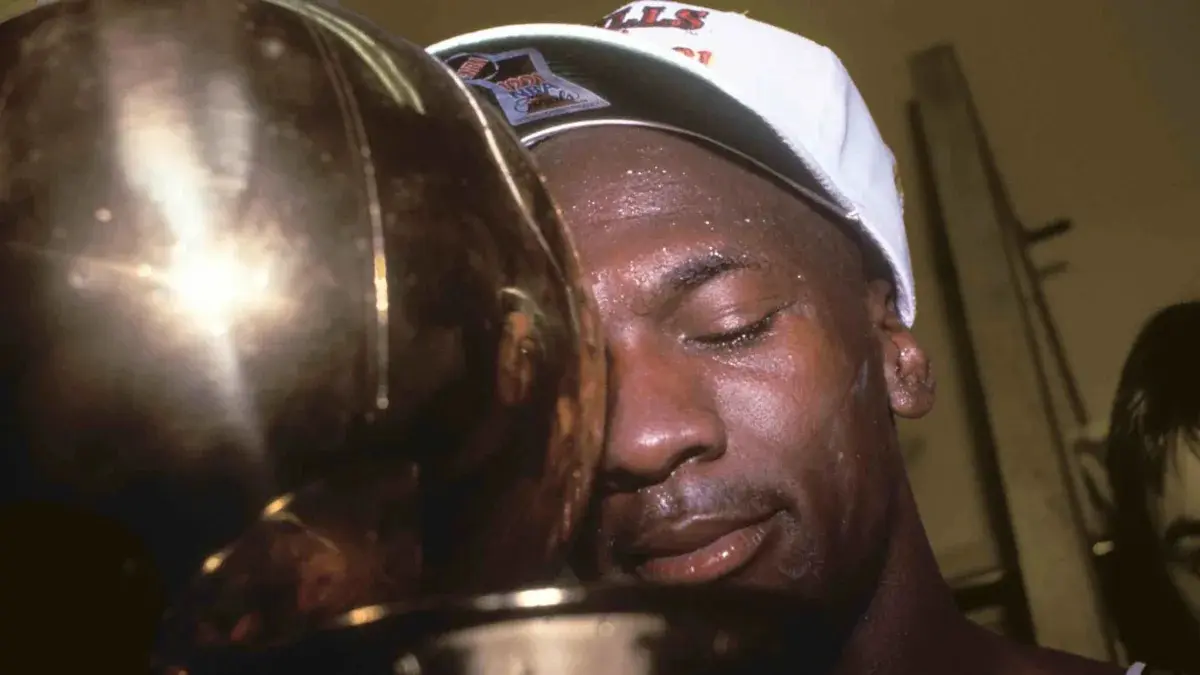
Jordan's time finally came in 1991 when the Bulls upstaged Johnson and the Los Angeles Lakers in the Finals. For the Bulls organization and its loyal fan base, it was a historic moment. But for MJ, it was more than just that.
In the acclaimed ESPN documentary, 'The Last Dance,' Jordan reflected on what that victory truly represented beyond finally becoming an NBA champion.
'At last, I fit somewhere in the category of Larry Bird and Magic Johnson,' Mike famously said.
This quote encapsulates the deep respect Jordan had for the two legends who preceded him. Bird and Magic were not just rivals; they were the architects of the modern NBA. Bird's Celtics and Johnson's Lakers had dominated the 1980s, reviving the league's popularity and setting a standard of excellence. Jordan knew that to be considered among them, he needed a ring. Winning that first title in 1991 erased any doubt about his place in the pantheon.
The 1991 Finals were a clash of eras. The Lakers, led by an aging but still brilliant Magic Johnson, were attempting to extend their dynasty. The Bulls, with Jordan at his peak and a emerging supporting cast including Scottie Pippen and Horace Grant, represented the new wave. After dropping the first game, Chicago stormed back to win four straight, clinching the title in Game 5 at the Forum. Jordan averaged 31.2 points, 11.4 assists, 6.6 rebounds, and 2.8 steals per game in the series, earning his first Finals MVP.
For Jordan, the victory was deeply personal. He had spent years battling the Detroit Pistons, who deployed the infamous 'Jordan Rules' to stop him. He had fallen short in the playoffs year after year. The burden of proving himself against the ghosts of Bird and Magic weighed heavily. When he finally held the Larry O'Brien Trophy, the relief and joy were palpable.
Magic Johnson, ever the gracious competitor, understood the significance. Rather than dwelling on the disappointment of losing, Magic embraced the moment. He showed class after their defeat and genuinely recognized that the league's future had officially arrived. In fact, Johnson was even honored that it was Jordan who beat him.
'It's a beautiful feeling,' Johnson said after Jordan and the Bulls beat them in the '91 Finals. 'If you're going to lose, you're going to lose to them, and I'm going to lose to Michael. That's how it should be.'
That sentiment speaks to the mutual respect between two icons. Magic had won five championships by that point and was a three-time MVP. He knew what it took to reach the summit. By passing the torch to Jordan, he acknowledged that the game was in good hands.
As the whole NBA world witnessed, Jordan went on to build a resume unlike any player before him. He won five more NBA titles and went unbeaten in the Finals, earned six Finals MVPs, five regular-season MVP awards, 10 scoring titles and two separate historic three-peats with the Bulls.
Yet MJ himself never viewed his unprecedented greatness as diminishing what Bird and Magic accomplished in their careers. In a candid admission, Jordan even explained why he could never consider himself greater than Larry Legend and Magic, regardless of what people think.
'I don't put myself above them,' Jordan told SLAM in 2013. 'I think that we're all on parallel ground here. You know, they educated me about a lot of things about the game, from a team standpoint. So, I can't put myself above… I mean, people try to, but we played in different eras.'
This humble perspective reveals a side of Jordan that fans seldom saw. His competitive ferocity was legendary, but he also understood that greatness is not a zero-sum game. Bird and Magic had paved the way for him, and he acknowledged their contributions even after surpassing them statistically.
Bird, for his part, always had high praise for Jordan. After watching Jordan's 63-point playoff game in 1986, Bird famously said, 'I think it's just God disguised as Michael Jordan.' The two also shared a memorable rivalry in the late 1980s, with Bird's Celtics and Jordan's Bulls clashing in the playoffs. Bird retired in 1992, and Jordan later honored him by wearing his shoes in a game.
Similarly, Jordan and Johnson remained close friends after the 1991 Finals. Johnson even served as a mentor to the young Bulls star, offering advice on how to handle fame and pressure. Their relationship transcended the court.
Jordan's first title was not just a personal milestone; it was a watershed moment for the NBA. It marked the end of the Lakers-Celtics dynasty era and the dawn of the Bulls dynasty. The league's popularity skyrocketed in the 1990s, thanks largely to Jordan's global appeal. His Airness became a cultural icon, transcending sports.
But throughout his career, Jordan never forgot the giants on whose shoulders he stood. His quote about fitting into the category of Bird and Magic is a testament to his respect for history. It also shows that, for all his competitiveness, Jordan remained grounded about his place in the game.
The 1991 championship opened the floodgates for Chicago. The Bulls would go on to win six titles in eight seasons, with Jordan as the unquestioned leader. Each subsequent title was special, but none carried the same emotional weight as the first. That initial breakthrough validated his entire basketball journey.
For younger fans who only know Jordan as the GOAT, it can be hard to imagine a time when he wasn't considered that. But before 1991, many analysts and fans argued that Bird and Johnson were superior because they had won. Jordan silenced those critics with the 1991 Finals performance.
In the years since, Jordan's legacy has only grown. His business empire, ownership of the Charlotte Hornets, and continued cultural relevance keep him in the spotlight. Yet he remains the same fierce competitor who once said, 'I want to be the best, and I'm willing to do whatever it takes.' That drive, combined with his respect for those who came before, defines his true greatness.
The story of Jordan's first title is also the story of how the NBA evolved. The league had never seen a player with Jordan's combination of athleticism, skill, and marketability. He was the perfect heir to Bird and Johnson, carrying their torch into a new era.
Magic Johnson's reaction to losing in 1991 was a masterclass in sportsmanship. Instead of making excuses or pointing fingers, he acknowledged Jordan's greatness and passed the baton. It was a moment that encapsulated the class of the 1980s stars.
Bird, too, had nothing but respect for Jordan. In a 1992 interview, Bird said, 'Michael Jordan is the greatest player I have ever seen. Period.' Coming from a legend like Bird, that endorsement carried immense weight.
Jordan's humility extended beyond his words. He often cited Bird and Johnson as his primary inspirations. He modeled his work ethic after theirs and studied their game tapes obsessively. He wanted to win like them, but also to be remembered like them.
The 1991 Finals were not just a victory for Jordan; they were a victory for the idea that hard work and perseverance pay off. Jordan had been in the league for seven years before winning his first title. He suffered through playoff exits, physical defenses, and constant criticism for being a scorer who couldn't lead his team to a championship. Winning it all silenced those doubters forever.
In conclusion, Michael Jordan's quote about fitting into the category of Bird and Magic reveals the depth of his character. He was not content with just being great; he wanted to be great alongside the greatest. His first title was the key that unlocked his legacy, and his humility in the face of that achievement is what makes him truly iconic.
For basketball fans, the 1991 Finals will always be remembered as the night a new king took the throne. But for Jordan, it was simply the moment he felt he finally belonged. And that feeling was worth more than any trophy.
Source: Yahoo Sports News