

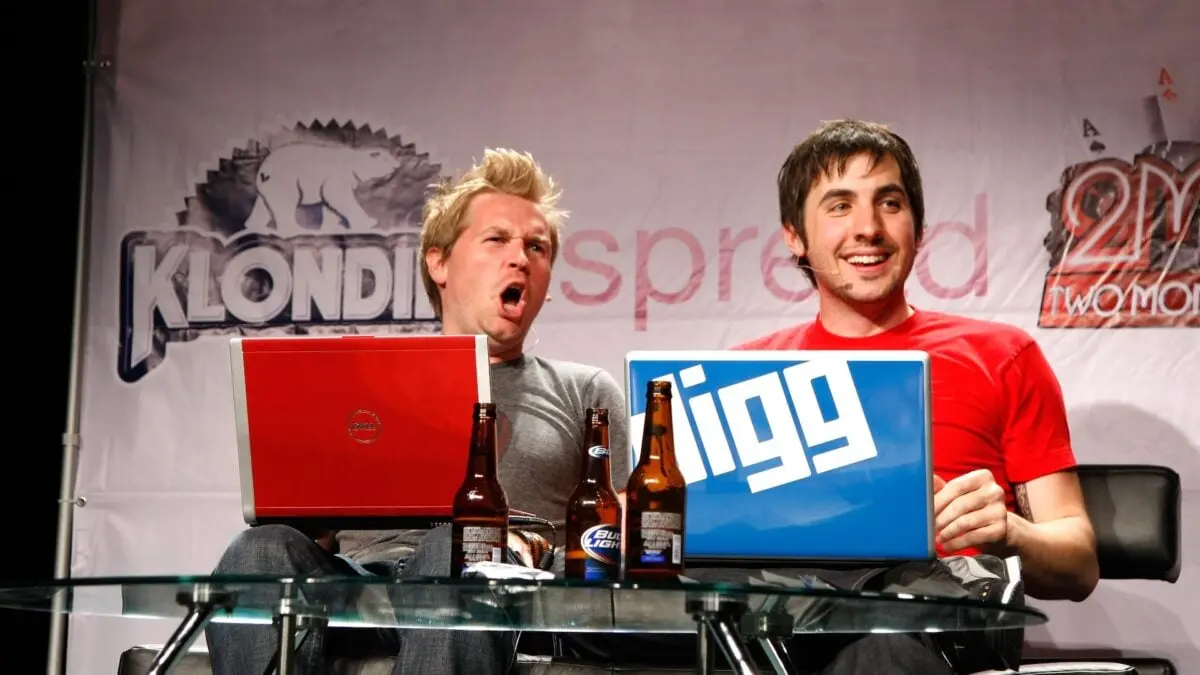
Digg, the once-mighty social news aggregator that defined the early social web, is back again. This time, it has re-emerged as a curated AI news outlet. The homepage currently displays a large “Hello Again” message, directing visitors to di.gg/ai, a new subdomain that aggregates links to AI papers, launches, discussions, and hot takes. Founder Kevin Rose, who reacquired the company last year alongside Reddit co-founder Alexis Ohanian, calls this the first of many planned verticals. “AI is the first vertical. More are coming,” Rose writes on the site.
A Brief History of Digg
To understand the significance of this relaunch, one must revisit Digg’s tumultuous history. Launched in 2004 by Kevin Rose, Digg was a pioneer of user-driven content aggregation. Users submitted links and voted them up or down, creating a democratic front page that often determined what the internet talked about. At its peak in the mid-2000s, Digg drove massive traffic to websites, coining the term “the Digg Effect”—a phenomenon where a link on Digg’s front page would cause a site’s servers to crash from the sudden influx of visitors. This was the precursor to what we now call “breaking the internet.”
Digg’s innovation extended beyond its voting system. It introduced the “Digg This” button, which publishers embedded directly on their articles. Major outlets like The New York Times adopted it, allowing casual users to effortlessly share stories. This simple widget democratized content distribution and foreshadowed the universal “Like” button that now dominates social media. Digg was a cultural force, shaping online discourse around technology, politics, and entertainment.
The Digg Effect and Its Downfall
Despite its early success, Digg’s downfall is a cautionary tale of product mismanagement. In 2010, Digg launched a controversial redesign known as Digg v4, which removed core features and integrated a new recommendation engine. The community revolted, and millions of users migrated to Reddit, which had been growing steadily as a more stable alternative. The exodus was swift and brutal. Digg never recovered its former prominence, despite multiple ownership changes and rebranding attempts. It was sold to Betaworks in 2012, then to LinkedIn co-founder Reid Hoffman and others, and later acquired again by Kevin Rose and Alexis Ohanian in 2025.
The False Start of 2026
The latest attempt began with great fanfare in January 2026. A press release announced that Digg would rival other platforms by “focusing on AI innovations designed to enhance the user experience and build a human-centered alternative.” The promise was transparency, reward for human effort, and enriching discussions. However, just two months later, the platform shut down and laid off most of its staff. The quick collapse raised questions about the viability of reviving an old brand in a crowded market dominated by Reddit, X, and now AI-native platforms.
The New AI-Focused Digg
Now, Digg has re-emerged in a more modest form. The new di.gg/ai is a barebones, beige newsfeed with a “Highlights” section at the top. Each story is accompanied by a cluster of circular images—these are X avatars of users who are discussing the article on that platform. According to TechCrunch, Digg pulls and analyzes popularity and sentiment data from X to curate its feed. This approach is distinctly different from its earlier user-vote model. Instead of relying on a community of active submitters and voters, Digg now uses algorithmic signals from another social network to determine what is trending in AI.
The design is undeniably elegant and minimalist. For a specific niche like AI news, the interface makes sense: it surfaces a feed of links, each supported by real-time social endorsement from X users. However, this iteration lacks the community-driven spirit that made Digg revolutionary. There are no user profiles, no commenting system on the aggregator itself, and no way for users to directly influence what appears. It feels more like a passive reading list than an interactive platform.
What This Means for the Future of News Aggregation
Digg’s pivot to AI news reflects a broader trend in the media landscape. As AI becomes a central topic in technology, business, and culture, specialized aggregators are emerging to filter the overwhelming flood of information. Platforms like The Rundown, Last Week in AI, and various newsletters compete for attention. Digg hopes to leverage its brand recognition and its founders’ experience to stand out.
Kevin Rose’s involvement adds credibility. He is a well-known tech entrepreneur and investor, having co-founded Revision3, Milk, and Google Ventures. Alexis Ohanian, co-founder of Reddit, brings deep expertise in community building. Together, they represent a team that understands both the history of social aggregation and the future of AI-driven content curation.
Yet the challenges are steep. Digg’s brand carries baggage—the infamous v4 redesign still haunts its legacy. Users who remember the glory days may be skeptical. Additionally, relying on X for curation signals raises questions about data dependence and the quality of signal. X’s algorithm itself is opaque and frequently criticized for amplifying divisive or low-quality content. By piggybacking on X’s trending topics, Digg might inherit those biases.
Can Digg Reclaim Its Throne?
The internet landscape has changed drastically since Digg’s heyday. Reddit now serves as the primary community-driven aggregator, with deep subcultures and sophisticated moderation. X is the real-time news firehouse. Platforms like TikTok and Instagram algorithmically feed users content. AI chatbots like ChatGPT are becoming search interfaces. In this environment, a niche AI aggregator might find an audience, but it is unlikely to achieve the mass adoption that Digg once enjoyed.
The new Digg does not aim to replace Reddit or X. Instead, it positions itself as a filter for the AI domain—a curated guide to what matters. If successful, it could expand to other verticals, as Rose promises. The simplicity of the design is its strength: no clutter, no user accounts required, just a feed of links with social proof. For professionals and enthusiasts who want a quick daily briefing on AI developments, di.gg/ai is a convenient resource.
Ultimately, Digg’s latest incarnation is a reminder of how the internet’s attention economy has evolved. The original Digg was about community discovery—people surfacing interesting content from obscurity. The new Digg is about algorithmic curation—pulling signals from an existing social graph to surface already popular content. It feels less like a revolution and more like an elegant RSS reader with social validation.
Time will tell whether this iteration sticks or becomes another chapter in Digg’s long history of comebacks. For now, it offers a clean, focused window into the chaotic world of AI news, powered by the very social signals that define our posts modern engagement landscape. The story of Digg continues, written in beige pixels and X avatars, quietly aggregating the future of information.
Source: Gizmodo News