

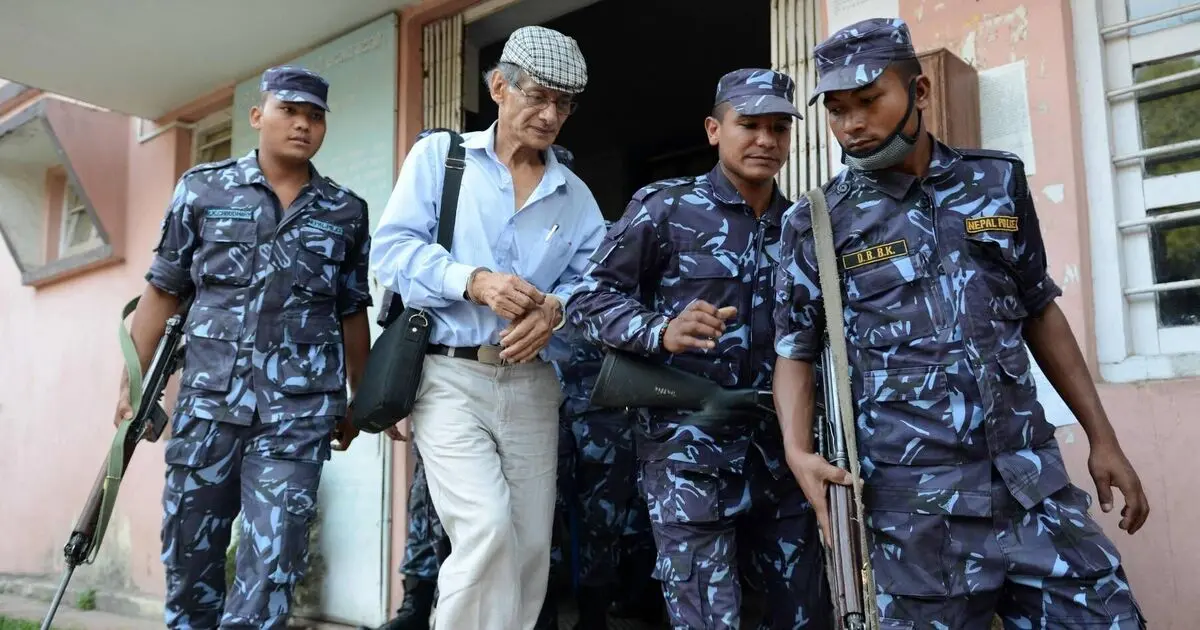
Charles Sobhraj, the depraved serial killer known as 'The Serpent', who murdered at least 20 backpackers travelling across Asia during the 1970s, now walks free. He was released from a Nepalese prison in 2022 after serving just 20 years for two murders. Recent footage from a Channel 4 documentary shows the 82-year-old casually wandering through London, stopping to photograph Big Ben. Sobhraj once bragged, 'I was like a shadow,' claiming that elusiveness was his key to evading capture for so long.
Sobhraj's reign of terror stretched across Thailand, India, and Nepal, where he poisoned, robbed, and murdered holidaymakers, luring them with his charisma and charm. Born in Saigon to a Vietnamese mother and an Indian father, he displayed criminal behavior as a teenager in France. His first jail term came in 1963 in Paris for burglary, according to historical records. Over the years, he became a master of disguise and manipulation, shifting between high society and criminal underworlds.
One of his earliest victims was Teresa Knowlton, a Seattle tourist found drowned in a tidal pool in the Gulf of Thailand in 1975, wearing a floral bikini. This earned him the moniker 'Bikini Killer' from the Bangkok Post, as many female victims were discovered dead in swimwear. Other victims included Dutch students Henk Bintanja and Cornelia Hemker, Turkish national Vitali Hakim, and his French girlfriend Charmayne Carrou, who was searching for her partner. Sobhraj's methods included poisoning, drowning, and setting fire to his victims.
His criminal career began in earnest after he fled France with his pregnant wife, Chantal Compagnon, in 1970. They traveled through Eastern Europe, preying on holidaymakers and forging documents. Their daughter Usha was born in Mumbai, while Sobhraj ran a car theft and smuggling operation. He was jailed again in 1973 for orchestrating an armed robbery targeting precious stones at Hotel Ashoka in India. However, he escaped by feigning illness, a tactic he used repeatedly, though he was swiftly recaptured. His father secured bail, and Sobhraj relocated to Kabul, where he was imprisoned yet again for preying on tourists.
Once more, Sobhraj faked sickness and drugged a hospital guard to escape, fleeing to Iran and abandoning his young family, who returned to France. He spent the next two years on the run across Eastern Europe and the Middle East before reuniting with his half-brother Andre in Istanbul. The duo were arrested in Greece, but Sobhraj switched identities with his brother, leaving Andre to languish in a Turkish jail for 18 years. This marked the turning point for The Serpent, escalating his crimes to outright murder.
He posed as a drug dealer to lure Western tourists, robbing them and murdering those he feared might betray him. Among his victims was Connie Jo Bronzich, whose murder in December 1975 led to his eventual conviction in Nepal. Sobhraj also killed Laurent Carriere in the same month. Despite Thai authorities issuing an arrest warrant in 1976, Sobhraj avoided extradition to Thailand and remains unprosecuted for crimes there. He was finally captured in Nepal in 2003 after being identified by a journalist at a casino. He was given a life sentence for Bronzich's murder in 2004, later extended by 20 years for Carriere's murder.
Sobhraj's accomplices included Marie-Andree Leclerc, a Canadian woman who became obsessed with him. She was arrested in India in 1976 and sentenced to 12 years, but successfully appealed and was released on condition she stayed in India. She wrote a memoir titled Je Reviens (I will be back), denying romantic feelings for Sobhraj. She died of ovarian cancer in 1984 at age 38. Another key figure was Dutch diplomat Herman Knippenberg, who built the case against Sobhraj while investigating missing Dutch tourists. He entered Sobhraj's flat to collect evidence and compiled files that eventually helped bring the killer to justice. Knippenberg currently lives in New Zealand.
The case of Charles Sobhraj remains one of the most chilling in true crime history. His ability to evade capture for years, manipulate those around him, and continue his murder spree despite multiple arrests highlights the challenges of international law enforcement in the 1970s. Now free and openly walking the streets of London, Sobhraj's story continues to fascinate and horrify. He has never shown remorse, and his only regret seems to be getting caught. The documentary 'The Real Serpent: Investigating a Serial Killer' provides a terrifying glimpse into his mind and the terrible legacy he left behind.
Source: Express.co.uk News