

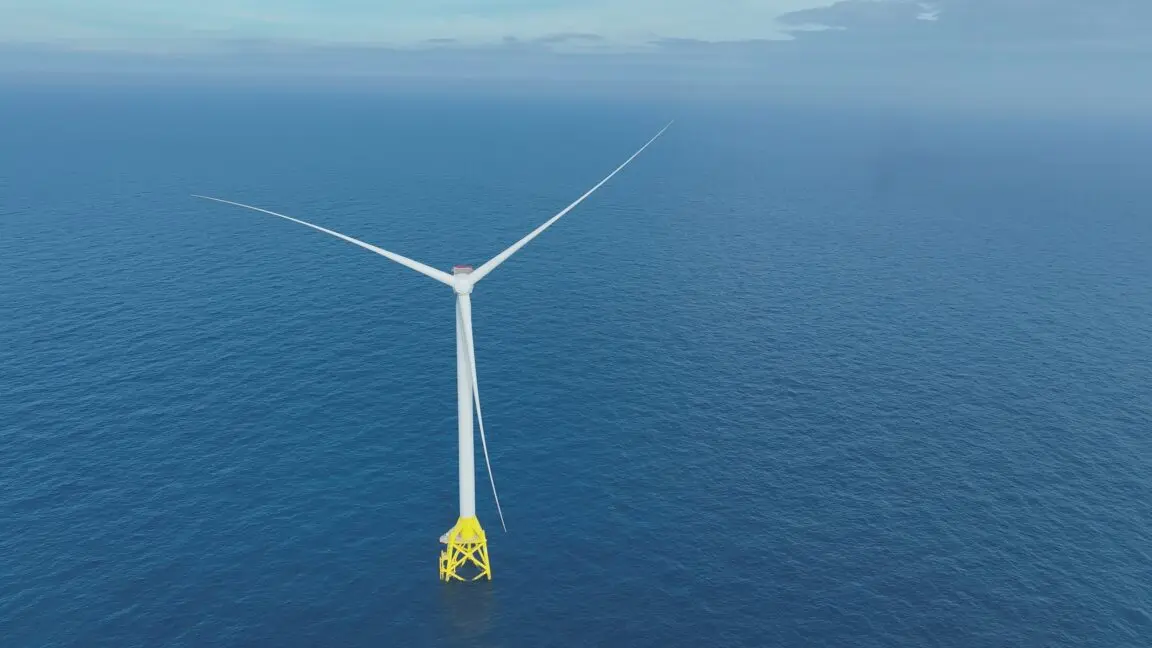
Taiwan Semiconductor Manufacturing Co. (TSMC), the world's foremost producer of advanced microchips, is capitalizing on the artificial intelligence boom with record profits. But the company is also racing to secure sustainable energy sources as Taiwan faces a deepening energy crunch. In a landmark move, TSMC has signed a 30-year corporate power purchase agreement (PPA) to buy 100% of the electricity generated by the Hai Long offshore wind project, located in the Taiwan Strait off the central coast of Taiwan.
The deal, announced on April 30, involves a partnership with Northland Power, a Canadian global power producer. The Hai Long project encompasses three offshore wind sites with a combined capacity exceeding 1 gigawatt (GW). Once fully operational, expected by 2027, the wind farms will produce enough electricity to power the equivalent of over 1 million Taiwanese households. Initial power delivery to the grid began in early 2025, providing a crucial boost to Taiwan's energy infrastructure.
TSMC's aggressive push into renewable energy is driven by multiple factors. The company's chip fabrication plants are among the most energy-intensive facilities in the world. According to the International Energy Agency (IEA), TSMC's energy consumption accounted for nearly 10% of Taiwan's total electricity usage in 2023. With the exponential growth in demand for AI chips—which require advanced manufacturing processes like 3nm and 2nm nodes—TSMC's share could rise to nearly one-quarter of Taiwan's overall electricity consumption by 2030, as estimated by S&P Global.
This energy demand comes at a precarious time for Taiwan. The island nation relies on imported fossil fuels for nearly 97% of its total energy needs, including electricity generation, transportation, and heating. Natural gas plants alone supply about half of Taiwan's electricity. However, a severe disruption occurred in March 2026 when drone strikes by Iranian forces damaged Qatar's natural gas production facilities, effectively halting shipping through the Strait of Hormuz. As a result, Taiwan lost one-third of its usual supply of liquefied natural gas (LNG). With only two weeks of fuel reserves typically on hand, the country faced an immediate energy crisis.
Taiwan's government has scrambled to secure alternative supplies from Australia, the United States, and other sources. On May 6, Taiwan's vice minister of economic affairs stated that the government had secured enough oil and gas to operate normally through August and possibly September. However, the long-term vulnerability has spurred the administration of President Lai Ching-te to accelerate efforts to diversify energy sources. This includes restarting shuttered nuclear power plants and expanding renewable energy projects.
Offshore wind power is a cornerstone of Taiwan's energy diversification strategy. The government has set a target to make 15 GW of offshore wind capacity available to developers by 2035. TSMC has aligned its corporate goals with this ambition, pledging to source 60% of its global operations' energy from renewable sources by 2030, and 100% by 2040. The Hai Long PPA is a significant step toward that target.
This is not TSMC's first major renewable energy deal. In 2020, the chipmaker signed a 20-year PPA with Danish renewable energy company Ørsted for 920 megawatts (MW) of power from the Greater Changhua offshore wind farm project, which is expected to become fully operational later in 2026. In 2021, TSMC also struck a deal with German developer WPD to develop over 1 GW of onshore and offshore wind power. Collectively, these agreements position TSMC as one of the largest corporate buyers of renewable energy in Asia.
The global energy crisis, exacerbated by the war in the Middle East and disruptions in the Strait of Hormuz, has highlighted the fragility of energy supply chains. TSMC's proactive approach not only secures its own operational needs but also contributes to Taiwan's energy independence. The chipmaker's influence on the island's energy landscape is immense; its facilities are central to the global semiconductor supply chain, which powers everything from smartphones to supercomputers.
AI chip demand shows no signs of abating. Companies like NVIDIA, AMD, and Intel are designing increasingly powerful processors that require cutting-edge fabrication. TSMC's 3nm and upcoming 2nm processes consume vast amounts of electricity both in the manufacturing process and in the operation of the finished chips. Data centers housing AI accelerators also have huge power requirements, indirectly adding to the demand on TSMC's production capacity.
In response, TSMC has invested heavily in new fabs in Taiwan, including in Hsinchu, Tainan, and the upcoming mega-sites in Taichung and Kaohsiung. Each fab can consume as much electricity as a small city. The company has also expanded globally, building factories in Arizona (USA), Kumamoto (Japan), and Dresden (Germany). However, the majority of its cutting-edge production remains in Taiwan, making the island's energy stability a national security issue.
The Hai Long wind project is a joint effort with Northland Power, which will develop, construct, and operate the wind farms. The project is expected to create thousands of jobs during construction and hundreds of permanent positions for operations and maintenance. Local supply chains in Taiwan will also benefit, as the government requires a certain percentage of local content in offshore wind projects.
Environmental groups have voiced support for the initiative, noting that it will reduce carbon emissions and help Taiwan meet its net-zero targets. However, concerns remain about the impact on marine ecosystems and fisheries. The developers have committed to environmental impact assessments and mitigation measures.
TSMC's renewable energy strategy also serves as a model for other energy-intensive industries in Taiwan and beyond. By demonstrating that large-scale renewable purchases are feasible and economically beneficial, TSMC is encouraging other corporations to follow suit. The company's purchasing power helps drive down costs for wind and solar technologies, making them more competitive against fossil fuels.
Ultimately, the intersection of AI chip demand and energy security is reshaping Taiwan's industrial policy. The government is considering revisions to the Electricity Act to facilitate more private-sector involvement in renewable energy. TSMC's CEO has publicly stated that the company is committed to being a responsible corporate citizen and that clean energy is essential for long-term sustainability. As the world watches, Taiwan's experiment in balancing high-tech growth with energy resilience may offer valuable lessons for other nations facing similar challenges.
Source: Ars Technica News