

AI Agents Take Center Stage at Consensus Miami Hackathon
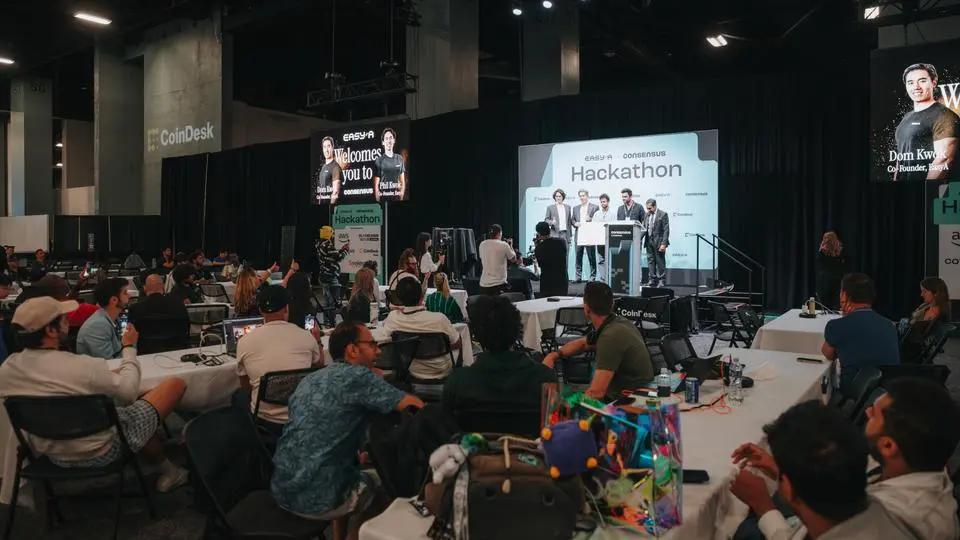
The EasyA hackathon at Consensus Miami 2026 was electric. Nearly 1,000 developers packed into the venue, armed with laptops and ideas, most focused on a single theme: AI agents. These autonomous software entities, powered by large language models and blockchain infrastructure, are rapidly becoming the hottest frontier in crypto and Web3. Participants came from leading ecosystems like Base and Solana, as well as tech giants Microsoft and Google, all racing to conceptualize, code, and present viable startups in just 24 to 48 hours.
The energy was palpable. Teams huddled over whiteboards, typing furiously while others debugged smart contracts or tweaked AI prompts. The resulting projects spanned an impressive range—from autonomous payment systems that negotiate and settle transactions without human intervention, to consumer apps that use agentic AI to curate personalized experiences, to hardware-generation tools that design and simulate physical products using AI. One team even built a drone that uses an AI agent to autonomously navigate and collect data for environmental monitoring, while another developed a prediction market where AI agents trade on outcomes using real-time data feeds.
According to EasyA founders Dom and Philip Kwok, this hackathon was a milestone. They noted that past EasyA events have already produced startups that went on to raise millions in venture capital, join Y Combinator, and achieve valuations in the billions. The Kwok brothers see the hackathon evolving from a pure coding competition into a full-fledged startup launchpad. “We’re seeing the same pattern we saw with early crypto hackathons that birthed Uniswap and other giants,” said Dom Kwok. “The combination of AI and blockchain is creating a new wave of innovation that will redefine the internet economy.”
The Rise of AI Agents in Crypto
AI agents are not entirely new, but their integration with blockchain is accelerating dramatically. These agents can execute complex tasks autonomously, such as managing crypto portfolios, interacting with smart contracts, or even negotiating deals with other agents. The hackathon showcased dozens of examples: an agent that automatically rebalances a DeFi liquidity pool based on market conditions; another that monitors social media sentiment and executes trades accordingly; and a third that generates and submits Ethereum Improvement Proposals (EIPs) based on community discussions.
The appeal for developers is clear. AI agents reduce the friction of human decision-making, enabling 24/7 operation and instant execution. For crypto applications, that means more efficient markets, better risk management, and new user experiences. Solana, for instance, has been a hotbed for agent development because of its high throughput and low transaction costs. Base, Coinbase’s Layer 2 on Ethereum, offers a more familiar Ethereum-compatible environment with growing tooling for AI. The presence of engineers from Microsoft and Google—companies at the forefront of AI research—added a layer of credibility and ambition. Many of them came with experience in large language models like GPT-4 and Gemini, which they adapted for on-chain use cases.
The hackathon also highlighted the convergence of hardware and software. One team demonstrated a system where an AI agent designs a circuit board, simulates its performance, and then sends the design to a 3D printer or PCB manufacturer—all autonomously. Another built a drone that uses an LLM to interpret natural language commands like “fly to the nearest weather station and report conditions,” with the agent breaking that down into flight paths, sensor readings, and data transmission. Such projects point to a future where AI agents bridge the digital and physical worlds seamlessly.
Historical Context: Crypto Hackathons as Startup Incubators
EasyA has a track record of producing successful startups. Previous winners have gone on to raise substantial funding rounds and achieve unicorn status. The hackathon format—intense, collaborative, and deadline-driven—forces participants to focus on the most critical aspects of their ideas: product-market fit, technical feasibility, and presentation. For many founders, it’s the first step on a journey that can lead to venture backing, accelerator programs, and eventually a public launch.
The Consensus Miami event is particularly significant because it brings together a large, diverse audience of investors, crypto natives, and tech executives. Startups showcased at the hackathon often receive immediate attention from venture capitalists and media. The 2026 edition was no exception, with several projects reportedly receiving term sheets on the spot.
Industry observers note that AI agents represent the next logical evolution of smart contracts. While smart contracts execute predefined logic deterministically, AI agents introduce probabilistic reasoning and adaptability. This allows for more nuanced interactions, such as assessing risk, learning from past outcomes, and adapting to changing conditions. For example, an AI agent managing a DAO treasury could analyze market data, governance votes, and community sentiment before proposing a funding allocation—something a static smart contract cannot do.
However, challenges remain. AI agents introduce unpredictability, which conflicts with blockchain’s deterministic nature. Developers must ensure that agents operate within defined constraints to prevent runaway behaviors. There are also concerns about transparency and accountability: if an agent makes a decision that results in monetary loss, who is responsible? These questions were hotly debated in panels and side conversations at the hackathon. Several teams presented frameworks for auditability, using on-chain logs and attestations to trace agent actions.
Key Projects and Their Impact
Among the standout projects was AutoPay, an AI agent that autonomously negotiates payment terms between parties on a blockchain. Using Natural Language Processing, the agent reads contract terms, analyzes credit histories (stored on-chain), and suggests payment schedules. It then executes smart contracts to release funds incrementally based on milestones. The team highlighted applications for freelancers and supply chain finance.
Another notable entry was AgentMarket, a prediction exchange where AI agents trade on event outcomes. Instead of humans placing bets, agents subscribe to data streams—weather, election polls, sports scores—and place wagers automatically. The agents learn from their performance and adjust strategies. The project aims to create a liquid, 24/7 prediction market that eliminates human bias.
On the consumer side, PersonaAI builds personalized AI assistants that live in a user’s wallet. These agents can book travel, manage subscriptions, and even interact with other agents to find the best deals for the user. The idea is to create a “personal concierge” that operates on the user’s behalf, powered by blockchain for trustless execution.
Hardware generation was represented by GenFab, which uses an AI agent to design and simulate hardware prototypes. The agent takes specifications, generates CAD files, runs simulations, and then outputs a bill of materials and manufacturing instructions. The team demonstrated this by designing a small robot chassis, which was then 3D-printed at the hackathon booth. They see applications in rapid prototyping for startups and makers.
Finally, a team called DroneNet built a decentralized network of AI-controlled drones that can be hired for tasks like aerial photography, delivery, or surveillance. The agent negotiates the job, plans the flight path, and executes, with payments handled via smart contracts. The system uses a reputation mechanism to ensure reliability.
Ecosystem and Community Momentum
The hackathon was not just about coding; it was also a networking hub. Developers from competing ecosystems shared tips and code. Microsoft engineers discussed integrating Azure AI services with on-chain agents, while Google engineers explored using their TensorFlow frameworks for model training on decentralized compute networks. Solana and Base both offered bounties and mentorship, attracting builders to their platforms.
EasyA’s founders, Dom and Philip Kwok, have built a reputation for identifying early trends. They previously organized hackathons that presaged the DeFi summer and NFT boom. Now, they are betting big on AI agents. “We’re seeing the same kind of excitement and potential that we saw with DeFi in 2020,” said Philip Kwok. “The next billion-dollar companies will be built around autonomous agents that transact and coordinate on-chain.”
Looking ahead, many participants plan to continue their projects post-hackathon, with several already forming legal entities. Incubators like Y Combinator and venture firms have been scouting the event, and EasyA itself has a venture arm that invests in promising teams. The convergence of AI and crypto is still in its early days, but if the energy at Consensus Miami is any indication, the future is being built right now—one agent at a time.
Source: Coindesk News