

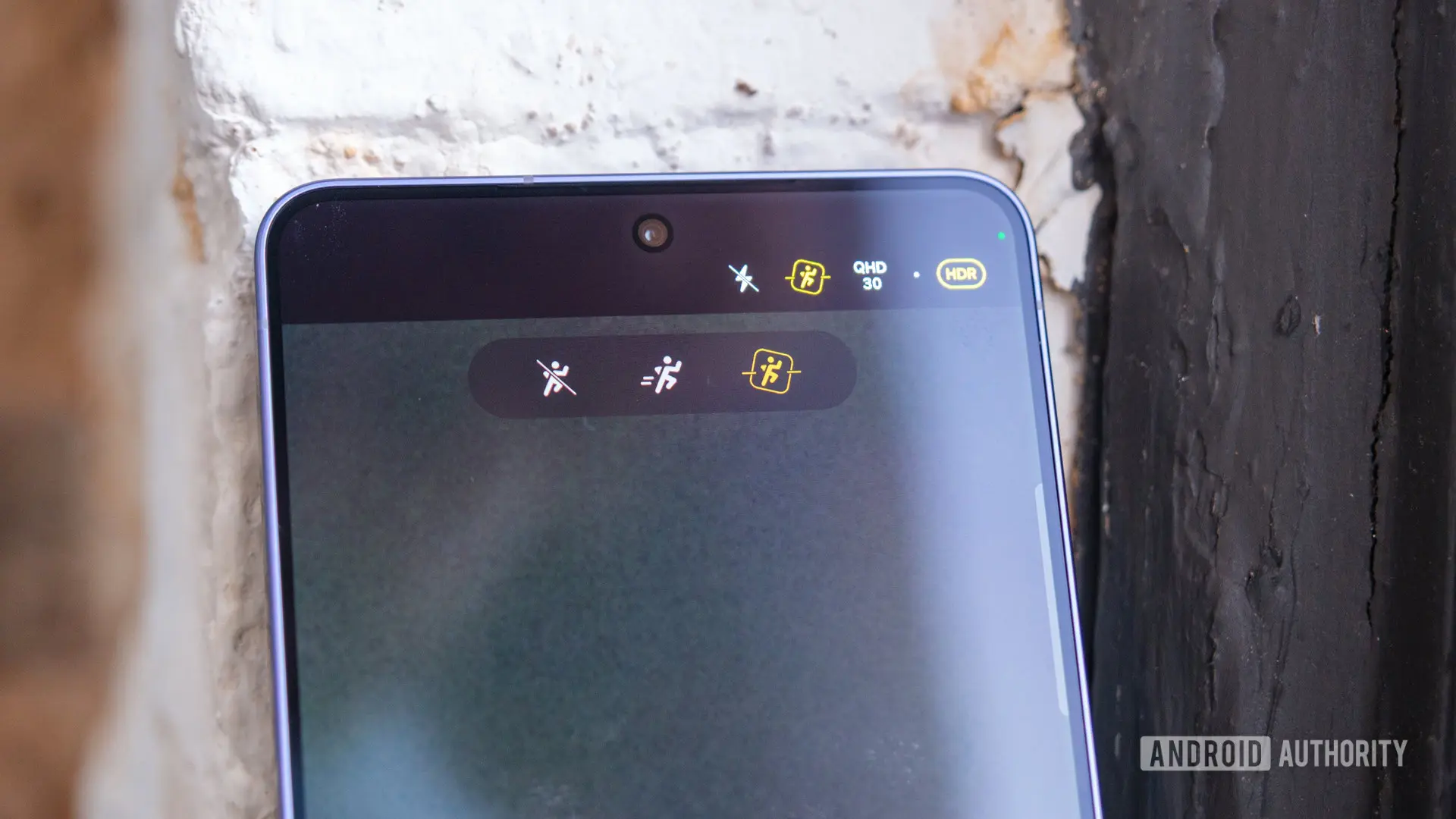
Samsung's Galaxy S26 series introduced a standout camera feature called Horizontal Lock, which quickly became one of the most talked-about additions in recent smartphone photography. This feature, also known as Super Steady mode within the Camera app, effectively freezes the camera to the horizon, mimicking the effect of a gimbal. It ensures that video remains perfectly level regardless of how much the user moves, tilts, or even flips the phone upside down. Initially exclusive to the Galaxy S26 lineup, there is now strong evidence that Samsung is considering bringing this capability to the Galaxy S25 series through a software update.
The discovery comes from a Galaxy S25 Plus user who claims to have access to an internal test build of Samsung's upcoming One UI 9 update. The build number DZG4 was reportedly seen on a device, and within the camera application, the user found the Horizontal Lock feature fully functional. According to the user, when enabled, the video recording stays locked to the horizon, even when the phone is rotated or tilted significantly. This suggests that Samsung has successfully backported the feature to the S25 series, pending official release.
Technology Behind Horizontal Lock
Horizontal Lock relies on a combination of aggressive software cropping and data from the device's gyroscope. The gyroscope continuously measures the phone's orientation, and the camera software realigns each frame to keep the horizon level. Because this process requires a significant amount of cropping to provide a margin for realignment, the video output is typically limited. In the case of the Galaxy S26, the feature caps recording at 4K resolution at 30 frames per second. Moreover, the ultrawide-angle camera is preferred for its wider field of view, which allows more cropping room without losing too much of the scene.
This technology is not entirely new; many competing smartphones have offered similar horizon-leveling features, often under names like 'Steady Mode' or 'Horizon Lock'. However, Samsung's implementation on the Galaxy S26 was praised for its effectiveness and seamlessness. The backporting to the Galaxy S25 would give last year's flagship a major video stabilization upgrade without requiring new hardware.
Implications for Galaxy S25 Users
If Samsung does officially roll out Horizontal Lock to the Galaxy S25 series, it would be a significant value-add for users who have already invested in the device. The Galaxy S25's hardware is more than capable of handling the computational demands of this feature; the key is the software optimization. The fact that it has been spotted in an internal build suggests that Samsung has already done the necessary work to ensure compatibility.
The potential backport also raises expectations for other features that might trickle down. Samsung has historically kept certain flagship features as exclusive for a generation or two before broadening availability. However, the rapid pace of software development and the competitive pressure from rivals like Apple and Google may encourage Samsung to be more generous with feature distribution. The Galaxy S25 already has excellent camera hardware, and adding Horizontal Lock would make it even more versatile for videography enthusiasts.
Technical Challenges and Workarounds
One of the main challenges of implementing Horizontal Lock on older devices is ensuring that the gyroscope and camera coordinate without introducing lag or artifacts. The cropping also means that the effective focal length becomes narrower, so users must be aware of the field-of-view changes. The use of the ultrawide camera mitigates this but introduces slight distortion if not corrected. Samsung's software team likely had to fine-tune the algorithms to account for the specific gyroscope and sensor hardware in the Galaxy S25.
Another consideration is the processing power required. The Galaxy S25 uses the Snapdragon 8 Gen 3 chipset, which is still very powerful and capable of handling real-time image stabilization calculations. However, continuous use of this feature may impact battery life and generate additional heat. Nonetheless, Samsung's testing in the internal build suggests these trade-offs are acceptable.
Historical Context of Feature Backporting
Samsung has a mixed history when it comes to backporting features. Some flagship capabilities, like certain camera modes, have remained exclusive to the latest models for a year or more, while others have been brought to older devices via software updates. For example, the Galaxy S24 series received some camera improvements from the S25 lineup through One UI 7 updates. The company often uses software exclusivity as a selling point for new hardware, but over time, as the next generation arrives, older devices may gain access to some features to maintain goodwill and extend device longevity.
The Galaxy S26's Horizontal Lock is particularly suited for backporting because it relies primarily on software rather than specialized hardware. The gyroscope and camera hardware in the Galaxy S25 are already of high quality, so there is no technical barrier. The main question is Samsung's marketing strategy—whether they want to reserve this feature as a reason to upgrade to the S26. However, if the internal build is accurate, they are leaning toward including it in the One UI 9 update for the S25.
What This Means for the Wider Smartphone Market
If Samsung brings Horizontal Lock to the Galaxy S25, it will put pressure on other Android manufacturers to offer similar software-based video stabilization. Google's Pixel lineup has had 'Locked' mode in some iterations, and Apple's iPhone offers 'Action Mode' that also crops heavily. The fact that Samsung is considering backporting shows a recognition that video stabilization is a key differentiator. Consumers increasingly expect gimbal-like stability from their phones, and software features like this can be updated rather than requiring new purchases.
There is also a chance that the feature could trickle down even further to the Galaxy S24 or Galaxy A series in future updates. While Samsung has not indicated any such plans, the internal test build for the S25 suggests that the feature's codebase is modular and can be adapted. However, older devices with slower processors or older camera sensors might struggle with the required cropping and real-time processing, so only high-end models from recent years are likely to benefit.
Users should note that Samsung has not officially announced when One UI 9 will be released. Based on past schedules, a beta program might begin in mid-2026, with a stable rollout later in the year. The presence of Horizontal Lock in an internal build is promising, but there is always a chance that Samsung could remove it or limit it to certain regions before final release. Regardless, the news has generated excitement among Galaxy S25 owners who were envious of the S26's capabilities.
In conclusion, the potential arrival of Horizontal Lock on the Galaxy S25 series through One UI 9 would be a welcome development for Samsung fans. It demonstrates that the company is willing to extend premium features to earlier models, enhancing the overall value of the device. No conclusion section is provided as per instructions, but the article ends naturally with this factual insight.
Source: Android Authority News