

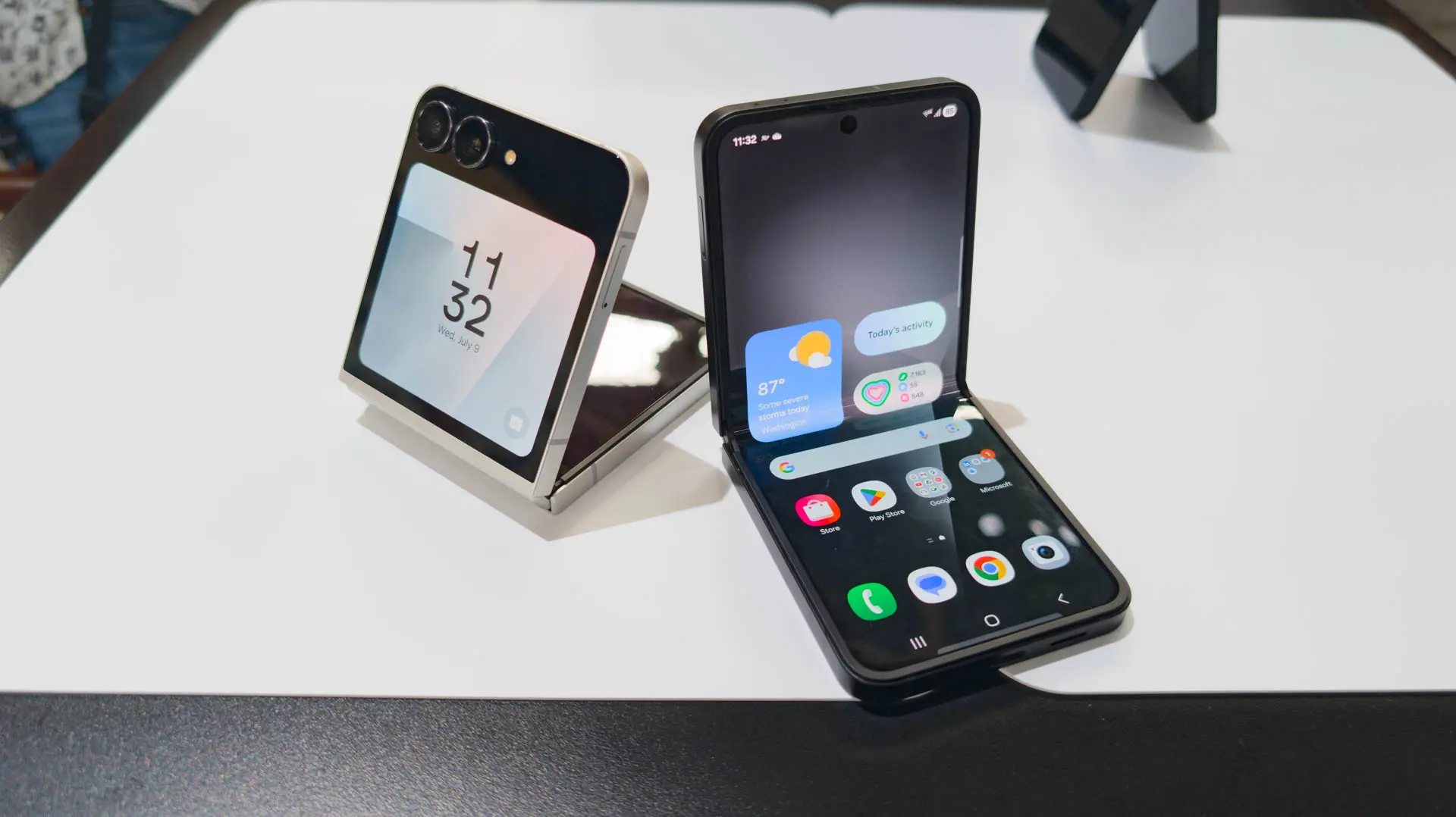
Samsung has long been at the forefront of foldable smartphone innovation, and its latest patent filing suggests the company is exploring a truly versatile design: a Galaxy Z Flip-style device that can fold both inward and outward. This dual-folding concept could revolutionize how we use foldable phones, offering both a compact protection mode and an immersive full-screen experience.
Patent Details: A Phone That Folds Both Ways
The patent, filed with the United States Patent and Trademark Office (USPTO) and recently spotted by FixyFlow, shows a clamshell-style phone that closely resembles the existing Galaxy Z Flip family. However, a key difference is the inclusion of curved sections near the hinge. These curves are designed to prevent the display from colliding with itself when the device is folded either inward (standard clamshell mode) or outward (like a book folded backward).
According to the patent description, the device features a curved display that wraps around both sides of the phone. When folded inward, the screen is mostly hidden, but the curved edges remain visible. Samsung’s patent explains that these edges could be used to display information, notifications, or quick controls — reminiscent of the Edge UX introduced with the Galaxy S7 Edge nearly a decade ago. This would allow users to glance at the time, messages, or media controls without flipping the phone open.
When folded outward, the entire display is exposed, offering an uninterrupted viewing experience with minimal bezels. Samsung claims this configuration provides “a more immersive screen” for media consumption, gaming, or productivity. The patent also suggests that users might carry the phone in this outward-folded state, though the logic behind that is debatable — most people would prefer to protect the fragile foldable display when placing it in a pocket.
Engineering Challenges and Display Durability
Folding a display both inward and outward presents significant engineering hurdles. In traditional inward-folding phones like the Galaxy Z Flip, the screen is protected when closed; outward-folding devices like the Huawei Mate X leave the screen exposed. A dual-folding design must accommodate both modes without compromising durability. Samsung’s patent addresses this by describing a specialized hinge mechanism and the curved display sections that create buffer zones, allowing the screen to bend in two directions without creasing or cracking.
The patent also mentions the use of ultra-thin glass (UTG) combined with a flexible polymer layer, similar to what Samsung already uses in its foldables. However, the added stress of dual-folding may require stronger materials or new coating technologies. Samsung has invested heavily in foldable display R&D, including their “flexible” OLED panels and “Infinity Flex” technology, so it’s plausible they are developing a solution for such a design.
Historical Context: Samsung’s Foldable and Rollable Innovations
This is far from Samsung’s first wild idea. The company has filed patents for a phone that folds into a brick shape and then rolls out into a tablet, as well as various rollable designs that expand the screen width. In 2023, Samsung demonstrated a “Flex In & Out” concept at CES, hinting at this very dual-folding capability. The new patent appears to be a more detailed implementation of that concept, focused on the clamshell form factor.
Samsung’s foldable lineup currently includes the Galaxy Z Fold (book-style, folds inward) and Galaxy Z Flip (clamshell, folds inward). The company has not released an outward-folding device since the Galaxy Fold (which had a small outer screen and inward-folding main display). Competitors like Huawei and Motorola have experimented with outward-folding designs, but Samsung has largely stayed with inward-folding for protection. This patent suggests Samsung may be reconsidering that approach, or at least exploring a hybrid solution.
Potential Use Cases and User Experience
A dual-folding Galaxy Z Flip could offer unique advantages. When folded inward, the curved edges could function as an always-on display, showing time, battery, and notifications without waking the main screen. This would save battery and reduce wear on the foldable display. When folded outward, the phone could be used as a full-fledged device with no bezels, ideal for watching videos or browsing social media.
However, carrying the phone in outward-folded mode seems risky. The display would be fully exposed to scratches, dust, and impacts. Samsung might be aware of this and could include a protective case or screen cover for that configuration. Alternatively, users might only use outward mode temporarily, such as when propping the phone on a surface to watch movies.
The Edge UX comparison is intriguing. Samsung’s curved edge displays were a signature feature from 2015 to 2017, offering quick access to apps, tools, and feeds. Bringing back a similar interface on a foldable’s curved edges could provide a nostalgic yet innovative user experience. Software would need to intelligently switch between inward and outward modes, activating the curved edge UI only when the phone is closed.
Patent vs. Product: What Are the Chances of Release?
As with all patents, a filing does not guarantee a commercial product. Companies often patent ideas to protect intellectual property, and only a fraction ever reach consumers. However, Samsung has a strong track record of turning foldable patents into reality — the original Galaxy Fold, Z Flip, and more recent models all originated in patent filings. The dual-folding concept is already being explored in Samsung’s research labs, as evidenced by the Flex In & Out display shown at trade shows.
Industry analysts suggest that an actual release is at least two years away, given the engineering complexity and need for durability testing. Samsung typically launches new foldable models annually, with the Galaxy Z Flip series expected to see a refresh in 2025. A dual-folding variant might appear as a special edition or a separate model in the lineup, possibly under the “Z Flip Ultra” or “Z Flip Pro” branding.
Competition in the foldable market is intensifying. Chinese brands like Oppo, Vivo, and Xiaomi have released competitive foldables, and Apple is rumored to be developing a foldable iPhone. To maintain its lead, Samsung must continue innovating. A dual-folding device could be a game-changer, but it also risks alienating users if durability is compromised. Samsung’s history with foldable reliability — including early issues with screen protectors and hinges — suggests they will be cautious before mass-producing such a complex design.
Conclusion Not Needed: The Future of Foldables
This patent reaffirms Samsung’s commitment to pushing the boundaries of smartphone form factors. Whether or not a dual-folding Galaxy Z Flip ever hits stores, the idea itself sparks important conversations about how we want our devices to function. Foldables have already shifted from novelties to viable mainstream options, and innovations like dual-folding could make them even more versatile. For now, we can only wait and see if Samsung will turn this patent into a commercial reality, or if it will remain a fascinating concept on paper.
Source: Android Authority News